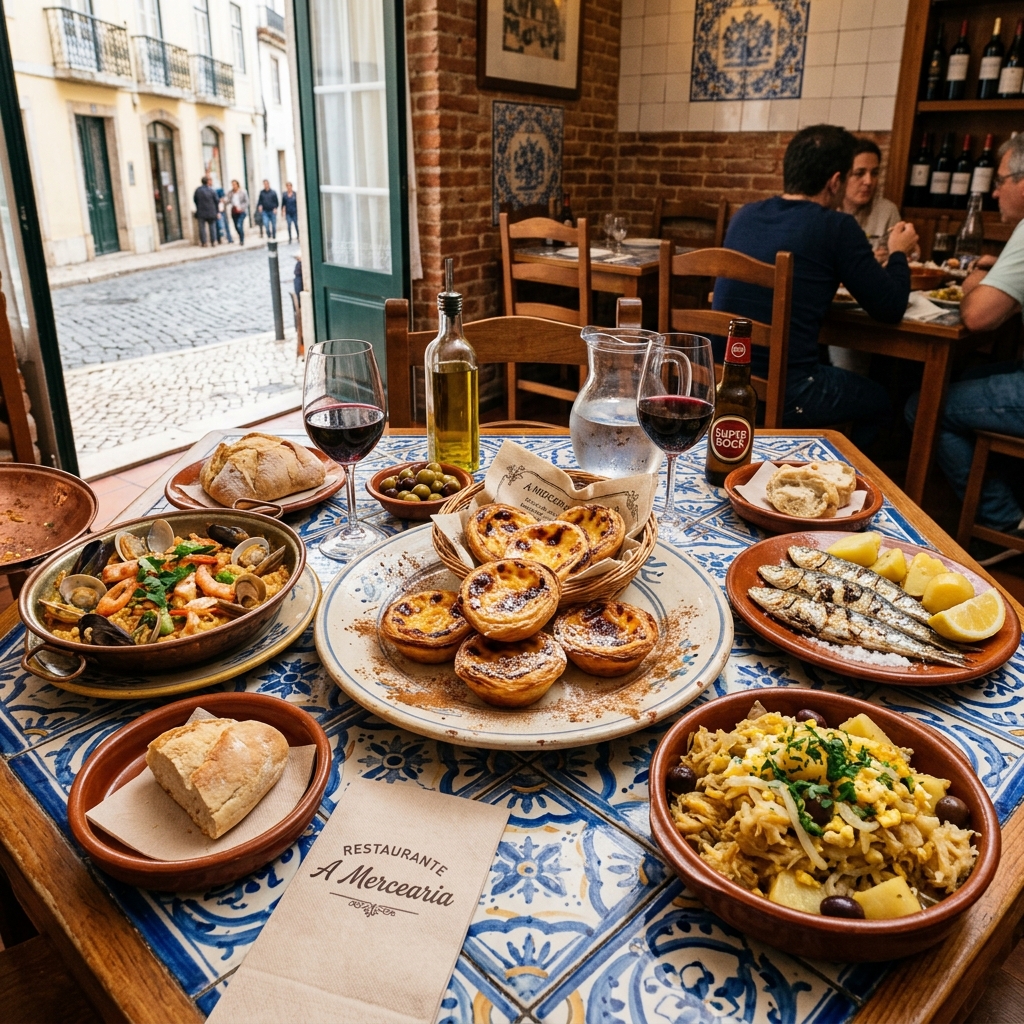
Portugal is one of the best places in Europe to eat well on a modest budget, and it is not famous enough for this yet. The food has not been tourist-ified in the way that Italian and Spanish cuisines have been: there are no Portuguese restaurants on every high street in London or New York, there is no international chain selling pastel de nata in airports, and the dishes that people eat in Lisbon or Évora are largely the dishes that people have been eating there for centuries, without significant modification for export.
This may change. The culinary world has noticed Portugal, and the international attention means that the best Lisbon restaurants are now expensive and reservation-only. But the bulk of Portuguese food culture — the working-lunch restaurants, the fish taverns, the regional producers, the markets — remains accessible, affordable, and genuine. The slow traveler’s job is to find that bulk, which is not difficult. It requires walking a little further from the main square and being willing to eat in a room where the menu is handwritten on a blackboard in Portuguese only.
Portugal by train — the complete rail guide
TL;DR: A proper lunch with wine costs €12–€18 across Portugal. The national obsession is bacalhau (salt cod, 365 preparations). Porto’s francesinha is mandatory. Alentejo produces the best black pig and sheep cheese. Algarve has the cataplana (seafood stew). Vinho verde with seafood is non-negotiable. Train from Lisbon to Porto: 2h45m (€25–€35 on the Alfa Pendular); Lisbon to Évora: 1h30m (IC train, from €12).
Lisbon: The Atlantic City
Pastel de Nata: The Argument
The Portuguese egg tart (pastel de nata — or pastel de Belém at the original producer) is not the simple custard tart that its appearance suggests. The genuine article has a flaky, multi-layered pastry shell — not shortcrust, not puff, but something between the two, made with lard and requiring skill — and a filling that is custard on the surface but has a burnt, caramelised top and a custardy interior that is slightly wobbly rather than set. It is served warm. The combination of hot, flaky pastry and the barely-set egg filling is the point.
Pastéis de Belém (Rua de Belém 84–92, in the Belém neighbourhood) has been making the original recipe since 1837 and sells thousands a day. They are legitimately excellent — the recipe is apparently secret and the result is distinguishably better than most imitations. The queue is real and worth it. Order two; eat them standing at the counter sprinkled with cinnamon and powdered sugar.
The argument against going only to Belém is that every neighbourhood in Lisbon has its own bakery (pastelaria) making perfectly good pastéis de nata for about €1.20 each, and eating them fresh from a neighbourhood oven with a bica (espresso) at 9am in a tiled café that has not been featured in any food magazine is one of the better Lisbon experiences. The Mouraria district and the streets around Campo de Ourique are good places to find these.
Bacalhau Culture
Bacalhau — salted, dried Atlantic cod — is the foundation of Portuguese cuisine in the same way that pasta is the foundation of Italian. It is not a single dish but a category: the Portuguese count 365 preparations, one for every day of the year, and while this figure is hyperbole, the reality of ten or fifteen distinct preparations regularly available in Lisbon restaurants is not.
The essential preparations to try:
Bacalhau à Brás: Shredded bacalhau mixed with fried potato straws and scrambled eggs, garnished with black olives and parsley. The texture is all — creamy egg, salty fish, crisp potato — and it is best ordered at lunch when it’s freshly made.
Bacalhau com natas: Baked bacalhau with cream and potato, gratinated on top. Richer and more substantial; more of a dinner than a lunch dish.
Bacalhau à Gomes de Sá: From Porto originally — bacalhau baked with sliced potatoes, onions, olive oil, and hard-boiled eggs, finished with olives. Simpler than it sounds and better than it should be.
For good traditional bacalhau in Lisbon, look for a tasca (small family restaurant) rather than a tourist restaurant. The Bairro Alto and Intendente neighbourhoods have several good options; the quality signal is a handwritten daily specials board and a room occupied by people who work nearby.
Petiscos and the Lisbon Table
Petiscos are the Portuguese equivalent of tapas — small plates meant for sharing and grazing rather than a formal meal. The petisco culture in Lisbon is genuine rather than performed: small plates of chouriço grilled on a terracotta brazier, ameijoas à bulhão pato (clams in garlic, olive oil, white wine, and coriander), presunto (cured ham), and salt cod cakes (pastéis de bacalhau) are staples.
Ginjinha is the cherry liqueur sold in tiny shots from small wooden kiosks in the Rossio area. The ritual is to order a single shot (€1.50–€2), drink it standing, and consider the view. The cherries (with or without — “com” or “sem” — is the question you’ll be asked) can be eaten or spat out discreetly; most locals leave them.
Porto: The City That Eats Seriously
The Francesinha
Porto has a reputation as a serious food city and the francesinha is the evidence. This is not a dish that makes compromises or apologises for itself.
The construction: two thick slices of bread enclosing ham (fiambre), linguiça (smoked pork sausage), fresh sausage (salsicha fresca), and either roast pork, steak, or roast beef. The assembled sandwich is covered in melted cheese and then flooded with a sauce of tomatoes, beer (typically a lager), brandy, and a collection of spices that varies by restaurant and is guarded as seriously as any trade secret. The whole assembly is then put under the grill until the cheese is bubbling, topped with a fried egg, and served with a bowl of additional sauce and a generous helping of fried chips.
It is the opposite of refined. It is tremendous.
The sauce is the key — each of Porto’s francesinha restaurants maintains a different recipe, and the locals have strong opinions about which is best. The general guidance: avoid tourist-facing restaurants on the main drag and find one where the clientele is eating with their sleeves rolled up.
Porto residents are called “tripeiros” — tripe-eaters — because of the city’s traditional association with tripas à moda do Porto (tripe stew with white beans and chouriço). The origin story involves Porto supplying meat to the Portuguese fleet during the Age of Discovery and keeping the offal for themselves; the truth is probably more mundane, but the dish is genuinely traditional and genuinely good if you approach it without prejudice. Order it at lunch in the Ribeira or Cedofeita areas.
Douro Wine Tastings: Vila Nova de Gaia
Directly across the Douro from Porto’s centre, the Vila Nova de Gaia waterfront is lined with the lodges of Port wine producers — Taylor’s, Graham’s, Sandeman, Ramos Pinto, and many others — where wine cellars cut into the hillside hold hundreds of thousands of barrels aging in the prescribed manner. Most offer tastings (€8–€15 for a flight of three wines, often including a tour of the cellars) and retail sales.
The visit to Gaia is worth making not just for the wine but for the view: from the terrace of most lodges, the Douro stretches east toward Spain, the Port wine boats (rabelo boats) are moored on the river, and the six bridges of Porto are visible from a different angle. The Luís I bridge, the one everyone photographs from the Porto side, is itself most impressive from here.
What to taste: a white Port (an aperitif style, usually served chilled), a Tawny (aged, nutty, oxidised), and a Reserve Ruby (rich, fruity, the most familiar style internationally). The older Tawnies — 20-year, 40-year — are the most complex and most expensive; a 20-year Tawny from Taylor’s or Graham’s is an appropriate luxury.
Mercado do Bolhão
The Mercado do Bolhão reopened after a full renovation in 2022 and remains Porto’s best food market. The iron-and-stone neoclassical building (1914) contains two floors of market stalls — fish on the lower level (arrive before 10am for the best selection), vegetables and fruit, cheese, olives, dried goods, and several small restaurants and bars that have operated for decades. The renovation is sympathetic: the structure has been preserved and the market character maintained rather than gentrified into a food hall.
Eat at one of the counters on the lower level: a bowl of caldo verde (kale soup with chouriço) or a plate of bacalhau cakes with a glass of wine at 11am is a legitimate Porto meal.
Alentejo: The Slow Food Heartland
The Alentejo is Portugal’s largest and least densely populated region — a rolling landscape of cork oaks, olive groves, wheat fields, and heat — and its food is the opposite of the coastal fish culture. This is the land of the pig and the olive, of bread-based soups and slow-cooked meats, of a cooking tradition shaped by agricultural necessity rather than Atlantic abundance.
Black Pig
The Alentejo black pig (porco preto alentejano, related to the Iberian pig of Spain’s jamón ibérico tradition) feeds on acorns from the cork and holm oak forests (montado) in a system of semi-wild farming called montanera. The result is a pork with exceptional fat marbling and a distinctive nutty flavour.
Presunto (cured ham from the black pig’s leg, equivalent to jamón ibérico) and chouriço (smoked sausage) are the preserved forms, available throughout Portugal but at their best bought directly from Alentejo producers. The market in Évora — the region’s capital and a beautiful walled Roman city — has good producers selling direct.
Pluma and secretos (specific cuts from the black pig’s shoulder and back, with extraordinary fat infiltration) are best grilled simply and served with a bottle of Alentejo red.
Queijo de Azeitão
The sheep’s milk cheese of Azeitão (a village south of Lisbon, technically in the Setúbal peninsula but part of the Alentejo cheese tradition) is runny, pungent, and sold in small rounds — the ripe version is scooped out with a spoon rather than sliced. It is made using wild thistle flower as a coagulant, which gives it a particular bitter note beneath the rich sheep’s milk. This cheese is not widely exported; it tastes different on its home ground, consumed at a market in Azeitão or in a restaurant in Évora where it appears as a starter with fresh bread and olive oil.
Açorda and Migas
Açorda is the Alentejo bread soup: a base of stale bread, olive oil, garlic, and coriander reconstituted with stock and topped with a poached egg. It sounds impoverished; it is deeply satisfying. Migas are similar — bread broken into a fat (usually pork fat) with garlic and greens, pan-fried until it is something between a stuffing and a hash. Both are dishes of necessity that became dishes of preference.
Évora is the natural base for Alentejo food exploration: a walled Roman city with a Temple of Diana (1st century AD) still standing in the centre, a charming old town of medieval alleys, and good restaurants. The Alentejo wine cellars in town offer tastings; the Cartuxa winery, a short taxi ride from the centre, is one of the region’s best.
Algarve: The Southern Coast
Cataplana
The cataplana is both a cooking vessel and the dish cooked in it: a hinged copper pot shaped roughly like a clamshell, sealed during cooking so that steam cannot escape. The original cataplana dish is a seafood stew of clams, prawns, chouriço, tomatoes, onion, peppers, and white wine, sealed in the pot and cooked until everything is perfectly done and the steam has integrated all the flavours.
It is served at the table in the pot, opened with a hinge, releasing the steam: this is theatre and good cooking simultaneously. The Algarve cataplana is at its best in the fishing villages away from the main resort coast — in Ferragudo, Carrapateira, or Tavira (the most beautiful town in the Algarve, eastern section) — where the seafood is genuinely fresh and the tradition is genuine rather than performed.
Percebes and Fresh Grilled Fish
Percebes (goose barnacles) are harvested from the exposed Atlantic rocks of the western Algarve coast (and more famously in Galicia, northwest Spain). They look alarming — a cluster of long, rubbery tubes with what appear to be fingernails at one end — and taste of pure cold Atlantic sea. Eaten by pinching the tube and pulling the base from the rubbery covering. Order with a glass of vinho verde and resist the urge to photograph them.
Fresh grilled fish throughout the Algarve — dourada (sea bream), robalo (sea bass), linguado (sole) — is simply cooked and excellent. Avoid restaurants near the main tourist beaches in July and August; drive or walk fifteen minutes inland or east to Olhão or Faro for better fish at better prices.
Mercado de Loulé
The Mercado de Loulé, in the inland Algarve town of Loulé (30 minutes north of Faro by bus), is housed in a Moorish-influenced building from 1908 and operates as a proper working food market: fish, meat, cheese, fruit, vegetables, and local honey and almond products. Loulé’s Saturday market — held in the streets around the mercado — is the largest in the Algarve and worth the bus journey from the coast.
Wine: The Essential Guide
Vinho verde (“green wine” — young wine, drunk young, from the Minho and Lima river valleys in the north) is the discovery that changes how most visitors think about Portuguese wine. Light, slightly sparkling due to residual CO2 from the fermentation process, low in alcohol (8–11%), and with a crispness that makes it the right wine for the hot months. The whites are the most famous; there are also vinho verde reds (Espadeiro, Vinhão) that are deeper and slightly tannic, unusual and worth trying. Drink vinho verde with seafood, with petiscos, with lunch in any season.
Douro reds are the best-known Portuguese table wines internationally — the grapes used for Port (Touriga Nacional, Tinta Roriz, Touriga Franca) make full-bodied, structured red wines with good aging potential. Quinta do Crasto, Niepoort, and Ramos Pinto produce reliable examples at various price points.
Alentejo reds are more approachable young than Douro wines — warmer climate, richer fruit, lower tannins. Herdade do Esporão and Casa de Santa Alina are widely available and excellent value.
Moscatel de Setúbal is the surprise: a fortified sweet wine from the Setúbal peninsula south of Lisbon, made from Muscat grapes, with an orange-peel and honey character entirely unlike Port. Served chilled as an aperitif or with dessert; available in wine shops throughout Portugal and worth buying a bottle to understand why it has been made here since the eighteenth century.
Getting Around by Train
The good news for the food-focused slow traveler is that Portugal’s main food regions are well-connected by train.
Lisbon to Porto: The Alfa Pendular (AP) — Portugal’s fastest train — covers the 335km in 2h45m. Tickets from €25–€35 booked in advance via CP (comboios.pt). Multiple daily departures from Lisbon Santa Apolónia or Oriente stations.
Porto to Coimbra: 1h on the AP or IC train, from €12. Coimbra is worth a half-day stop: a university city with one of the most beautiful libraries in Europe (the Joanina Library, a UNESCO Heritage site) and a good student-focused food scene with cheap lunches near the university.
Lisbon to Évora (Alentejo): IC train from Lisbon Oriente station, approximately 1h30m, from €12–€15. Direct services several times daily.
Lisbon to Faro (Algarve): IC train from Lisbon Oriente, approximately 2h45m, from €22. Faro is the Algarve’s main city and a useful base.
The Case for Eating in Portugal Now
Portugal’s position as a food destination is changing. The fine dining scene in Lisbon has attracted international attention; restaurants like Belcanto (two Michelin stars) and Feitoria are booked months ahead. The prices at the top end of the market have risen accordingly.
But the bulk of Portuguese food culture has not changed: the lunchtime casas de pasto where a three-course meal with wine costs €15, the Alentejo tascas where the same pork recipe has been used for three generations, the markets where Alentejo black pig producers sell direct to anyone who asks. This is the food culture that rewards slow travel — not the Michelin circuit, but the daily meal that happens to be excellent because the ingredients are good and the cooking is honest.
The window in which you can eat this well in Portugal for this little money may be shorter than it appears. The country’s tourism growth is substantial. Go now; eat well; eat slowly.
Related Reading
- The Best Food Tours in Lisbon: Pastéis, Petiscos, and Ginjinha — The best food tours in Lisbon — from Mouraria to LX Factory — what to eat, which bakeries to trust, and how to…
- The Best Food Cities in Europe (Ranked by a Slow Traveler) — The 10 best food cities in Europe for travelers who eat seriously: San Sebastián, Bologna, Lyon, Naples, Istanbul,…
- The Best Food Tours in Europe: 12 Cities Worth Eating Your Way Through — From Barcelona’s Boqueria to Istanbul’s Grand Bazaar, these are the food tours that go beyond the tourist trail —…