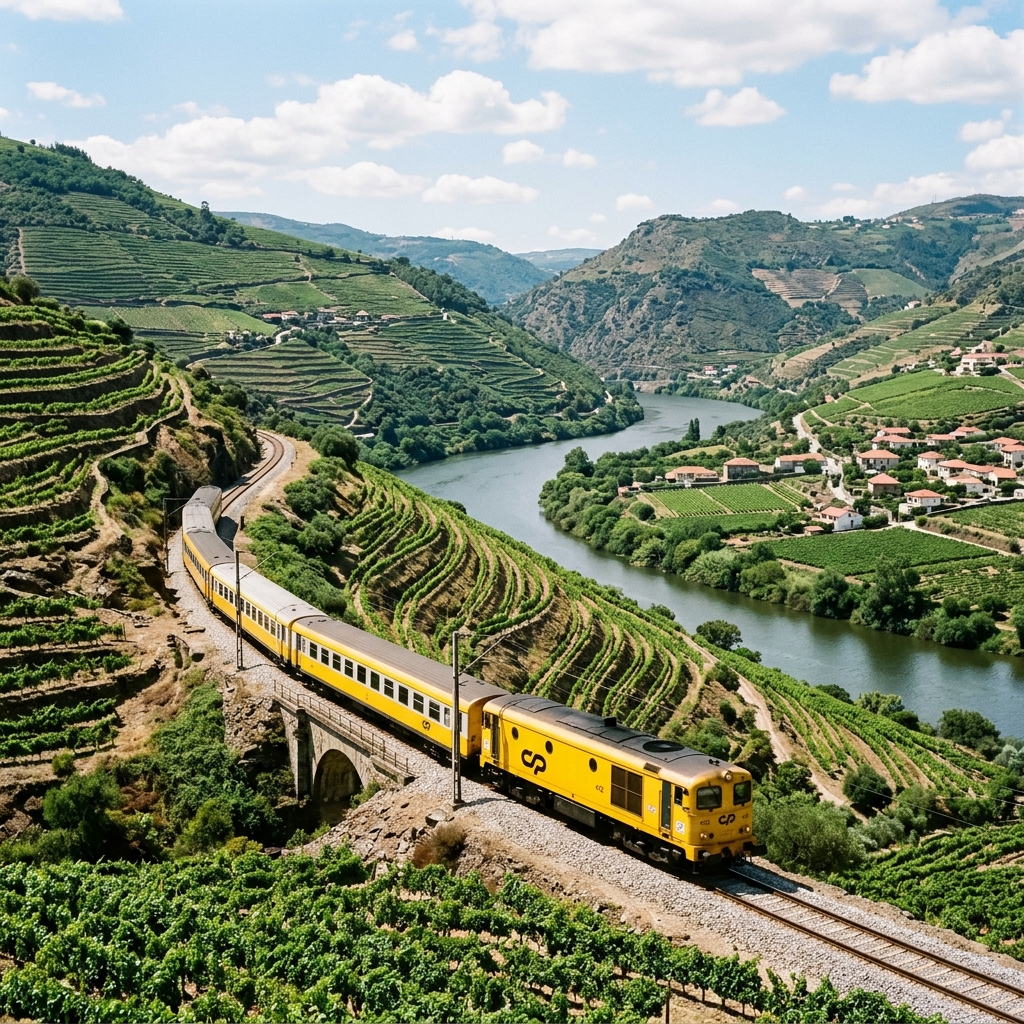
Portugal is one of Western Europe’s most underrated rail countries, and the numbers make the case plainly. CP (Comboios de Portugal), the national operator, runs around 130 million passenger-kilometres per year, and the flagship Alfa Pendular tilting train covers the 337 km between Lisbon and Porto in under 3 hours for as little as €25 booked ahead (CP Comboios de Portugal, 2026). That is a fare that would embarrass most of its European equivalents.
But the case for Portugal by train isn’t really made in statistics. It’s made in the view from the window. The Douro Valley line running east from Porto along the river through stacked granite terraces and quintas. The coastal suburban line from Lisbon to Cascais hugging the Tagus estuary. The leisurely approach into Faro past cork-oak groves and salt marshes. Portugal’s trains don’t rush past the country. They move through it at exactly the right speed.
slow travel philosophy and why pace matters
TL;DR: Portugal is one of Europe’s best-value train countries. The Alfa Pendular connects Lisbon to Porto in under 3 hours from €25 and to Faro in around 3h 15min. The Douro Valley regional line from Porto is one of the continent’s most scenic rail journeys. Interrail and Eurail passes cover CP services, with Alfa Pendular reservations costing just €3–5 extra. Book tickets on the CP website or through Trainline, and allow more time than you think you’ll need (CP Comboios de Portugal, 2026).
What Is Portugal’s Train Network Like?
Portugal’s rail network is operated almost entirely by CP (Comboios de Portugal), the state-owned carrier, which runs three main service tiers on a network of roughly 2,550 km of track (CP Comboios de Portugal, 2026). The Alfa Pendular is the fastest, a tilting train that operates on the Lisbon–Porto and Lisbon–Faro corridors. The Intercidades (IC) is the intercity standard, slightly slower and slightly cheaper. Regional trains cover the rest, including the most scenic lines, at a pace that rewards the unhurried.
The network is not vast. It doesn’t pretend to be Spain’s high-speed AVE or Italy’s Frecciarossa. But it covers every destination that matters to a traveller, Lisbon, Porto, Coimbra, the Algarve coast, the wine country of the Douro and Alentejo, at prices that make it genuinely accessible. A country this size doesn’t need a high-speed network to be excellent for train travel. It needs a good one, used well.
Portugal’s rail network rewards the traveller who plans it as the journey, not just the transport. The country is small enough that no train ride is arduous. The longest reasonable rail leg, Lisbon to the far Algarve, takes around 3h 15min. The Douro Valley line from Porto is widely considered one of Europe’s top scenic rail journeys. These aren’t transit corridors. They’re the trip itself.
planning a European rail itinerary
What Are the Key Train Routes in Portugal?
Lisbon to Porto: The Spine of the Country
The Lisbon–Porto route is the backbone of Portuguese rail, a 337 km corridor served by Alfa Pendular and Intercidades trains throughout the day. The Alfa Pendular does the journey in 2h 55min to 3h 10min depending on stops, with advance fares from around €25 in second class (CP Comboios de Portugal, 2026). The Intercidades takes around 3h 30min and costs a little less. Both depart from Lisbon’s Santa Apolónia station; arrivals in Porto are at Campanhã, with many services continuing the few minutes into São Bento in the city centre.
The journey passes through Coimbra, Portugal’s university city, perched on a hill above the Mondego river, which is worth a 2–3 hour stop if you’re not in a hurry. Book a through ticket and pick up a later Alfa Pendular north.
Lisbon to Faro: Reaching the Algarve
The Alfa Pendular to Faro runs approximately every two hours and takes 3h 15min to 3h 30min depending on the routing, with some services changing at Tunes in the Alentejo (CP Comboios de Portugal, 2026). Fares start from around €22–€30 booked ahead. This is the correct way to reach the Algarve, not because flying is impossible, but because arriving by train through the cork forests and whitewashed towns of the Alentejo sets the right tone for everything that follows.
From Faro, a regional rail line runs west along the Algarve coast through Lagos, stopping at beach towns including Tavira, Olhão, Albufeira, and Portimão. This coastal line is slow, scenic, and ideal if you want to move between Algarve resorts without renting a car.
Porto to the Douro Valley: One of Europe’s Great Scenic Lines
The Douro Valley line running east from Porto along the river to Pocinho is, without exaggeration, one of the finest train journeys in Western Europe. CP operates regional trains from Porto Campanhã through Pinhão and Régua to Pocinho, a journey of around 3h 30min to 4 hours for the full route (CP Comboios de Portugal, 2026). Much of the track hugs the north bank of the Douro river, close enough to the water that the reflection of the vine terraces ripples in the window.
The Régua to Pocinho section is the most scenically concentrated. Between these two towns, the schist terraces rise sharply from the riverbank on both sides, dotted with quintas (wine estates) producing the grapes that become port and Douro red wine. You’ll see barrel-laden boats moored at the riverbanks, villages spilling down the hillside, and the occasional stork standing in a field as the train curves through a rock-cut tunnel. Book ahead in summer, this line fills up.
Take a window seat on the left-hand side going east from Porto. That puts you on the river side for the most dramatic section between Régua and Pinhão. The line was built between 1879 and 1887 along the Douro gorge, and the engineering decisions made then, following every river bend rather than tunnelling through, are entirely to your benefit today.
[IMAGE: The Douro Valley line train running along the river with steep vine terraces rising from the water on both sides, search terms: Douro Valley train Portugal river terraces]
Lisbon to Sintra: The 40-Minute Day Trip
The suburban Sintra line from Lisbon Rossio station to Sintra takes around 40 minutes and runs every 15–20 minutes throughout the day, with fares around €2.35 each way on the standard Navegante transport card (Transportes Metropolitanos de Lisboa, 2026). It’s the easiest day trip in Portugal and arguably the best. Sintra is a UNESCO World Heritage Site, a hillside town of royal palaces, Moorish ruins, and dense Atlantic forest about 28 km northwest of Lisbon. The train is the obvious approach; the road into Sintra by bus or car tends to queue in season.
Go on a weekday, arrive early, and climb to the Pena Palace before 10am. The light is better and the selfie-sticks haven’t arrived yet.
Lisbon to Cascais: Coastal Running Along the Tagus
The Cascais line from Lisbon Cais do Sodré runs 39–40 minutes to Cascais, a small Atlantic resort town at the mouth of the Tagus estuary, with fares around €2.35 on the Navegante card (Transportes Metropolitanos de Lisboa, 2026). The line passes through Belém (Jerónimos Monastery, the Tower of Belém), Estoril (casino, beach, Formula 1 history), and a string of small beach towns before reaching Cascais. It’s one of the better commuter train experiences in Europe, the sea appears within the first ten minutes and stays close the entire way.
For a day out from Lisbon, take the train to Cascais and walk the 30 minutes along the coastal path back toward Estoril. Lunch at one of the seafood restaurants in Cascais harbour first.
Which Stations Should You Know?
Lisbon: Santa Apolónia and Oriente
Lisbon has four main train stations, and knowing which one matters for your journey saves confusion.
Santa Apolónia is the historic terminus for Alfa Pendular and Intercidades services, the long-distance station. It sits on the riverfront east of the Alfama district, accessible by the 28 tram and the subway’s Blue line. The building dates from 1865 and has the slightly austere charm of a Victorian railway terminus that’s never been aggressively modernised. Most national trains begin or end here.
Oriente (full name: Gare do Oriente) is the modern alternative, a Santiago Calatrava-designed structure in Parque das Nações, opened for Expo ‘98, and still architecturally remarkable. Many Alfa Pendular services stop here before or after Santa Apolónia. If you’re staying in the eastern part of Lisbon or connecting to the airport (one stop on the suburban rail), Oriente is the practical choice.
Rossio is the central suburban station for the Sintra line. Cais do Sodré is the departure point for the Cascais coastal line.
[IMAGE: The exterior of Gare do Oriente in Lisbon at dusk showing Santiago Calatrava’s distinctive white steel and glass vaulted canopy structure, search terms: Lisbon Oriente station Calatrava exterior]
Porto: Campanhã and São Bento
Campanhã is Porto’s main rail hub, where the Alfa Pendular from Lisbon arrives, where the Douro Valley line begins, and where most intercity trains originate or terminate. It’s functional rather than beautiful, about 2 km east of the city centre and connected to the metro.
São Bento, in the heart of Porto’s historic centre, is the station most visitors see first, and it’s worth seeing even if you’re not catching a train. The main concourse is lined with 20,000 hand-painted azulejo tiles depicting scenes from Portuguese history and regional rural life, installed between 1905 and 1916 by artist Jorge Colaço (Porto Tourism, 2026). It’s one of the finest examples of azulejo decorative art anywhere in Portugal, and it’s free to enter. São Bento serves suburban and regional services rather than Alfa Pendular, the long-distance trains stop at Campanhã, but the few minutes on the metro to swap stations is worth it to arrive here.
Many visitors to Porto report that São Bento was among the most memorable things they saw in the city, more so than any individual museum, simply because the scale and detail of the azulejo panels is so unexpected. Twenty thousand tiles. Forty-two scenes. Every panel tells a story from Portuguese history that most visitors can’t read but don’t need to: the visual density is enough.
[IMAGE: The magnificent azulejo-tiled interior of Porto São Bento station showing the floor-to-ceiling blue and white tile panels depicting historical scenes, search terms: Porto Sao Bento station azulejo tiles interior]
Is Portugal Good Value for Train Travel?
Portugal is one of Western Europe’s most affordable train countries, and the gap between its fares and comparable routes in France, Italy, or Switzerland is substantial. The Lisbon–Porto Alfa Pendular starts at €25 for 337 km, that’s around 7.4 cents per km booked ahead (CP Comboios de Portugal, 2026). The equivalent Paris–Lyon TGV covers a similar distance for roughly two to three times that price. Regional trains in Portugal, the ones that run to Sintra, Cascais, and along the Algarve coast, operate at suburban-style fares of €2–€4.
The broader context matters too. Portugal is consistently among the more affordable Western European countries for accommodation, food, and daily spending. A seafood lunch in a Lisbon tasca costs €10–€15. A glass of Douro wine at a Porto wine bar runs €3–€5. A night in a mid-range guesthouse in the old city of Coimbra might be €60–€80. Combined with affordable rail connections between cities, it means a week of train travel through Portugal costs substantially less than equivalent itineraries in France, Switzerland, or Scandinavia.
making a European rail pass work financially
Does the Eurail Pass Work in Portugal?
Portugal is fully covered by both Interrail (for European residents) and Eurail (for non-European visitors) passes, with one important practical note: Alfa Pendular trains require a separate seat reservation, currently costing around €3–€5 on top of your pass (Interrail, 2026). This is among the cheapest reservation fees on any fast European train, the equivalent French TGV reservation costs €10–€20.
Regional trains, including the Douro Valley line, the Sintra suburban line, and the Cascais line, do not require reservations and can be boarded freely on a valid pass. This makes the combination of a regional pass with free movement on scenic and suburban services particularly good value.
If you’re visiting only Portugal, a single-country pass may not be worth the maths against point-to-point tickets, especially if your itinerary is four cities or fewer. Run the calculation before buying. The rule of thumb: if you’re making three or more Alfa Pendular journeys, a pass starts to look competitive.
How Do You Book Train Tickets in Portugal?
The CP website (cp.pt) handles domestic bookings in Portuguese and English and is entirely functional, if not the most intuitive interface. Alfa Pendular and Intercidades tickets can be booked up to 30 days in advance on the CP site, with earlier windows opening periodically for promotional fares. Mobile tickets are available and accepted onboard.
For international visitors combining Portugal with a wider European trip, Trainline offers a single booking interface covering CP services alongside other European operators, useful if you’re routing Lisbon into a broader itinerary. Rail Europe serves a similar function, particularly for North American travellers.
Regional trains, the ones running to Sintra and Cascais, and the Douro Valley service, can generally be bought at the station on the day, either at a manned ticket window or at automated machines. They accept card. If you’re planning a Douro Valley day trip in peak summer (July–August), book ahead: the scenic trains fill up with tourists and the seats are not abundant.
booking European trains without stress
What Does Portugal Do Better Than Most?
Portugal doesn’t shout about itself. That’s part of the appeal. It’s been quietly one of Western Europe’s most rewarding travel destinations for years while other countries collected the marketing budget.
For train travellers specifically, a few things stand out. The affordability is real, not the curated impression of value you get in destinations that have caught up with their reputation. The Atlantic seafood along the railway corridor is extraordinary: percebes (barnacles), grilled dourada (sea bream), bacalhau (salt cod) prepared fifty different ways, amêijoas (clams) in white wine. You can eat exceptionally well within walking distance of every station on the main line.
The people are genuinely warm without being performatively hospitable. Portuguese cities have the European café culture without the Parisian remove. You can sit in a Lisbon tasca for two hours over lunch and nobody will rush you. The pace that slow travel demands is, in Portugal, simply the normal pace.
And the landscape changes fast. The morning train south from Lisbon passes through Setúbal and the Arrábida coast, then into the flat Alentejo scrubland, then suddenly the train is threading between orange groves and the light has gone Mediterranean. The north is granite, Atlantic green, and rain. The south is cork oak, red clay, and heat. Both are best seen from a train window.
how to plan a slow travel trip
food travel and culinary experiences in Europe
Related Reading
- Lisbon to Porto by Train: The Complete Guide, Lisbon to Porto by Alfa Pendular takes 2h 45min from €15.
- Eating Well in Portugal: A Slow Traveler’s Food Guide, Portugal food guide for slow travelers: bacalhau in Lisbon, francesinha in Porto, black pig in Alentejo, and…
- The Best Food Tours in Lisbon: Pastéis, Petiscos, and Ginjinha, The best food tours in Lisbon, from Mouraria to LX Factory, what to eat, which bakeries to trust, and how to…
Frequently Asked Questions
How do I get from Lisbon to Porto by train?
Take the Alfa Pendular from Lisbon Santa Apolónia or Oriente to Porto Campanhã, the journey takes around 2h 55min to 3h 10min and costs from €25 booked in advance (CP Comboios de Portugal, 2026). Around 15–20 daily departures operate across the Alfa Pendular and Intercidades services. Book through the CP website or Trainline. The train stops at Coimbra, worth a visit if you’re not rushing.
Is the Douro Valley train worth the trip?
Yes, emphatically. The CP regional line from Porto Campanhã to Pocinho, running through Régua and Pinhão, is one of the most scenic rail journeys in Western Europe. The Régua–Pocinho section is the most dramatic, following the river through schist vine terraces and port wine quintas. The full journey takes around 3h 30–4 hours one way. Book well ahead in July and August (CP Comboios de Portugal, 2026).
Do I need to book Portugal trains in advance?
For Alfa Pendular services on the Lisbon–Porto and Lisbon–Faro corridors, booking ahead is strongly advised in peak season and recommended year-round for the best fares. Regional trains and suburban services (Sintra, Cascais) can be bought at the station on the day. The CP booking window opens up to 30 days in advance for most services, with occasional earlier promotional windows (CP Comboios de Portugal, 2026).
What is the best rail route in Portugal for first-time visitors?
The Lisbon–Porto Alfa Pendular is the essential route, it’s fast, affordable, and the two cities are different enough to justify the journey. Add the Douro Valley day trip from Porto and the 40-minute suburban run to Sintra from Lisbon, and you have a compact rail itinerary that covers Portugal’s three most celebrated fields in under a week.
How does Portugal compare to Spain for train travel?
Portugal’s trains are slower and the network is smaller than Spain’s high-speed AVE system, but fares are significantly cheaper and the scenic value on regional lines, particularly the Douro Valley, is unmatched. There’s no direct high-speed connection between Lisbon and Madrid yet; the current options involve a long conventional journey or a flight. For purely domestic travel within Portugal, the rail network covers everything a traveller needs (CP Comboios de Portugal, 2026).
Start in Lisbon, Finish in Porto (or the Other Way Around)
Portugal is small enough that a single rail itinerary can hold the whole country. Start in Lisbon: a day on the Cascais coastal line, a morning in Sintra, two days in the city itself. Take the Alfa Pendular north through Coimbra. Spend three nights in Porto. Take the Douro Valley train east on a day trip, get off at Pinhão, drink a glass of port at the quinta above the river, and catch the late train back.
That’s one week and roughly €60–€80 in train fares. You’ve seen two capital cities, one of Europe’s finest university towns, one of the continent’s great scenic rail journeys, and you haven’t rented a car or touched an airport once.
Portugal doesn’t require a complicated itinerary. It requires enough time to let it unfold at the pace it prefers. The trains understand this. They move slowly enough through the field that you’ll notice the storks in the fields, the cork oaks stripped of their bark, the white towns with azulejo-tiled churches catching the afternoon sun. This is what train travel is for.
planning a slow travel trip step by step the broader Europe by train picture
Citation Capsule, Lisbon to Porto by Alfa Pendular: CP’s Alfa Pendular tilting train connects Lisbon Santa Apolónia with Porto Campanhã in approximately 2 hours 55 minutes to 3 hours 10 minutes, with advance fares starting from around €25 in second class. Around 15–20 daily services operate on the corridor via Alfa Pendular and Intercidades. The train stops at Coimbra, the principal stop between the two cities. Interrail and Eurail passes are valid with a €3–5 reservation fee (CP Comboios de Portugal, 2026).
Citation Capsule, The Douro Valley Line: The CP regional train from Porto Campanhã to Pocinho follows the Douro river through the UNESCO-listed Alto Douro Wine Region, one of the oldest protected wine regions in the world (protected since 1756). The Régua to Pocinho section runs directly alongside the river through schist vine terraces producing port and Douro DOC wines. The full one-way journey takes approximately 3h 30min to 4 hours. Summer booking in advance is strongly recommended (CP Comboios de Portugal, 2026; UNESCO World Heritage, 2026).
Citation Capsule, Porto São Bento Station: São Bento station in Porto was inaugurated in 1916 and is decorated with approximately 20,000 azulejo tiles hand-painted by artist Jorge Colaço between 1905 and 1916. The panels depict scenes from Portuguese history including the Battle of Valdevez (1140) and the arrival of John I in Porto. Entry to the station hall is free. The station serves suburban and regional services; Alfa Pendular trains use Porto Campanhã, 2 km east (Porto Tourism, 2026).