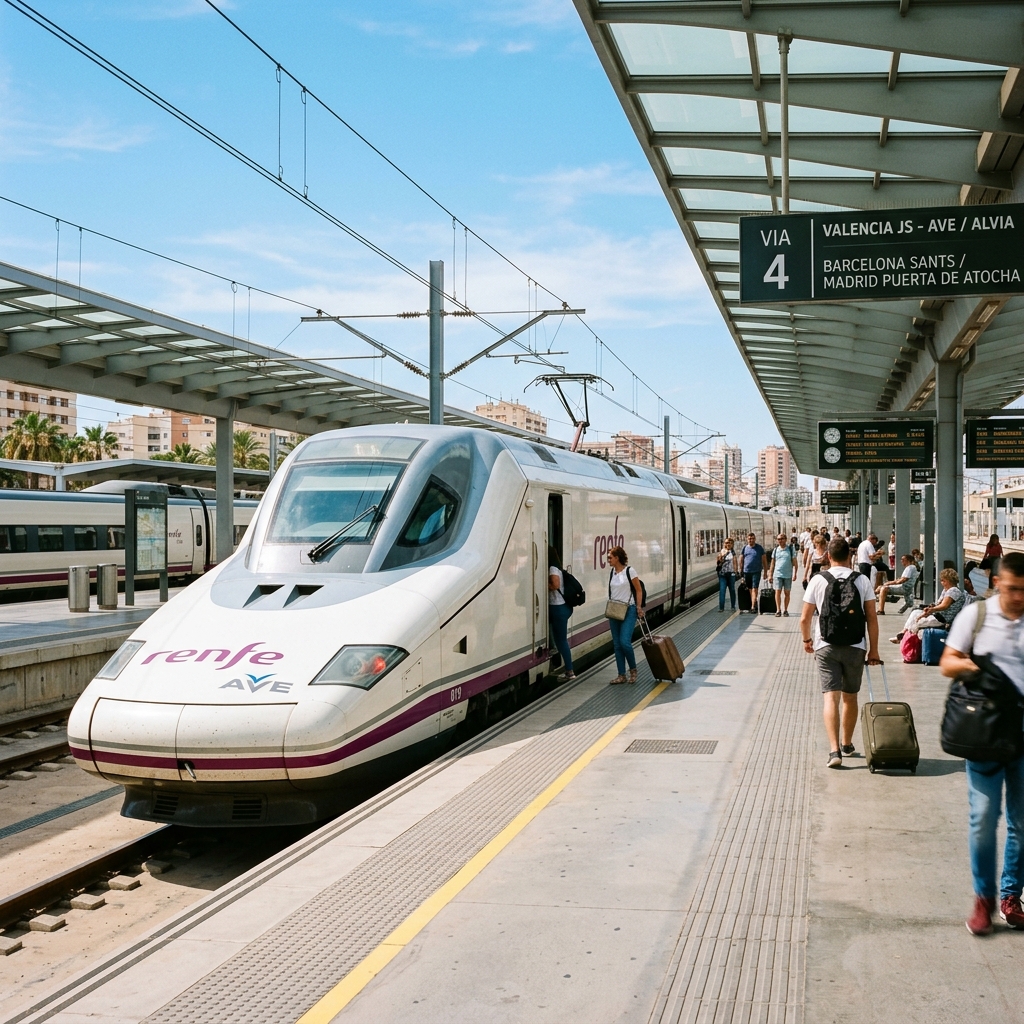
Spain presents a quietly paradoxical rail situation. The country that invented the bullfight and siesta has somehow built Europe’s longest high-speed rail network, 3,900 kilometres of dedicated AVE track, more than France, Germany, or Italy (Adif, 2025). The AVE is genuinely world-class. The regional network, by contrast, is patchy in ways that can catch unprepared travellers off guard. Understanding which is which doesn’t just save time. It unlocks the country.
TL;DR: Spain has Europe’s longest high-speed rail network, over 3,900km of AVE track (Adif, 2025), centred on a hub-and-spoke design through Madrid. Renfe and Ouigo España both serve major AVE corridors, with advance fares from €15. Book directly at Renfe.com or Ouigo.com. The 60-day booking window is shorter than most European operators. Europe rail travel overview
The AVE Network: Does Spain Really Have Europe’s Longest High-Speed Rail?
Spain’s AVE (Alta Velocidad Española) network covers over 3,900km of high-speed track as of 2025, more than any other European country, including France, which invented the TGV (Adif, 2025). That figure surprises most people. It surprised the Spaniards building it too, for much of its construction in the 1990s and 2000s.
[IMAGE: Map of Spain’s AVE high-speed rail network showing routes radiating from Madrid, search “Spain AVE high speed rail network map”]
The network is built on a hub-and-spoke design centred on Madrid. Almost every AVE route begins or ends at Madrid Puerta de Atocha, Spain’s largest station, which means inter-city journeys that feel like they should be direct often require routing through the capital. Barcelona to Seville, for instance, involves either a change in Madrid or a much slower conventional train. This is not a flaw exactly. It is a design choice, and a useful one to understand before planning.
Key AVE routes and journey times:
| Route | Journey Time | Max Speed | Frequency |
|---|---|---|---|
| Madrid → Barcelona | 2h 30min | 310 km/h | ~20/day |
| Madrid → Seville | 2h 30min | 300 km/h | ~10/day |
| Madrid → Valencia | 1h 40min | 300 km/h | ~14/day |
| Madrid → Málaga | 2h 20min | 300 km/h | ~8/day |
| Madrid → Bilbao (via Vitoria) | ~5h | 250 km/h | ~4/day |
| Barcelona → Valencia | 3h 10min | 300 km/h | ~8/day |
| Madrid → Zaragoza | 1h 20min | 300 km/h | ~16/day |
The hub-and-spoke structure has a practical implication for trip planning. If you want to move between Spanish cities efficiently, building Madrid into your route, even briefly, usually makes more sense than trying to construct a loop that avoids it. Spain is a large country; the AVE makes it manageable.
Citation capsule: Spain’s Adif (Administrador de Infraestructuras Ferroviarias) operates 3,900km of high-speed rail track as of 2025, making it the largest dedicated high-speed network in Europe by total track length. The network expanded from the original 471km Madrid–Seville line, inaugurated in April 1992 for Expo 92, to its current continental scale over three decades of sustained infrastructure investment.
Barcelona to Madrid train guide
Renfe vs Ouigo: Two Very Different Rail Experiences
Renfe, Spain’s national rail operator, runs the full AVE service with multiple seat classes: Turista (standard), Turista Plus (extra legroom), Preferente (business class equivalent), and Club (first class). Fares are dynamic, like most European high-speed rail. Flexibility costs money; the cheapest Básico fares are non-refundable and non-exchangeable.
Ouigo España arrived on the Spanish network in 2021 and has steadily expanded. It operates a budget model borrowed from its French parent, fixed seating, strict luggage rules (55×35×25cm cabin bag included; anything larger costs extra), no changes once booked. In exchange, it offers fares that are often 30–50% cheaper than equivalent Renfe services on the Madrid–Barcelona and Madrid–Valencia corridors.
[IMAGE: Side-by-side interior comparison of Renfe AVE Club class seat and Ouigo España economy seat, search “Renfe AVE interior seat” and “Ouigo España train interior”]
The practical rule is straightforward. If your plans are fixed, Ouigo is the better value. If you need flexibility, you’re connecting flights, touring with children, or your schedule might shift, Renfe’s Elige or higher fare families are worth the premium. Ouigo has none of Renfe’s grace when things go wrong.
Renfe fare families at a glance:
- Básico, cheapest, fully non-refundable, no changes
- Elige, limited changes permitted for a fee
- Elige Confort, standard class with more flexibility
- Prémium, fully flexible, cancellable
On the Madrid–Barcelona corridor, we’ve found that checking both Renfe.com and Ouigo.com for the same departure date is the only reliable method. Ouigo’s cheapest fares sell out fast on Fridays and Sunday evenings, Spain’s domestic travel peaks mirror its weekend rhythms precisely.
How to Book and When
Spain’s booking window is shorter than you might expect from a major European rail system. Renfe opens tickets 60 days in advance, compared to 120 days on French SNCF and up to 180 days on some Eurostar routes. This compresses the window for planning summer travel and means last-minute isn’t necessarily disastrous on quieter routes.
How to book European train tickets
Booking channels:
- Renfe.com, direct, no booking fee, full fare flexibility, Spanish and English interfaces
- Ouigo.com, direct, no booking fee, budget fares only
- Trainline, useful for comparing routes but adds a booking fee (typically €3–€5 per ticket)
- Eurail app, valid for Renfe services, but requires seat reservations (€10–€30 per journey)
One option worth knowing for travellers over 60: Renfe’s Tarjeta Dorada (Golden Card) offers 25–40% discounts on most services, including many AVE routes. It costs €6 per year and requires an application at a Spanish station or online with a valid ID. The payback on a single Madrid–Barcelona journey at full fare is immediate (Renfe, 2025).
The Ouigo seat caveat: Ouigo’s booking system does not assign seats at purchase, you choose your seat at check-in using a kiosk or app. On busy departures, this means window seats and forward-facing positions fill quickly. Arriving 30+ minutes before departure on Ouigo is not optional; it is how the system is designed to work.
Five Routes Worth Taking Slowly
Madrid to Seville: The Original AVE
The Madrid–Seville corridor was Spain’s first high-speed line, inaugurated in April 1992 for the Seville World Expo, 471km completed in just five years of construction. That original line remains one of the smoothest rail rides in Europe. The Castilian plateau gives way to the sun-baked plains of Extremadura before the train descends into Andalusia.
At 2 hours 30 minutes, the journey is short enough to complete before lunch. Seville’s Santa Justa station deposits you 15 minutes by taxi from the Alcázar and the Giralda. Do not rush this one.
Barcelona to Valencia: The Levante Approach
The Barcelona–Valencia AVE (3 hours 10 minutes) skirts the Mediterranean coast through the Comunitat Valenciana, the inland route is faster but the coastal segments are better. Valencia’s Estació del Nord is a Modernista building worth arriving into slowly. The city rewards the kind of traveller who eats lunch at 3 p.m. and takes it seriously.
Madrid to San Sebastián and the Basque Coast
The AVE reaches Vitoria-Gasteiz in around 2 hours 15 minutes; from there, Renfe’s regional services connect to San Sebastián (Donostia) in about an hour. Alternatively, take Euskotren’s narrow-gauge coastal line from San Sebastián, slow, beautiful, and entirely different in character from the AVE. The Basque Country repays a week of unhurried attention.
Seville to Ronda: Regional Line Through the Mountains
This is not an AVE route. The Seville–Ronda regional train takes around 1 hour 45 minutes on conventional track, climbing into the Serranía de Ronda through a field of cork oaks and whitewashed villages. Ronda’s gorge, the Tajo, is one of Spain’s genuinely dramatic arrivals, the train deposits you on the edge of the old town without ceremony.
The Seville–Ronda regional is consistently underbooked relative to its quality. Renfe’s online system doesn’t prominently surface it, and most visitors default to a hire car. The train is the better option, the road involves 90 minutes of mountain hairpins and nowhere to park in Ronda’s old town.
Madrid to Zaragoza: The Underrated Hour
Zaragoza sits midway between Madrid and Barcelona, 1 hour 20 minutes from Madrid on the AVE, and almost nobody stops there on purpose. This is an error. The Basílica del Pilar on the banks of the Ebro is one of Spain’s great religious buildings. The city has excellent tapas in the El Tubo district and almost no English menus. A planned stopover between Madrid and Barcelona costs one hour of travel time and yields a disproportionate reward.
What the AVE Doesn’t Cover: Regional Rail Gaps
Spain’s high-speed network is large and, in places, curiously incomplete. Understanding the gaps is as important as knowing the routes.
Galicia remains the most conspicuous gap. Santiago de Compostela, the endpoint of one of Europe’s great pilgrimage routes, has conventional rail connections to Madrid (via the overnight Galicia sleeper) but no AVE service as of 2025. The high-speed extension to Galicia has been under construction for years; a full connection remains projected rather than confirmed (Adif, 2025).
The Andalusian Mediterranean coast, Almería, and the route between Almería and Granada, is bus-dependent. The AVE reaches Málaga and Córdoba cleanly; the eastern Andalusian coast and the city of Granada require either a Renfe bus connection or separate regional services. Granada’s rail connection to the AVE network via a new line to Antequera opened in 2019 and now offers a Granada–Madrid journey of around 3 hours.
The Canary Islands have no trains of any kind. The volcanic geology that makes the islands visually extraordinary makes underground rail infrastructure essentially impossible to construct economically. All inter-island travel is by air or ferry.
Europe by train planning guide
Citation capsule: Spain’s Adif confirmed in 2025 that several AVE extensions remain in progress, including the Galicia high-speed corridor. The gap between Spain’s headline track-length figure and its actual route coverage reflects a build-out that prioritised key commercial corridors, Madrid to Barcelona, Madrid to Seville, before serving peripheral regions. A country can have Europe’s longest high-speed network and still leave major cities off the map.
Spain’s Night Train Situation
Renfe operates a reduced but functioning Trenhotel network, Spain’s branded overnight rail service. The network contracted significantly after 2012 austerity measures, but several routes survive and are worth knowing.
The Madrid to A Coruña overnight (Galicia sleeper) is the most practically useful. It departs Madrid Chamartín in the evening and arrives in Galicia by morning, effectively solving the AVE gap problem for travellers heading to Santiago de Compostela or the Galician coast. Couchettes and private sleeper compartments are available.
The Madrid to Lisbon Lusitania train has had a complicated recent history. The service existed for decades but has operated irregularly in recent years; as of early 2026, the connection is not reliably bookable. The overland Madrid–Lisbon journey is currently best done by Alsa bus (approximately 7–8 hours) or by air. This is a known gap in Iberian rail connectivity.
The EU’s broader night train revival, backed by funding through the European Green Deal and a commitment to restoring cross-border overnight services, is beginning to reach Spain. A renewed Madrid–Paris overnight service has been discussed at a political level, though no confirmed launch date exists as of March 2026 (European Commission, 2024).
Arriving in Spain by International Train
Barcelona to France and Beyond
Barcelona is Spain’s only practical international rail gateway. From Barcelona Sants, high-speed TGV services run to Perpignan (1 hour), Narbonne, Montpellier, and Lyon, connecting at Lyon Part-Dieu or Paris Gare de Lyon for onward European services. The Paris–Barcelona journey takes approximately 6 hours 20 minutes with one change, typically at Lyon or Paris (SNCF, 2025).
The Gauge Problem
Here is why Madrid–Paris has no direct high-speed train, and why the Madrid–Lisbon situation is complicated. Spain’s historic rail network was built on Iberian gauge, 1,668mm between the rails, wider than Europe’s standard gauge of 1,435mm. This was a deliberate nineteenth-century decision, allegedly to prevent French military trains from rolling directly into Spain. Whether true or not, the consequence is that Spanish and European rolling stock are not directly interchangeable.
The AVE network was built from the beginning on standard gauge, which is why international high-speed connections from Barcelona work. But much of Spain’s conventional rail, including cross-border routes to Portugal, still runs on Iberian gauge, requiring either gauge-changing equipment (which exists and works, but slowly) or a change of trains at the border.
This engineering inheritance shapes Spanish international rail in ways that no amount of political will has yet overcome. It is, in a way, the most Spanish possible infrastructure problem: a nineteenth-century decision about railway width that still dictates twenty-first-century travel patterns.
Related Reading
- Madrid to Seville by Train: Spain’s AVE in Under 2.5 Hours, The AVE from Madrid to Seville takes 2h 30min and costs from €25 advance.
- Paris to Barcelona by Train: TGV Guide, Prices & Tips, Paris to Barcelona by train takes 6h 25m on the direct TGV/AVE.
- The Camino de Santiago by Train: Getting There and What to Expect, How to reach the Camino de Santiago by train, which route to choose, and what to expect on 25–33 days of walking to…
Frequently Asked Questions
How do I book Spanish AVE train tickets?
Book directly at Renfe.com, Spain’s national operator, or through Ouigo España for cheaper fares on key corridors including Madrid–Barcelona and Madrid–Valencia. The Renfe booking window opens 60 days in advance, shorter than most European operators. Trainline works but adds a booking fee of €3–€5 per ticket. For the cheapest fares, book at the 60-day mark for summer travel and public holidays. Advance fares from Ouigo start around €15; Renfe’s cheapest Básico fares from around €25 on major AVE routes.
What is the fastest train route in Spain?
The Madrid to Barcelona AVE is Spain’s most frequent high-speed service, around 20 daily departures, and takes as little as 2 hours 30 minutes at speeds up to 310km/h (Renfe, 2025). That makes it one of the fastest intercity journeys in the world by elapsed time relative to distance. Ouigo España also serves this corridor with advance fares from around €15, though with stricter luggage rules and no seat changes once booked.
Is the Eurail pass worth using in Spain?
Usually not for domestic Spanish travel alone. Spain’s AVE requires mandatory seat reservations even with a Eurail pass, costing €10–€30 per journey depending on the service and class (Eurail, 2025). Since advance Renfe and Ouigo point-to-point tickets often start at €15–€25, the reservation fee alone can approach or exceed a direct ticket price. The pass makes more financial sense for multi-country European itineraries where you’re crossing several borders in a short period.
How do I get from Madrid to Barcelona by train?
Take the Renfe AVE or Ouigo España from Madrid Puerta de Atocha to Barcelona Sants or Barcelona Passeig de Gràcia. The journey takes 2h 30min to 3h depending on the service. Book at Renfe.com for full-service, flexible fares, or Ouigo.com for the cheapest fares (budget airline-style, no changes, strict luggage limits). Advance fares from around €15 on Ouigo; Renfe’s Básico fares from around €25. Both operators run direct services; there’s no connection required.
Can I travel Spain by train without a car?
Yes, entirely, for the main cities. The AVE connects Madrid, Barcelona, Seville, Málaga, Valencia, Bilbao (via Vitoria-Gasteiz), Zaragoza, Alicante, and Córdoba. Regional Cercanías networks cover commuter zones around each city efficiently. Rural Andalusia, the Galician coast, and the Canary Islands still require buses or hire cars, but most of what a slow traveller wants to see is reachable by rail. The honest answer: rent a car for the Ronda–Jerez–Cádiz triangle; use the AVE for everything else.
The Country the Train Reveals
Spain rewards the traveller who doesn’t rush. The AVE makes that easier than it has any right to be, you can be in Seville for breakfast, Córdoba for lunch, and back in Madrid for dinner. Whether that constitutes travel or merely movement is a question worth sitting with.
The more interesting observation is what happens when you step off the AVE and onto a regional service. The Seville–Ronda train. The Euskotren coastal tram from San Sebastián. The overnight to Galicia. These are the journeys that reveal a country rather than connect its economic nodes. Spain is large, older than its infrastructure, and in places stubbornly inaccessible in the best possible way.
The AVE is the starting point. What you discover when it runs out is where the journey actually begins.
For the flagship corridor in detail, see our complete guide to travelling from Barcelona to Madrid by train. For planning a wider European rail trip, our Europe by train guide covers booking strategy, rail passes, and multi-country routing in full.