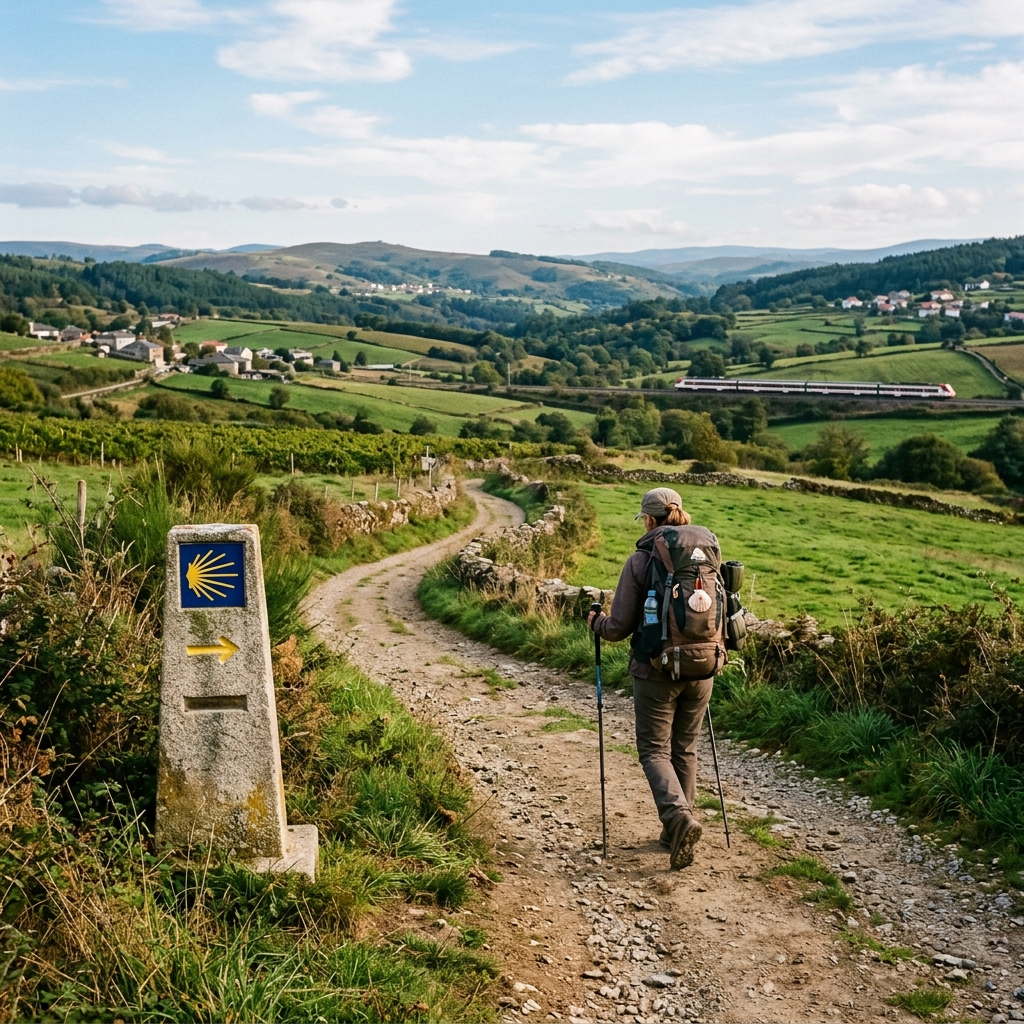
The Camino de Santiago is not a single path. It is a network of historic pilgrimage trails across France, Spain, and Portugal that converge on the Cathedral of Santiago de Compostela in Galicia. While the journey itself is a traditional walking (or cycling) pilgrimage, getting to the remote starting points can be a logistical challenge. Traveling by train is the most scenic, sustainable, and relaxing way to reach your starting trailhead before you begin your journey on foot.
This guide focuses on bridging that gap: how to reach the main starting points by train, how to choose the walking route that suits you best, and what to expect once you set out on the trail.
The Main Routes: What Each One Offers
Camino Francés — The Classic
Distance: 800km, St Jean Pied de Port (France) to Santiago de Compostela Typical duration: 28–35 days Difficulty: Moderate, with one serious mountain crossing on Day 1
The Camino Francés is the route most people mean when they say “the Camino.” It crosses the Pyrenees at the Col de Lepoeder (1,450m) on the first day, descends into Roncesvalles in Spain, and then follows a relatively logical east-to-west traverse across the northern Meseta before climbing into Galicia. The final 100km from Sarria to Santiago are the most congested.
The infrastructure on the Francés is extraordinary: albergues (pilgrim hostels) every few kilometres in most sections, pilgrim menus in almost every village, and a waymarking system (yellow arrows and scallop shell markers) so consistent that navigating without a map is genuinely possible. The flip side is crowds. In July and August, the most popular stages feel less like a pilgrimage and more like a long-distance walking tour with too many people.
For first-timers who want a complete experience with minimal logistical friction, this is the route.
Camino Portugués — The Practical Choice
Distance: 620km from Lisbon, 280km from Porto to Santiago Typical duration: 12 days (Porto start) or 25 days (Lisbon start) Difficulty: Easier terrain than the Francés; the coastal variant has some cliffs
The Camino Portugués from Porto is increasingly the choice of experienced walkers who want fewer crowds and easier logistics. Porto to Santiago is roughly 280km — 12 walking days at a moderate pace — and the route is now well-waymarked and supported. The coastal variant (Via Costeira) adds spectacular cliff-top walking above the Atlantic.
This route makes particular sense for travellers who are already in Portugal or who can fly into Porto (a short walk or Metro ride from the historic centre). It can be combined with a slow travel itinerary through Portugal.
Camino del Norte — The Coastal Route
Distance: 820km, Irún (on the French border) to Santiago Typical duration: 35 days Difficulty: Harder than the Francés — more elevation change, sometimes dramatic coastal terrain
The Norte follows the Cantabrian coast west through the Basque Country, Cantabria, and Asturias before turning south into Galicia. It is significantly less busy than the Francés and passes through some of the most beautiful and underappreciated corners of Spain — San Sebastián, Bilbao, Santander, Gijón. The food is better too: this is pintxos and cider country.
The Norte requires more fitness, more navigation attention (waymarking is less saturating than on the Francés), and a higher tolerance for changeable Atlantic weather. It rewards walkers who want a harder, quieter experience.
Camino Primitivo — The Oldest and Hardest
Distance: 320km, Oviedo to Santiago Typical duration: 12–15 days Difficulty: The hardest of the main routes — sustained mountain terrain
The Primitivo is the original Camino, walked by King Alfonso II of Asturias in 830 CE. It leaves from Oviedo, crosses the mountains of Galicia on rough terrain with significant daily elevation, and arrives in Santiago after 320km that feel considerably longer. Albergues exist but are spaced further apart; you need to be a competent walker with properly broken-in footwear.
This is not a beginner route, but it offers a quality of solitude and wildness that the more popular routes cannot match.
Getting to the Start by Train
To St Jean Pied de Port (Camino Francés)
St Jean Pied de Port is a small Basque village in the French Pyrenees, the traditional starting point for the Camino Francés. Getting there by train requires a combination:
From Paris Montparnasse: TGV to Bayonne (3h30m–4h, from €35 booked ahead), then the regional SNCF train from Bayonne to St Jean Pied de Port (1h10m, around €12). Total journey: approximately 5 hours. Trains from Bayonne to St Jean run 3–5 times daily; check the SNCF schedule as this regional line has limited frequency.
From Madrid Chamartín: RENFE to Irún or San Sebastián (5h30m–6h), then cross into France and take local trains via Bayonne to St Jean Pied de Port. This route makes sense if you’re travelling from Spain and adds roughly an hour to the total journey.
From Biarritz (by bus): Some pilgrims fly into Biarritz or Pau and take a bus or taxi to Bayonne, then connect to St Jean. This is a legitimate option when train fares to Bayonne are high.
Arrive in St Jean the evening before you plan to cross the Pyrenees. The Pilgrim Office (Accueil Pèlerin, Rue de la Citadelle) is open from around 7:30am and will issue your credential, advise on the weather, and sometimes suggest the alternate Napoleon Route if mountain conditions are poor.
To Porto or Tui (Camino Portugués)
If starting from Porto: Porto is served by direct international trains from Madrid (9h30m) and by connections from Lisbon (2h45m by Alfa Pendular). From Porto’s São Bento station, the Camino Portugués begins immediately — yellow arrows lead you out of the city toward Matosinhos and north.
If starting from Tui (the shorter Central Route): Trains from Porto to Valença (1h50m by regional train) cross the international bridge into Tui, Spain, on foot — you literally walk across the border. This is one of the more unusual and satisfying ways to enter Spain. From Tui, it’s 110km to Santiago along the central route of the Camino Portugués.
To Irún (Camino del Norte)
Irún is the Spanish border town opposite Hendaye (France), right on the Atlantic coast. It’s served by Euskotren from San Sebastián (30 minutes) and by direct RENFE trains from Madrid Chamartín (5h30m). From Paris, you take the TGV to Hendaye (5h30m) and walk across the international bridge into Irún.
Irún itself is not a particularly inspiring starting town, but San Sebastián is 30 minutes away by Euskotren and is arguably the finest food city in Spain — a strong case exists for beginning your Norte journey with a day in San Sebastián eating pintxos in the Parte Vieja before taking the train to Irún the next morning.
What to Expect: The Daily Reality of Walking the Camino
The Albergue System
Albergues are the pilgrim hostels that make the Camino financially accessible. Municipal albergues (run by the local government or the church) charge €8–€15 for a bunk in a dormitory of 20–80 people. Private albergues are cleaner and quieter — €18–€30 per person, often in smaller rooms. Both require a credential stamp.
A typical albergue offers: bunk beds with a mattress (bring your own sleep sheet or liner — mandatory in most albergues), shared bathrooms, a kitchen or at least a place to store food, and no guarantee of silence from 10pm onward. Earplugs are not optional; they are essential equipment.
Most albergues open around 2pm and operate on a first-come, first-served basis except for those that accept reservations. On the Camino Francés in summer, arriving at an albergue after 4pm can mean it’s full.
The Pilgrim Menu
The menú del peregrino is a three-course set lunch available at almost every bar and restaurant on the route, typically from 1pm to 3pm. For €12–€15 you get: a starter (soup or salad), a main (grilled meat or fish with chips), a dessert or fruit, bread, and a half-litre of house wine or a soft drink. It is not sophisticated cuisine, but it’s sufficient fuel, good value, and one of the most reliable pleasures of a walking day.
Dinner in the albergue kitchen (cooking your own pasta, buying provisions from a village shop) is another common approach — it costs €3–€5 and saves money for the days when you want a real restaurant.
The Physical Reality
The Camino Francés has a total elevation gain of approximately 16,000m spread over 800km — more than walking up Everest from sea level twice. The daily distances typically range from 20km to 30km, with some stages longer. Most people experience foot problems in the first week: blisters, tendon soreness, knee pain from descents.
The advice that prevents most injury: do not carry more than 10% of your body weight. A 70kg person should carry 7kg or less. This feels impossibly light until you’ve walked 25km with a pack that’s even slightly too heavy. Merino wool socks (two pairs, alternating), properly fitted trail runners (not boots, for most people — boots are heavier and cause more blisters), and trekking poles reduce impact on descents significantly.
Poles are not optional luxury equipment on the Camino. They absorb roughly 20–30% of the impact on downhills, reduce knee strain over a 33-day walk by a meaningful amount, and double as tent stakes if you’re camping. Bring them.
When to Go
April–June: The best months. Weather is mild to warm, wildflowers are out across the Meseta, and the route is busy but not overwhelmed. Albergues are easier to find without booking ahead.
September–October: A close second. Summer heat has passed, the harvest landscape in Galicia is beautiful, and pilgrim numbers drop sharply after mid-September. October in Galicia means Atlantic rain — bring a rain cover for your pack and a decent jacket.
July–August: Hot, crowded, logistically harder. The Meseta in July, with temperatures exceeding 35°C and exposed terrain, is a serious physical test. If you walk in summer, start by 6am to cover most of your daily distance before noon.
November–March: Possible but requires experience and preparation. Many albergues close; mountain stages may have snow; Galicia is genuinely wet. The solitude is total and the experience is profound for those who seek it.
The Credential and the Compostela
The credencial del peregrino (pilgrim passport) is a folded document, slightly larger than a passport, made of stiff card. You collect stamps (sellos) in it at albergues, churches, cafés, tourist offices, and various other official points along the route. There are no rules about how many stamps you need per day, but albergues will check your credential on arrival.
To receive the Compostela — the official certificate of completion issued by the Cathedral of Santiago — you need to have walked at least the final 100km (from Sarria on the Francés) and have at least two stamps per day for that final section. If you’ve cycled rather than walked, the requirement doubles to 200km. The Compostela is written in Latin, gives your name in Latin form, and is the document pilgrims have been receiving in Santiago since the medieval period.
The pilgrim office in Santiago (Oficina de Acogida al Peregrino, Rúa do Vilar) processes credentials from about 8am to 8pm during peak season and 9am to 6pm off-season. Expect a wait of 30–60 minutes on busy days.
Santiago de Compostela: Arrival and After
The approach to Santiago from the Camino Francés passes through Monte do Gozo (the Hill of Joy, where pilgrims first see the cathedral towers) and then descends through the modern outskirts into the old town. You enter the Praza do Obradoiro through a tunnel under the buildings on its eastern edge, and then the cathedral is directly in front of you.
The Pilgrim Mass at the cathedral takes place at noon every day and is worth attending, both as a ritual conclusion to the walk and for the possibility of seeing the botafumeiro — the enormous incense burner, nearly a metre tall and weighing 80kg, that is swung on a rope across the transept by eight robed attendants. The botafumeiro tradition dates to the 11th century and was originally practical: the smoke masked the smell of the arriving pilgrims. Now it’s a spectacle that even non-religious visitors find genuinely moving.
After Santiago, the question of what to do next divides pilgrims. Some take the bus to Finisterre (the lighthouse at the end of the world, on the Atlantic coast) or walk it in 3 days. Others board a train immediately. Others simply stop and remain in Santiago for several days, unable yet to return to normal life.
Onward connections by train:
- Santiago to Madrid: AVE high-speed train, 5h30m, from €35 booked ahead
- Santiago to Porto: A combination of train to Vigo (40 minutes) and then across the border — roughly 3 hours total with connections, or a direct bus service (2h30m) that many pilgrims prefer for the simplicity
For rail connections across Spain, see our guide to Spain by train. If you arrived via Portugal and want to continue south, our Portugal by train guide covers the network in detail.
For the philosophical dimensions of long walking, our slow travel guide addresses why this pace of movement changes how we see.
What to Pack: The Essentials Only
The 10% body weight rule is not a suggestion. This is what that looks like in practice for a typical walker:
Clothing (for 3-season walking): Two sets of merino wool walking clothes (including underwear), one warm layer (fleece or lightweight down), a waterproof shell jacket, a sun hat, and one set of “town clothes” for evenings — usually light trousers and a long-sleeve shirt. That’s it.
Footwear: Trail runners, fitted at a specialist store with an afternoon appointment (feet swell during the day — always fit shoes in the afternoon). Break them in over 4–6 weeks of walking before you arrive. Two pairs of merino wool socks. Sandals for albergue use.
Poles: Collapsible trekking poles. Carbon fibre is lighter; aluminium is cheaper and more durable if you’re rough on gear.
Sleep: A silk or cotton sleep liner — mandatory in most albergues. A small inflatable pillow if you sleep badly without one.
Medical: Blister kit (Compeed, a needle, alcohol wipes), ibuprofen, sun cream SPF 50, electrolyte tablets for hot stages, moleskin.
Navigation: The Buen Camino app (free, offline-capable, excellent) plus a printed stage guide as backup. Physical guidebooks are heavy; the app carries the same information.
The Camino is one of the few long walks in the world where you genuinely need very little. Villages come frequently enough that you can buy almost anything you’ve forgotten. The things you cannot replace are will and broken-in shoes.
Related Reading
- Hiking the Dolomites by Train: Getting There Without a Car — How to hike the Dolomites without a car — arriving by train to Bolzano, the best trails accessible by bus and cable…
- Barcelona to Madrid by Train: AVE Times, Tickets and What to Expect — The AVE from Barcelona to Madrid takes 2h 30min and costs from €14 in advance.
- Madrid to Seville by Train: Spain’s AVE in Under 2.5 Hours — The AVE from Madrid to Seville takes 2h 30min and costs from €25 advance.