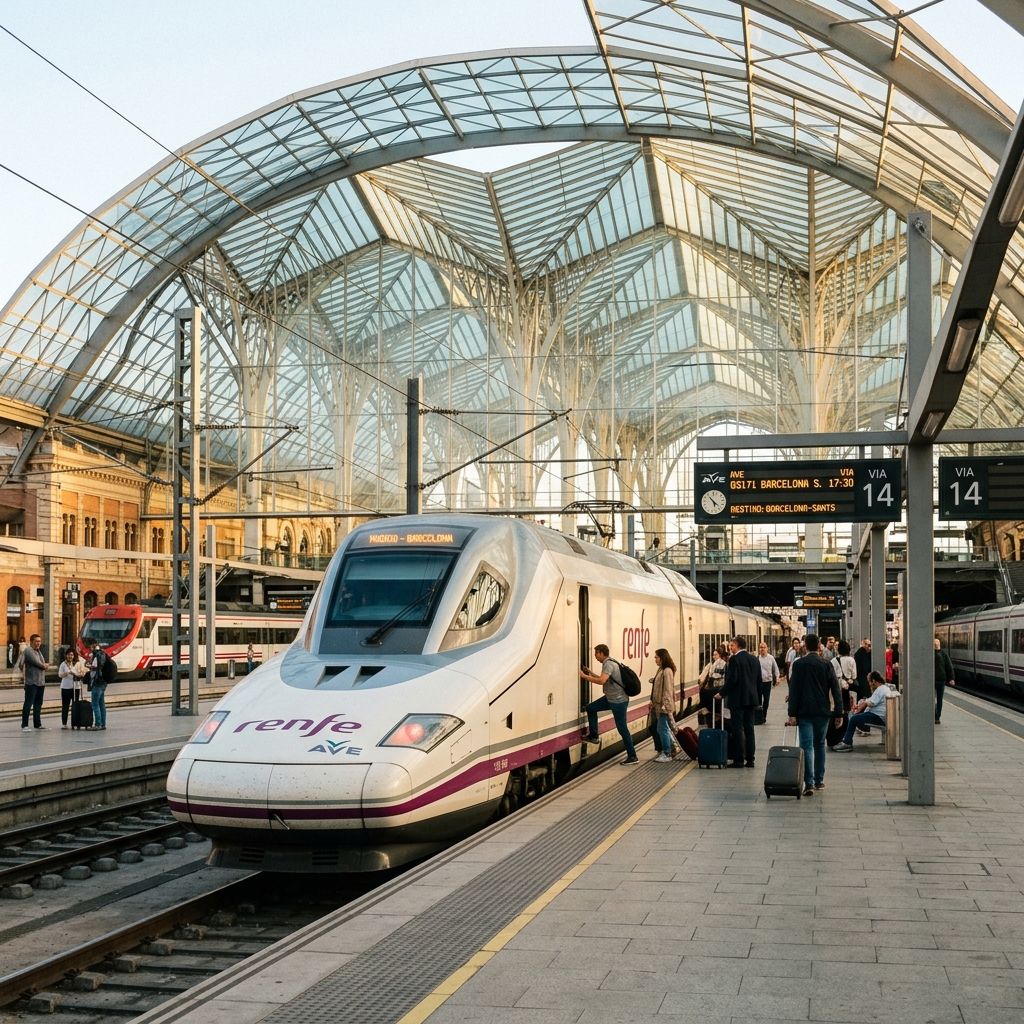
The Madrid–Seville corridor was where Spain’s high-speed railway story began. The line opened in 1992, built for the Seville Expo, and it was the first truly fast train on the Iberian Peninsula — a country that had previously been rail-isolated from the rest of Europe by its wider gauge track. The AVE covered 471 kilometres in under three hours and changed the way Spain understood the relationship between its cities.
Three decades later, that original line is the busiest high-speed corridor in Andalusia, and it now has competition: Iryo launched services in 2022, Ouigo followed with budget fares. The result is genuinely useful price pressure for travellers. This guide covers the full picture — journey times, operators, booking strategy, and what to do with the time Seville will give you.
comparing AVE fares across Spain
TL;DR: The Madrid to Seville AVE takes 2 hours 30 minutes with Renfe, from €25 advance. Iryo offers competing services from €9–15 on the same route. Depart Madrid Puerta de Atocha, arrive Seville Santa Justa — 15 minutes from the old town. The booking window opens 60 days out for Renfe, 90 days for Iryo.
How Long Does the Madrid to Seville Train Take?
2 hours 30 minutes — that’s the standard journey time on Renfe’s fastest AVE services, covering 471km from Madrid Puerta de Atocha to Seville Santa Justa. Some services stop at Córdoba and take 2h 45m to 3h. Iryo and Ouigo high-speed services typically run 2h 40m to 3h depending on the service.
There are roughly 15–20 high-speed departures daily in each direction, spread evenly from early morning to evening. Unlike the Barcelona–Madrid corridor with its 30+ daily departures, the Madrid–Seville corridor has somewhat fewer trains — book ahead, especially on Friday afternoons and Sunday evenings.
| Operator | Journey Time | Notes |
|---|---|---|
| Renfe AVE (nonstop) | 2h 30m | Fastest option, most departures |
| Renfe AVE (via Córdoba) | 2h 45m–3h | One intermediate stop |
| Iryo | 2h 40m–3h | Often cheaper |
| Ouigo | 2h 45m–3h 10m | Cheapest fares, most restrictions |
understanding your booking options
[IMAGE: Seville Santa Justa railway station exterior — search terms: Seville Santa Justa station high-speed train AVE]
The Three Operators: Renfe, Iryo, and Ouigo
Renfe
Renfe remains the dominant carrier and runs the most departures. The reservation system at renfe.com is available in English and accepts international cards. Fare tiers run from Promo (non-refundable, fixed train, ~€25–35 advance) through Promo Plus (one free exchange, ~€40–55) to Flexible (full refund and exchange, ~€80–120). For most leisure travellers, Promo Plus is the sensible middle ground — a single date change is genuinely useful, and the extra €10–15 over Promo is worth the insurance.
Iryo
Iryo is the private operator that launched on Spain’s high-speed network in December 2022, and it has been genuinely disruptive on price. Iryo’s cheapest advance fares (from €9–15) frequently undercut Renfe by a meaningful margin on the same corridor, particularly on shoulder-time departures. The trains — Alstom Avelia Horizon sets — are modern and comfortable. The booking site (iryo.eu) is functional in English.
The key practical difference: Iryo opens its booking window 90 days ahead versus Renfe’s 60 days. If you know your travel dates well in advance, Iryo is worth checking first.
Ouigo
Ouigo España — the Spanish arm of French budget rail operator Ouigo — offers the cheapest headline fares on the corridor, starting from €9. The trade-offs are familiar from budget air travel: luggage allowances are strictly enforced (carry-on only on the cheapest tier; checked bags are an extra charge), the booking experience is basic, and exchanges and refunds are extremely limited. If your plans are firm and you travel light, Ouigo can save a useful amount. Otherwise, the restrictions make the apparent savings less clear.
Where to Book: Price Comparison Strategy
For the lowest possible fare, the practical approach is:
- Check Iryo first at the 90-day mark — their early-release fares are often the cheapest available on the corridor.
- Check Renfe at 60 days — Promo fares release at this point and go quickly on busy departures.
- Use Omio or Trainline as a comparison tool — both aggregate Renfe and sometimes Iryo inventory and make it easy to see what’s available across operators and times on a single screen. Note that Omio and Trainline charge a small booking fee.
- Book direct for Ouigo — at ouigo.es; third-party platforms don’t always carry their cheapest fares.
For the cheapest fares, booking direct with the operator is always the surest path. Third-party platforms add a booking fee (typically €2–8 per ticket) in exchange for convenience and a unified interface.
Madrid Puerta de Atocha: The Departure
All Madrid–Seville trains depart from Madrid Puerta de Atocha — the grand station in the Retiro district, about 1.5km south of Puerta del Sol. The station divides into two connected sections: the old 19th-century iron-and-glass hall (now a tropical botanical garden with free-roaming tortoises — genuinely worth ten minutes) and the modern high-speed terminal where your train departs.
Arrive at least 20 minutes before departure. There’s no security screening in the airport sense, but Atocha is large, and finding your platform and carriage letter takes a few minutes. Metro line 1 (Atocha Renfe) connects directly to the station from central Madrid in about 10–12 minutes.
Seville Santa Justa: Arriving in Andalusia
Seville’s station — Santa Justa — is a good deal more interesting than most high-speed terminals. The 1992 building, designed by Rafael Moneo and Cruz and Ortiz, has held up well: tall, light, with a confident Andalusian restraint to its architecture. It’s approximately 15 minutes from the historic centre by taxi or Uber (€10–12); taxis queue outside the main exit. The city bus network also connects Santa Justa to the centre for around €1.40.
[IMAGE: Seville historic centre, Giralda tower and cathedral from across the Guadalquivir — search terms: Seville Giralda cathedral rooftops Andalusia aerial]
Why Seville Rewards Slow Travel
Seville is one of the cities where the slow travel argument makes itself. Its famous monuments — the Real Alcázar, the cathedral and Giralda tower, the Parque de María Luisa — are worth visiting, but they’re not where you understand the city. That happens elsewhere.
The Triana Neighbourhood
Cross the Guadalquivir on the Triana Bridge and you’re in a different city. Triana was historically the barrio of ceramicists, bullfighters, and flamenco artists — working-class in ways the tourist-dense centre never quite was. The ceramic tiles that cover Seville’s buildings largely came from workshops here. Today the market (Mercado de Triana, inside a beautifully restored building on the riverfront) is the right place for breakfast: coffee at the bar, pan con tomate, the morning light coming through the market roof.
Tapas Culture: Real vs. Touristy
The distinction matters in Seville. The tapas bars around the cathedral — Calle Mateos Gago particularly — serve tourists at tourist prices. The places worth finding are a ten-minute walk away. The neighbourhood around Plaza del Salvador has a cluster of genuinely local bars: El Rinconcillo (Seville’s oldest tapas bar, open since 1670, excellent montaditos), Casa Román, and Bodega Santa Cruz. In Triana, Bar Santa Ana and Bar Las Golondrinas are both the real thing.
Seville’s tapa tradition differs from Madrid’s: here, a drink often comes with a free tapa — a small plate, unbidden, carried out by the barman. It’s one of the city’s most pleasant customs.
The Question of Timing: Feria de Abril
Seville’s Feria de Abril takes place two weeks after Easter — a six-day festival of casetas (private tents), flamenco, horseback riding, food, and sherry that is almost entirely for Sevillanos and their guests. It is spectacular and almost impossible to access as an independent traveller; most casetas are private, run by families, businesses, and political parties. If you visit during Feria, go for the atmosphere of the fairground and the paseo de caballos (horse parade) in the morning — you’ll see enough without needing an invitation. But Seville is equally compelling in October and November, when the heat has dropped, the cruise ships have largely gone, and the city belongs more to itself.
Day Trips from Seville by Train
Seville’s position on the high-speed network makes it an exceptional base for exploring Andalusia. Three day trips are worth considering seriously:
Córdoba (45 minutes, from €10–15 advance)
Córdoba is arguably the most rewarding day trip in Spain. The Mezquita-Catedral — a Moorish mosque with a Christian cathedral built through its centre in the 16th century — is one of the most extraordinary buildings in Europe: a forest of 856 columns in red and white striped marble, a space that simultaneously belongs to two faiths and transcends both. The Jewish Quarter (Judería) surrounding it is dense with medieval alleys, patios spilling flowers, and the remains of one of Spain’s best-preserved synagogues.
Trains from Seville to Córdoba take 45 minutes and run frequently; advance fares start from €10–15. Most visitors spend four to six hours in Córdoba and return by early evening — which is exactly right. (Renfe, 2025)
Cádiz (1h 45m, from €12–20 advance)
Cádiz is a city on a spit of land jutting into the Atlantic — surrounded by water on three sides, full of crumbling baroque churches and exceptional seafood. The Mercado Central (19th-century iron market) and the seafront along the Paseo Marítimo are the best of it; the city’s old town feels genuinely edge-of-the-world. The train from Seville takes 1h 45m and arrives at a central station within walking distance of everything. (Renfe, 2025)
Jerez de la Frontera (1 hour, from €8–15 advance)
Jerez is sherry country. The bodegas — González Byass, Lustau, Sandeman — offer tours that run through the process from grape to fino and end in a tasting. The city also has an important flamenco tradition (the Festival de Jerez in February/March is one of the best in Spain) and a Royal Andalusian School of Equestrian Art for the horse-minded. The train from Seville takes approximately 1 hour. (Renfe, 2025)
[IMAGE: Córdoba Mezquita-Catedral interior, striped Moorish arches — search terms: Córdoba Mezquita interior columns arches Moorish architecture]
A 10-Day Madrid–Toledo–Seville–Córdoba Itinerary
For travellers arriving into Madrid, a 10-day Andalusian circuit by rail looks like this:
Days 1–2: Madrid — Prado, Retiro, La Latina tapas, vermouth in Malasaña.
Day 3: Toledo day trip (30 min from Madrid Atocha, €12–18 advance) — medieval city on its granite promontory, El Greco paintings in the Museo de El Greco, the cathedral, back to Madrid by evening.
Days 4–6: Seville — Real Alcázar, cathedral and Giralda, Triana market, tapas in Alfalfa and El Arenal, boat on the Guadalquivir.
Day 7: Córdoba day trip — Mezquita, Judería, lunch at the Plaza de la Corredera, back to Seville by evening.
Day 8: Cádiz day trip — Atlantic seafood, crumbling baroque, the Mercado Central.
Days 9–10: Jerez and return — sherry bodega tour, equestrian show if timed right, then Jerez-Seville and Seville-Madrid AVE home.
Total rail spend (advance booking): approximately €80–120 per person for all the train legs. The whole circuit connects on high-speed rail without a single domestic flight.
building a wider Iberian itinerary the AVE connection from Barcelona
Related Reading
- Madrid for Slow Travellers: A City That Starts Late and Rewards Patience — Madrid operates on a different clock to the rest of Europe — lunch at 3pm, dinner at 10pm, streets at their best…
- The Camino de Santiago by Train: Getting There and What to Expect — How to reach the Camino de Santiago by train, which route to choose, and what to expect on 25–33 days of walking to…
- Paris to Barcelona by Train: TGV Guide, Prices & Tips — Paris to Barcelona by train takes 6h 25m on the direct TGV/AVE.
Frequently Asked Questions
How long does the Madrid to Seville train take?
The fastest Renfe AVE services cover the 471km in 2 hours 30 minutes, nonstop from Madrid Puerta de Atocha to Seville Santa Justa. Services via Córdoba take 2h 45m to 3h. Iryo and Ouigo high-speed competitors typically run 2h 40m to 3h. There are around 15–20 daily departures in each direction.
How much does the Madrid to Seville AVE cost?
Renfe’s cheapest advance Promo fares start around €25–35 booked 60 days ahead. Iryo frequently undercuts this, with fares from €9–15 at the 90-day advance mark. Ouigo’s cheapest tickets start from €9 but carry strict baggage and flexibility restrictions. Full-fare flexible Renfe tickets run €80–120. Check iryo.eu at 90 days, then renfe.com at 60 days, for the best combination of price and flexibility.
Which station in Madrid do trains to Seville depart from?
All high-speed trains to Seville depart from Madrid Puerta de Atocha, the main intercity station in the Retiro district. Metro line 1 (Atocha Renfe stop) connects to central Madrid in about 10–12 minutes. The high-speed AVE terminal is in the modern wing of the station — follow signs to Trenes de Alta Velocidad.
Is Córdoba worth a stop between Madrid and Seville?
Emphatically yes. Córdoba sits directly on the Madrid–Seville high-speed line, making it a natural and near-free addition to any itinerary. Madrid to Córdoba takes 1h 45m (from €15–25); Córdoba to Seville takes 45 minutes (from €10). The Mezquita-Catedral is one of the most extraordinary interiors in the world and merits at least an afternoon. Book the legs separately on renfe.com.
Is Seville worth more than two days?
Three to five days is more honest for anyone interested in more than the main monuments. The Triana neighbourhood, the city’s tapas culture, the pace of Andalusian life (late lunches, later dinners, long evenings), and the excellent day trips to Córdoba, Cádiz, and Jerez all reward a slower schedule. October and November are particularly good — the heat has broken, the main tourist rush has passed, and Seville is more itself.
The AVE and What It Did to Seville
When the Madrid–Seville high-speed line opened in 1992, the journey that had taken four hours by conventional train collapsed to two and a half. Seville’s economy and tourism changed substantially — the high-speed line is partly credited with making the Expo viable and with the city’s subsequent growth as a visitor destination.
The train is why Córdoba, an hour from Seville, now functions as a day trip rather than an overnight. It’s why you can build a 10-day Andalusian circuit without renting a car. Spain invested heavily in high-speed rail while other countries hesitated, and the result is one of Europe’s most usable domestic rail networks — particularly in the south.
Book on renfe.com or check iryo.eu for competing fares. Aim to sit on the right side of the train heading south from Madrid for views over the Sierra Morena as you descend into Andalusia. Seville, three and a half centuries of accumulated heat in its stones, will do the rest.
For day trips and wider exploration, read our Spain by train guide. And if you’re combining this journey with the Barcelona–Madrid leg, the Barcelona to Madrid train guide covers all the details.