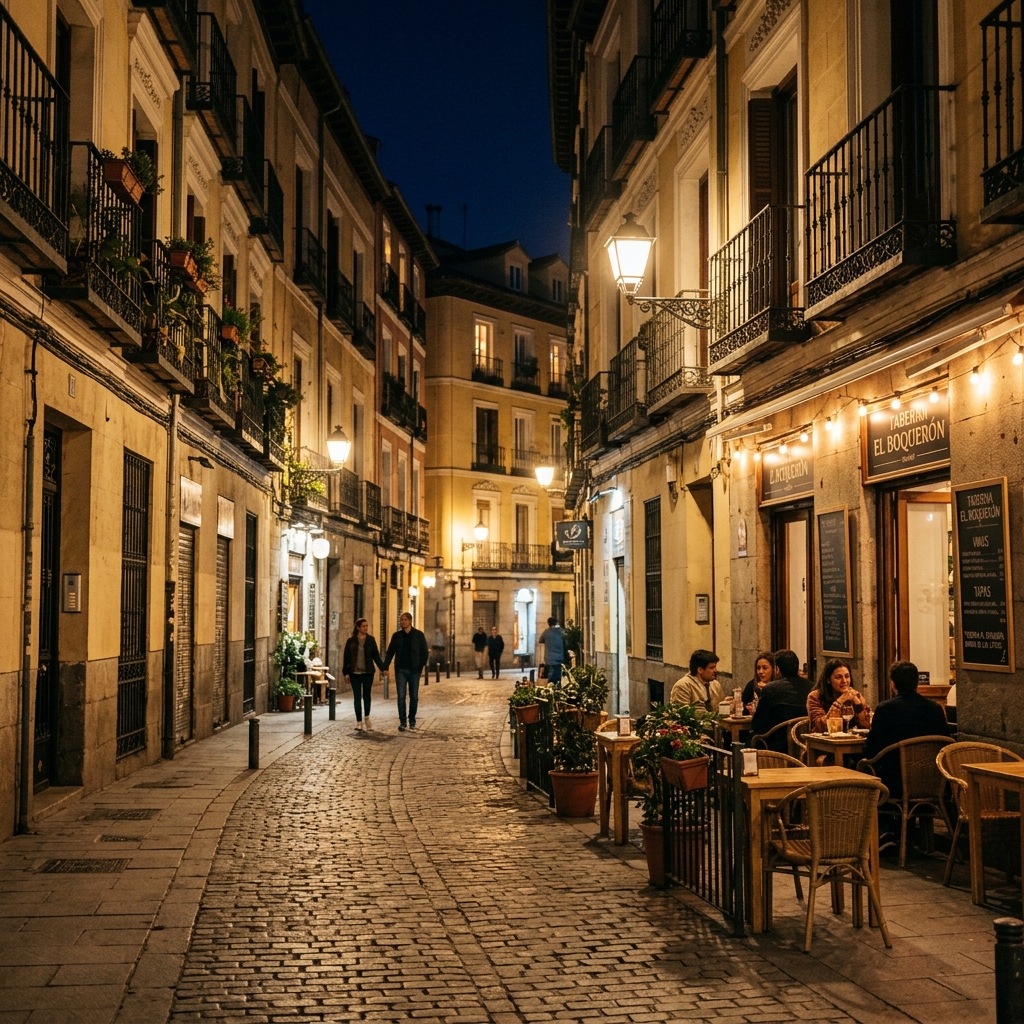
The first thing Madrid does is confuse your body clock. Lunch at half past two in the afternoon. Dinner at ten in the evening. The streets at their most animated between eleven at night and two in the morning. Most visitors, conditioned by the Northern European schedule of lunch at noon and dinner at seven, spend their first day in Madrid eating too early, arriving at restaurants before they’re ready, and sitting in streets that haven’t yet come alive. They conclude that Madrid is pleasant. The visitors who stay longer conclude that it’s extraordinary. The difference between those two conclusions is almost entirely a matter of schedule.
This is the key insight that slow travel unlocks in Madrid. The city isn’t withholding anything from the three-day visitor. It’s simply operating on a rhythm that takes several days to inhabit, and once inhabited, it makes every other city feel slightly rushed, slightly mechanical, slightly less committed to the proposition that the day’s most important moments should happen in the evening.
the philosophy behind slow travel and why depth beats coverage
TL;DR: Madrid is Spain’s capital and largest city, with 3.3 million residents inside the city limits (Instituto Nacional de Estadística, 2025) and a daily schedule that runs two to three hours later than the rest of Western Europe. A slow traveller who adjusts to Madrid time, late lunch, early-evening vermouth, 10pm dinner, finds a city that is social, affordable, and in possession of two of the world’s greatest art collections within walking distance of each other. Five nights is the minimum. Seven is better.
Why Does Madrid Reward Staying Longer?
Madrid is home to 3.3 million people within the city limits and 6.7 million across its metropolitan area (Instituto Nacional de Estadística, 2025), making it Spain’s largest city by a considerable margin. The scale matters. Madrid is large enough to be genuinely layered, 21 administrative districts, each with distinct character, price levels, and social life, and compact enough at its centre that most of those layers are walkable from each other.
The city is not, it’s worth establishing immediately, a city of monuments. Rome has the Forum and the Vatican. Venice has its canals. Lisbon has its hills and its views. Madrid has the street and the interior: the bar, the restaurant, the market, the gallery. Its great public spaces, the Retiro, the Plaza Mayor, the Paseo del Prado, are genuinely beautiful, but they’re not what the city is for. Madrid is for the things that happen inside and between them.
[IMAGE: A map illustration of central Madrid showing the Golden Triangle of Art, the Prado, Reina Sofía, and Thyssen-Bornemisza, with the Retiro park and key neighbourhoods marked, search terms: Madrid city centre illustrated map art museums]
The art concentration is singular. The Prado, the Reina Sofía, and the Thyssen-Bornemisza Museum form what is commonly called the Golden Triangle of Art, three world-class institutions within a one-kilometre triangle on the Paseo del Prado. No other city in Europe puts this volume of first-rate art in this small a space. London’s equivalents are scattered. Paris’s are large and exhausting. Madrid’s Golden Triangle can be walked between in fifteen minutes, which means you can go to one museum, leave when you’re ready, have lunch, and return to a different one in the same afternoon. This changes everything about how you use them.
What the neighbourhood structure means in practice: Madrid’s 21 districts each contain multiple barrios, smaller neighbourhood units that function as the city’s real social geography. The difference between Malasaña and the adjacent Chueca, both inside the same Chamberí/Centro axis, is entirely one of barrio character: different bars, different demographics, different evening rhythms. A slow traveller who picks one barrio and walks it thoroughly for two days will find more of Madrid than a visitor who covers five districts in a taxi.
Turismo de Madrid recorded 10.8 million overnight visitors to the city in 2024 (Turismo de Madrid, 2025). The vast majority concentrated in the Sol/Opera/Gran Vía corridor. The barrios that Madrid residents actually use, Malasaña, Lavapiés, Chueca, La Latina, absorbed a fraction of that number. This is the central practical advantage of slow travel in Madrid: the city that tourists visit and the city that exists are almost completely separate, and they share the same streets.
What Is Madrid Time and Why Does It Matter?
Understanding the Madrid schedule is not optional context, it’s the operational requirement for experiencing the city. Spain’s relationship to the clock is not cultural affectation. It has roots in geography, post-war policy, and the fact that Madrid sits in a time zone that is, technically, one hour ahead of where its longitude would naturally place it.
The day runs approximately as follows. Breakfast runs from 8am to 10am: a café con leche and a tostada con tomate (toasted bread rubbed with garlic, drizzled with olive oil, and spread with crushed tomato) at the neighbourhood bar. This is a daily institution and costs €2–€3 at any non-tourist establishment. The morning is quiet and useful, the best time for museums, for Retiro walks, for the kind of unhurried city movement that makes the afternoon feel earned.
Pre-lunch vermouth, vermut, runs from 1pm to 2pm, typically at a bar with croquetas or patatas bravas alongside. This is not a preamble to anything; it’s a social event in its own right. The custom of drinking vermouth before lunch has experienced a significant revival in Madrid over the past decade, with specialist bares de vermut in Malasaña and La Latina doing serious business by 1:30pm on any weekend.
Lunch proper arrives at 2:30pm to 4pm. This is the main meal of the day, not dinner. The menú del día, two courses plus drink and dessert for €12–€15, is the mechanism. After lunch comes the pause: not necessarily sleep, but the city’s natural response to afternoon heat in summer and the weight of a substantial lunch year-round. Museums empty slightly. Streets quiet. Between 6pm and 8pm, the city wakes back up.
The tapeo, moving between bars and eating small dishes, begins at 8pm. Dinner, properly, starts at 9:30pm and runs to 11pm. Bars that stay open until 2am are the norm; establishments with later licences run until 3 or 4am. The streets of Malasaña and Chueca at midnight on a Thursday are not late-night stragglers; they’re the middle of an evening.
On the practical adjustment: The first two days in Madrid feel disorienting for anyone arriving from Northern Europe or the US. The correct response is not to fight the schedule, eating at 7pm, wandering empty streets at 9pm, but to commit to it completely. Eat lunch at 3pm. Rest from 5pm to 7pm. Go out at 9pm. By day three, the rhythm feels not just natural but clearly superior to the alternative. This is how slow travel works: the city teaches you how to live in it, but only if you stop trying to live in it on your own terms.
Citation Capsule: Spain’s mealtimes operate approximately two hours later than the Western European average. Madrid’s restaurants typically serve lunch from 2pm to 4pm and dinner from 9pm to 11pm (Turismo de Madrid, 2025). This schedule reflects both historical convention and Spain’s geographical position in the Central European Time zone, which places the country roughly one hour ahead of its natural solar time. Adapting to it is the single most consequential decision a slow traveller makes in the city.
Which Neighbourhood Should You Stay In?
The choice of neighbourhood in Madrid determines almost everything about the quality of daily life you’ll experience. The Sol/Gran Vía corridor, the tourist centre, is well-connected and convenient and entirely without neighbourhood character. It’s the Madrid that exists for visitors. The following are the options for everyone else.
[IMAGE: A street scene in Malasaña, Madrid, narrow road with independent shops, a bookshop, people at café tables on a quiet morning, search terms: Malasaña Madrid neighbourhood street independent shops]
Malasaña
Malasaña is the slow traveller’s default in Madrid. It was working-class through most of the 20th century, became the centre of the Movida Madrileña, the cultural explosion that followed Franco’s death in 1975, and has spent the past two decades gentrifying slowly enough to keep most of its character. The result is excellent coffee, independent bookshops, neighbourhood bars that open at 9am and close at 2am, and a local-to-tourist ratio that strongly favours locals.
The grid of streets around Plaza del Dos de Mayo contains the best concentration of neighbourhood bars in central Madrid. Prices are reasonable, a beer costs €2.50–€3, a glass of house wine the same. The bakeries are genuinely good. The weekend flea market at El Rastro is within walking distance. For a stay of five nights or more, Malasaña gives you a functioning neighbourhood life without any effort to find one.
Chueca
Chueca is Malasaña’s neighbour to the east, Madrid’s established LGBTQ+ neighbourhood, with excellent restaurants, a strong weekend market scene, and a slightly more polished version of the same neighbourhood warmth. It’s marginally more expensive and marginally more tourist-facing, but the quality of the food scene (particularly the restaurants around Calle de las Infantas and the surrounding streets) is genuinely high. A stronger choice for someone prioritising eating over the bar-and-coffee circuit.
Lavapiés
Lavapiés is the cheapest neighbourhood in central Madrid and arguably its most interesting. The historical working-class barrio has become, over the past two decades, one of the most genuinely multicultural urban areas in Spain, Bangladeshi, Moroccan, Senegalese, and Chinese communities alongside the traditional Spanish residents, with a food scene that reflects this range. The Reina Sofía is on its northern edge. The neighbourhood’s Centro Cultural Conde Duque and La Casa Encendida are the city’s most interesting mid-sized cultural spaces.
It’s less finished than Malasaña, fewer artisanal coffee shops, more functional bars, but the density of genuinely local life is higher. If you want the least tourist-facing version of Madrid, Lavapiés is the answer.
Salamanca
Salamanca is affluent, tree-lined, and residential in a way that doesn’t come fully alive in the evenings. The Thyssen-Bornemisza is here. The upmarket tapas bars are here. It’s the correct neighbourhood for a day of excellent food and the Thyssen’s collection, and a less convincing choice as a base for anything longer than two nights. The streets are beautiful and quiet; quiet is not, in Madrid, always a virtue.
What Is the Food Argument for Staying Longer?
The menú del día is Spain’s greatest democratic institution. Every neighbourhood restaurant, not tourist-facing establishments, but the places with handwritten chalkboards and a mixed clientele of office workers and retired couples, serves two courses, bread, a drink, and dessert for €12–€15 (Turismo de Madrid, 2025). The menu changes daily because it reflects what the kitchen bought that morning. This is not budget eating. It’s often the best food you’ll find in Madrid at any price.
The vermouth ritual deserves separate consideration. Vermut in Madrid is served at a specific temperature (cold but not ice-cold), in a specific glass (wide-mouthed, with a large ice cube and a slice of orange), with a specific accompaniment (an olive, sometimes a small plate of olives with anchovy). The culture around it, standing at a bar at 1:30pm on a Saturday with a glass of Martini Rosso and a plate of croquetas, is one of the most pleasurable social rituals in Europe and one that a three-day visitor almost entirely misses because it requires inhabiting a specific part of the day that most short-stay travellers fill with sightseeing.
tapas culture and how to eat well on a slow travel budget in Spain
The distinction between tapas and raciones matters. In the bars of La Latina and Lavapiés, a tapa is a small portion, sometimes free with a drink, always inexpensive, of a single preparation: a croqueta, a slice of tortilla, a few olives. A ración is a full-sized shared dish: half a tortilla española, a plate of jamón ibérico, a bowl of patatas bravas. An evening of moving between bars and ordering raciones to share is how Madrid eats socially, and it’s a fundamentally different experience from sitting at a restaurant table and ordering a formal dinner.
Two markets are worth knowing and worth distinguishing. The Mercado de San Miguel, a covered iron-and-glass market adjacent to the Plaza Mayor, is beautiful and expensive, designed primarily for visitors, with stalls selling premium jamón and oysters and craft gin at tourist prices. The Mercado de Antón Martín, five minutes’ walk from the Reina Sofía, is the opposite: a genuine neighbourhood market supplying the residents of Lavapiés with fish, produce, meat, and cheese. It’s unglamorous and entirely worth an hour on a weekday morning.
The bocadillo de calamares, a roll filled with fried squid rings, served with lemon and sometimes a smear of alioli, is Madrid’s signature street food. It is eaten at a zinc bar with a cold beer, mid-morning or mid-afternoon, at establishments around the Plaza Mayor that have been serving exactly this for decades. It costs €3–€4 and is one of the more honest pleasures available in the city.
On the relationship between price and quality in Madrid: In most European capitals, a lower price correlates with a worse meal. Madrid reverses this logic in one specific way: the menú del día at a neighbourhood restaurant is almost always better than the à la carte menu at a tourist-facing restaurant of the same price. The economics are different, the neighbourhood restaurant is feeding regulars who will notice if quality drops; the tourist restaurant is feeding people who will never return. A slow traveller who eats the menú del día for lunch every day for a week will eat better in Madrid than someone spending twice as much at places recommended by hotel concierges.
What Should You Do Properly in Madrid?
The Prado: How to Actually See It
The Prado holds a permanent collection of approximately 8,000 works, of which around 1,300 are on display at any given time (Museo Nacional del Prado, 2026). This is not a museum you can see. It’s a museum you can visit repeatedly and understand incrementally. The mistake that most visitors make is attempting comprehensiveness, moving through room after room until the Velázquez rooms blur into the Rubens rooms and nothing is retained.
The correct approach is a focused visit of two to three hours with three objectives. First: the Velázquez rooms, specifically Las Meninas (Room 12). Allow twenty minutes in front of it, not five, not ten, but twenty, and watch what the painting does to your understanding of what painting can do. Second: Goya’s Black Paintings, transferred from the walls of his house and hung in a dedicated section; they are among the strangest and most unsettling works in the European canon. Third: El Greco before the tour groups find him. Arrive at 10am on a Tuesday. Leave by 1pm.
Entry costs €15, free for visitors under 18 and over 65 (Museo Nacional del Prado, 2026). Free admission runs Monday to Saturday from 6pm to 8pm and Sunday from 5pm to 7pm, but these slots are crowded. The 10am Tuesday opening is the best option for anyone wanting space to think.
The Reina Sofía: Guernica and What Surrounds It
Guernica is larger than you expect. Picasso painted it in 1937 in response to the bombing of the Basque town by Nazi German and Fascist Italian warplanes during the Spanish Civil War, and the painting, 3.49 metres tall and 7.76 metres wide, fills Room 206 of the Reina Sofía’s permanent collection (Museo Reina Sofía, 2026) in a way that reproductions completely fail to convey.
The painting is surrounded by Picasso’s preparatory studies for it, dozens of drawings that track the composition’s evolution and illuminate the final work in ways that hours of reading about it cannot. Most visitors spend ten minutes in front of Guernica and leave. The slow traveller spends an hour in the room, cycling between the painting and the studies. The permanent collection that surrounds it, 20th-century Spanish art, chronologically organised across three floors, is consistently undervisited relative to the one painting that draws everyone here. The work by Juan Gris, Dalí, and Miró in the surrounding rooms is genuinely excellent and consistently uncrowded.
Retiro Park Before 9am
The Parque del Buen Retiro covers 125 hectares in the centre of Madrid, a deliberate intervention of green inside the dense city grid. Most visitors encounter it mid-morning, when the paths are full and the rowing boats on the artificial lake are doing good business. The park before 9am on a weekday is a different place entirely.
The Palacio de Cristal, a Victorian iron-and-glass exhibition pavilion built in 1887 for a colonial exhibition, now used for large-scale contemporary art installations, is one of the most beautiful structures in Madrid. It sits beside a small lake in the quieter southern section of the park, and in the early morning, in good light, it is the kind of thing that makes you understand why people retire to cities rather than away from them. Entry is free; exhibitions rotate throughout the year (Museo Reina Sofía, 2026).
The Sunday Rastro
El Rastro is Europe’s largest open-air flea market, held every Sunday from 9am to 3pm in the La Latina district. It sprawls down the Calle de la Ribera de Curtidores and its surrounding streets in a cascade of stalls selling tools, clothing, records, ceramics, antiques, and an enormous quantity of objects whose category is difficult to specify. It is not primarily a place to buy things. It is a place to see Madrid’s social life operating in its most relaxed and comprehensive form.
The bars on Calle de la Cava Baja, five minutes’ walk from the market, are the correct conclusion to a Rastro morning: a glass of vermouth, a plate of something fried, the sounds of several conversations at once. The neighbourhood returns to a version of itself that the weekday doesn’t quite show. Allow three hours for the market and the bar afterwards. Go before 10am if crowds bother you; go at 11am if the social density is the point.
How Do You Get to Madrid by Train?
Madrid sits at the centre of Spain’s high-speed rail network, the Red de Alta Velocidad, which covers 3,981 kilometres of track (Adif, 2026), and the arrival at Puerta de Atocha station is one of Europe’s better train arrivals. The station’s Victorian iron-and-glass concourse has been converted into an indoor botanical garden; stepping off a train and into a tropical atrium is a reasonable introduction to a city that takes pleasure seriously.
From Barcelona, the AVE covers the 621 kilometres to Madrid in 2 hours 30 minutes. Ouigo España operates the route from €15; Renfe’s AVE from €25, both significantly cheaper than the equivalent flight once airport transfer time is factored in (Renfe, 2026). This is one of the great city-to-city high-speed journeys in Europe, and it’s become so reliable and affordable that the Barcelona–Madrid air corridor, once one of the busiest in Europe, has lost substantial traffic to the train.
the complete guide to travelling Spain by high-speed train
booking the Barcelona to Madrid AVE, fares, classes, and what to expect
From Seville, the AVE takes 2 hours 30 minutes, this was the original Spanish high-speed line, opened in 1992 for the Seville World Expo, and it remains one of the most reliable in the network. From Valencia, the journey takes 1 hour 40 minutes, making it one of the fastest short-haul city pairs in Europe. From Lisbon, there is currently no reliable rail connection; the bus via Badajoz or a direct flight are the practical options.
Getting from Atocha to the centre takes ten minutes on Metro Line 1 (direction Valdecarros, exit at Sol or Retiro) or twenty minutes on foot to Lavapiés. The walk is worth doing once: it takes you along the Paseo del Prado, past the botanical garden, through the eastern edge of La Latina. It’s a better arrival than the Metro.
Citation Capsule: Spain’s high-speed rail network (the Red de Alta Velocidad) covered 3,981 kilometres as of 2026 (Adif, 2026), the longest high-speed network in Europe ahead of France. The Barcelona–Madrid AVE route, 621 kilometres in 2 hours 30 minutes, operates up to 17 daily return services and carries over 4 million passengers annually. The cheapest Ouigo España fares start at €15 one-way, making this route one of the most competitive rail corridors on the continent by price-per-kilometre.
What Does the Slow Traveller’s Week in Madrid Look Like?
This is not an itinerary. An itinerary imposes a structure that Madrid actively resists. What follows is a rhythm, the architecture of a week that stops trying to see everything and starts trying to understand something.
Mornings belong to movement and one focused thing. Coffee and tostada at your neighbourhood bar at 9am, not a café, not a hotel dining room, but the bar on your corner that has had the same owner for fifteen years. A walk through the Retiro before the park fills. One museum visit, starting at 10am and ending by 1pm: the Prado on Tuesday, the Reina Sofía on Thursday, the Thyssen on Wednesday for a different kind of pleasure (the Thyssen’s permanent collection runs from the 13th century to the late 20th, and the Impressionist rooms on the first floor are extraordinary).
Afternoons belong to lunch, rest, and wandering without purpose. The menú del día at 3pm, at a restaurant you found by walking rather than searching. A rest from 5pm to 6:30pm, this is not laziness; it’s the city’s operating instruction. Emergence at 7pm into the evening light, which in Madrid in spring and summer lasts until 9:30pm and is, in that hour before dinner, one of the most generous lights in Europe.
Evenings belong to the social contract. Vermouth or wine somewhere at 8pm. Dinner at 10pm, either a raciones circuit between three or four bars, or a seated meal at a restaurant that doesn’t take bookings before 9:30pm. Back to the neighbourhood by midnight, which is not late in Madrid. Late is 2am. Very late is 4am. The city makes both available without judgment.
The week, built on this rhythm, produces something that a tourist itinerary cannot: the sensation of having lived briefly inside a city rather than moved through it. By day four, you have preferences. A corner where you like to drink coffee. A bar where the croquetas are better than anywhere you’ve tried. A stretch of park that looks different at 8am than at noon. These are not tourist memories. They’re the texture of a place, accumulated slowly.
Related Reading
- Madrid to Seville by Train: Spain’s AVE in Under 2.5 Hours, The AVE from Madrid to Seville takes 2h 30min and costs from €25 advance.
- Amsterdam for Slow Travellers: How to Actually Arrive in the City, Amsterdam rewards people who stay long enough to stop sightseeing.
- Budapest for Slow Travellers: Two Cities, One River, and More Time Than You Planned, Budapest is two cities divided by the Danube and unified by thermal baths, ruin bars, and a food scene that has…
Frequently Asked Questions
How Long Should You Spend in Madrid for Slow Travel?
Five nights is the minimum at which Madrid’s rhythm becomes genuinely available. Research on travel wellbeing suggests that psychological detachment from home routine, the state in which you stop running your daily life in your head and start perceiving your surroundings directly, takes three to four days to establish (Journal of Leisure Research, 2023). A three-night visit gives you one day of genuine presence. Five nights gives you two or three. Seven to ten nights lets the city open up fully: the morning Retiro walks become habitual, you’ve found a neighbourhood bar you return to, and the Prado is available for a second visit that uses different rooms. A week also makes room for a day trip to Toledo by fast train, 33 minutes from Atocha, one of the great short excursions in Spain.
Which Neighbourhood Should I Stay in for Slow Travel in Madrid?
Malasaña and Chueca offer the best balance of neighbourhood character and access to the city for most slow travellers. Both sit within walking distance of the Golden Triangle museums, both have dense concentrations of neighbourhood bars and restaurants, and both have local-to-tourist ratios that still strongly favour residents. Lavapiés is the correct choice for anyone who wants the least tourist-facing version of the city, cheaper, more multicultural, closer to the Reina Sofía, and genuinely interesting in ways that Malasaña’s gentrification has gently erased. Salamanca is worth visiting for the Thyssen and upmarket tapas; it’s less convincing as a base unless you prefer quiet evenings and don’t mind paying more for them.
how to choose a neighbourhood for a slow travel stay in any city
Is Madrid Expensive for Slow Travel?
Madrid is one of Western Europe’s more affordable capitals, particularly relative to its quality of life. The menú del día at a neighbourhood restaurant runs €12–€15 (Turismo de Madrid, 2025). A glass of house wine or vermouth costs €2.50–€4. Prado entry is €15; the Reina Sofía is €12. A one-month apartment rental in Malasaña runs €1,200–€1,800, cheaper than Paris, Barcelona, or Lisbon at equivalent quality. The expensive Madrid, the tourist-facing restaurants around the Puerta del Sol, the rooftop bars on the Gran Vía, bears no resemblance to the city’s actual price structure. Avoid it and you’ll find that a week in Madrid costs less than a week in almost any comparable European capital.
What Does Madrid Do That Other European Capitals Don’t?
Madrid concentrates pleasures that other capitals scatter. Two world-class art museums, the Prado and the Reina Sofía, are within fifteen minutes’ walk of each other, both achievable in a single morning without rushing. The tapas and vermouth culture is so embedded in daily life that eating and drinking function as continuous social activity rather than scheduled events. The football, Real Madrid and Atlético Madrid both play in the city, the Liga season runs September through May, is available to watch at a bar on almost any weekend evening at a level of quality found nowhere else in Europe. And the schedule, once surrendered to, produces a quality of evening that most cities can’t replicate: the streets at their best precisely when most visitors have gone to bed.
How Do I Get to Madrid by Train?
From Barcelona: Ouigo España from €15 or Renfe AVE from €25, 2 hours 30 minutes, up to 17 daily return services (Renfe, 2026). This is one of the best-value city-to-city train journeys in Europe. From Seville: AVE, 2 hours 30 minutes, the original Spanish high-speed line, dating to 1992. From Valencia: AVE, 1 hour 40 minutes. From Paris: no direct service exists; the practical route is TGV to Barcelona (6 hours 20 minutes from Paris Gare de Lyon) then AVE to Madrid, a full day’s travel that is nonetheless more interesting than flying. From Lisbon: no reliable rail connection currently operates; the bus via Badajoz takes around 8 hours.
The Argument, Simply
Madrid has a reputation problem among slow travellers. It’s frequently omitted from the slow travel circuit in favour of Lisbon, Seville, or San Sebastián, cities with more obvious scenic qualities, more immediately legible neighbourhood structures. The case for those cities is real. But they don’t have the Prado. They don’t have the Reina Sofía. They don’t have a food culture quite this deeply embedded in daily life, operating at a price point this accessible, available to anyone willing to eat at 3pm and drink vermouth at 1pm.
Madrid rewards the traveller who arrives without a checklist. The city has almost no monuments that demand to be seen and photographed and departed. What it has is texture: the quality of the morning light on the streets of Malasaña, the particular warmth of a bar that has been in the same family for thirty years, the sensation of sitting in a restaurant at 10:30pm while the room is filling rather than emptying. These things don’t show up on a three-day itinerary. They accumulate, slowly, over five nights and seven and ten.
The city operates on a schedule that the rest of Europe finds eccentric and that, once you live inside it, feels simply correct. Late lunch. Long afternoon. Late dinner. Streets alive until 2am. It’s a schedule organised around the proposition that the best part of the day hasn’t happened yet, that the evening is where the city puts its best offer. That offer is available. You simply have to stay long enough to collect it.
what slow travel means and why it changes how you experience a city
Spain by high-speed train, getting between Madrid, Barcelona, Seville, and Valencia
slow travel for seniors, how to structure a longer trip without over-scheduling
All transport times, fares, and museum entry prices reflect February 2026 conditions. Verify current prices before travelling, fares, entry fees, and opening hours change seasonally.