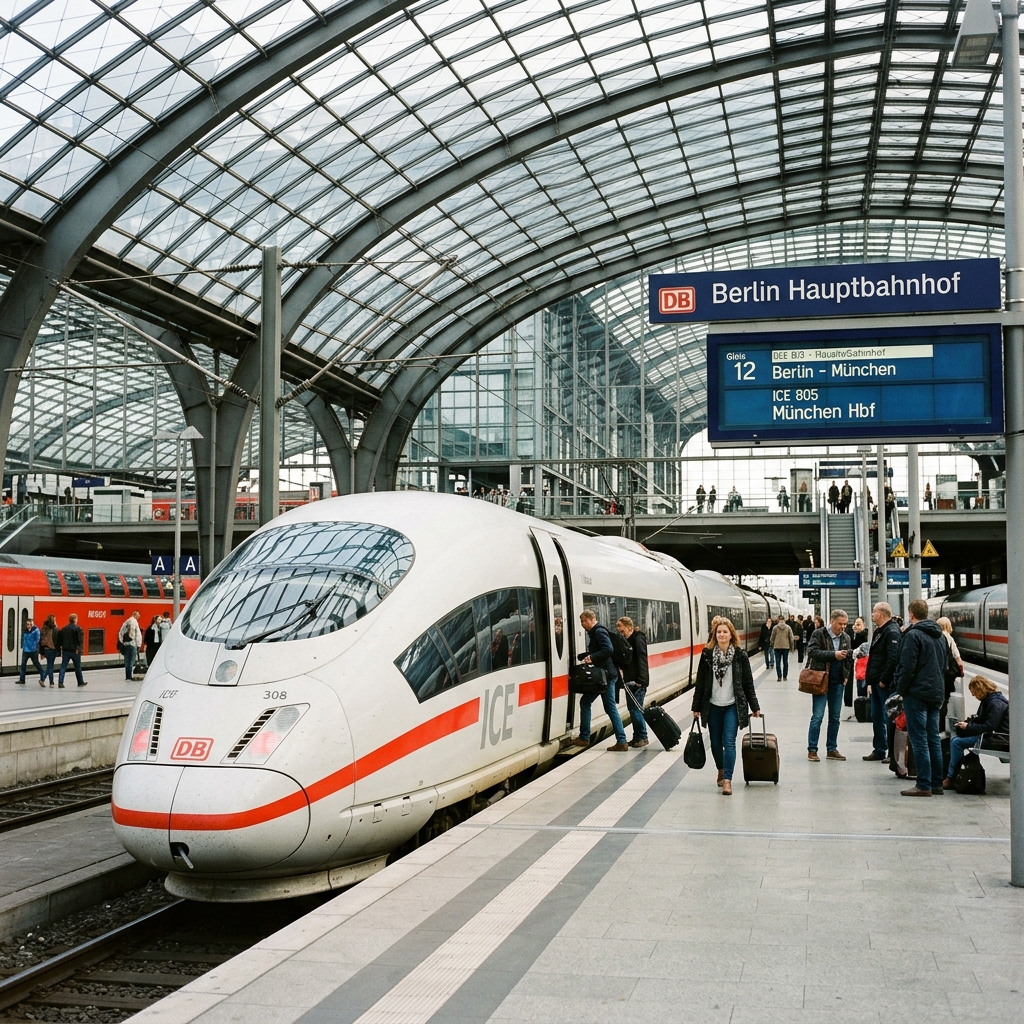
Germany is one of the easiest countries in Europe to reach by train, and one of the most interesting to cross slowly. It has the continent’s second-largest rail network, a recognisable high-speed fleet that operates on most major corridors, and a low-cost monthly subscription that lets you wander the country’s smaller cities and river valleys on regional lines for the price of a couple of long-distance tickets. None of that is in dispute.
What is also true, and what any honest account of German rail travel must say upfront, is that Deutsche Bahn has a punctuality problem. The delay figures are published annually. They are not impressive. And yet millions of people travel Germany by train every year, arrive at their destinations, see the country, and find the whole experience considerably better than they expected. The trick is knowing what you’re working with.
what is slow travel and why it matters for your next trip
TL;DR: Germany’s 33,000 km rail network connects every major city via ICE high-speed trains (Berlin to Munich in 4 hours) and a dense regional network. The Deutschland-Ticket at €58/month covers all regional trains, S-Bahn, and local transport across the country, but not ICE services. Book ICE tickets early via DB.de for Sparpreis fares from €17.90. Only 63.5% of long-distance trains ran on time in 2023 (DB Infrastruktur, 2024), build connection buffers into your itinerary.
[IMAGE: Aerial view of Frankfurt Hauptbahnhof’s glass and steel terminal building with trains on multiple platforms, search: “Frankfurt Hauptbahnhof aerial trains platforms”]
The Deutsche Bahn Network: What You’re Working With
Germany’s rail network covers 33,000 kilometres of track across 5,700 stations (Deutsche Bahn AG, 2024), making it the second-largest national rail network in Europe after Russia. That figure translates into something genuinely useful: almost every town of any significance is on the rail map. You rarely need to rent a car to reach a destination worth visiting.
The network runs on three tiers. At the top sits the ICE, Inter-City Express, Germany’s high-speed flagship, connecting major cities at up to 300 km/h on dedicated Schnellfahrstrecken (high-speed lines). Below that, InterCity (IC) and EuroCity (EC) trains serve longer intercity corridors at 200 km/h and cross international borders into Austria, Switzerland, and the Netherlands. At the base, RegionalExpress (RE) and RegionalBahn (RB) trains form the dense capillary network that connects smaller cities, market towns, and the kind of places that don’t appear in most travel guides.
The scale of investment being directed at this network tells you something about its current state. The German federal government committed €200 billion to rail infrastructure between 2024 and 2027 (Bundesministerium für Digitales und Verkehr, 2024), specifically to address the chronic track bottlenecks causing most delays. Travelling Germany by train in 2026 means travelling through a network in active, visible renovation, including some temporary disruption on key corridors during Streckensperrungen (track closures).
The infrastructure investment backstory matters to travellers because it explains why delays cluster on specific corridors rather than appearing randomly across the network. The Frankfurt–Mannheim and Hamburg–Berlin axes carry the heaviest traffic loads and have the oldest infrastructure. Routes built or upgraded since 2000, Cologne–Frankfurt, Munich–Ingolstadt–Nuremberg, run with far greater reliability.
What Are the Key ICE Routes and Journey Times?
Germany’s ICE network connects its major cities quickly enough to make the train a genuine alternative to flying on most domestic routes. The fastest corridor in the country, Cologne to Frankfurt, takes under an hour. That’s a journey where the airport alternative, door to door, doesn’t come close.
[CHART: Bar chart, ICE route journey times in minutes, source: Deutsche Bahn timetable 2026]
Here are the main intercity rail connections and their current scheduled journey times:
| Route | Train | Journey Time | Frequency |
|---|---|---|---|
| Hamburg → Berlin | ICE | 1h 47min | Every 30min |
| Berlin → Munich | ICE | 4h 00min | Hourly |
| Frankfurt → Cologne | ICE | 58min | Every 30min |
| Frankfurt → Munich | ICE | 3h 10min | Hourly |
| Frankfurt → Stuttgart | ICE | 1h 12min | Every 30min |
| Munich → Hamburg | ICE | 5h 40min | Every 2h |
| Berlin → Hamburg | ICE | 1h 47min | Every 30min |
| Cologne → Düsseldorf | ICE/IC | 25min | Multiple/hour |
| Cologne → Amsterdam | ICE International | 2h 32min | Hourly |
| Frankfurt → Paris | ICE/TGV | 3h 20min | Several daily |
A note on those times: they reflect scheduled departures. Given DB’s current punctuality figures, a 4-hour journey may take 4h 30min. Plan accordingly, especially when catching onward connections.
the complete guide to travelling Europe by train
The Deutschland-Ticket: The Slow Traveller’s Secret
The Deutschland-Ticket is arguably the most radical public transport policy introduced in Europe in the last decade. For €58 per month (the 2026 subscription price, up from the original €49 launch price), it gives unlimited access to all regional trains, S-Bahn services, U-Bahn, trams, and local buses across the entire country. Every operator. Every region. One ticket.
What it does not cover is equally important: no ICE, no IC, no EC long-distance trains. The Deutschland-Ticket is a pass for the slow layer of the network.
That distinction creates an interesting travel choice. If you’re trying to cover Germany in five days, the Deutschland-Ticket won’t serve your purpose, you’ll be on ICE trains and booking point-to-point. But if you have two weeks and want to move through the country in the way the country actually works, stopping in Weimar, spending a day in Erfurt, drifting through smaller cities most tourists skip entirely, the ticket transforms what’s possible.
Consider a route that works beautifully on the Deutschland-Ticket: Berlin to Dresden by RE takes about 2 hours. Dresden to Leipzig takes 1h 15min. Leipzig to Weimar takes about 1h. Weimar to Erfurt takes 15 minutes. You’ve crossed Thuringia, one of the most historically dense corridors in Germany, without spending a euro on transport beyond your monthly subscription. This is slow travel with infrastructure behind it.
In our experience, the Deutschland-Ticket rewards travellers who front-load their itinerary research. Regional connections between smaller cities aren’t always obvious from the main DB website, the DB Navigator app handles them better, showing RE and RB departures that the web interface sometimes buries.
You subscribe through the DB Navigator app or DB.de. It’s a monthly rolling subscription with no long-term commitment, cancel anytime before the end of the current month. Non-German residents can subscribe using an international payment card.
[IMAGE: Regional train travelling through autumn forest in Thuringia, Germany, search: “regional train Thuringia Germany autumn forest”]
How to Book, and When
Germany’s ticket structure rewards advance planning more than almost any other European rail system. The Sparpreis (saver fare) is DB’s cheapest ticket category: a fixed price for a specific train, non-refundable, non-changeable. Sparpreis fares start at €17.90 for most ICE routes when booked well in advance (Deutsche Bahn, 2026). The booking window opens 180 days before departure.
The Flexpreis sits at the other end of the flexibility spectrum. It’s fully refundable and changeable until the journey begins. You pay a premium for that flexibility, typically two to three times the cheapest Sparpreis equivalent. For business travellers, the Flexpreis makes obvious sense. For a planned holiday, Sparpreis is usually the right call.
BahnCard: Worth Buying for Regular Travellers
The BahnCard is a discount card for anyone travelling DB with any frequency. The BahnCard 25 gives 25% off all tickets and costs €57.90/year (second class). The BahnCard 50 gives 50% off Flexpreis fares and costs €244/year. For a two-week trip involving multiple ICE journeys, the BahnCard 25 typically pays for itself. Do the maths before you buy, but if your total ticket spend will exceed roughly €230, it’s likely worth the outlay.
Trainline vs Booking Direct
Always book domestic German journeys through DB.de or the DB Navigator app. Trainline charges a booking fee and sometimes shows higher base fares on German routes. For multi-country international journeys originating outside Germany, Trainline or Rail Europe can be more convenient, but for anything within Germany, the direct channel is cheaper and gives you the full range of fare classes.
Eurail pass guide, when a pass beats point-to-point tickets
Five Routes Worth Taking Slowly
Not every German train journey is about arriving quickly. These five routes reward a slower pace, whether by design on regional trains or because the field outside the window earns your attention.
Hamburg → Lübeck → Rostock (Baltic Coast)
The regional train from Hamburg to Lübeck takes 45 minutes and drops you into one of the best-preserved medieval port cities in northern Europe. From Lübeck, continue north on regional services to Rostock along the Baltic coast. The entire stretch is Deutschland-Ticket territory. Rostock’s harbour district and the nearby seaside town of Warnemünde are the kind of places you reach by staying on the slower network.
Munich → Salzburg (Into Austria)
An ICE runs Munich to Salzburg in about 1 hour 30 minutes. It’s a short journey with an unexpectedly dramatic arrival, the Alps announce themselves as you close in on the Austrian border, and pulling into Salzburg’s main station with the Festung Hohensalzburg visible above the roofline is one of the better train arrivals in Central Europe. A Eurail pass covers this crossing without reservation fees.
Munich to Vienna by train, the full route breakdown
Dresden → Prague (Elbe Valley Corridor)
The IC service from Dresden to Prague takes about 2 hours 15 minutes and follows the Elbe Valley for a substantial portion of the route. This is one of Europe’s genuinely scenic cross-border rail corridors, sandstone cliffs, river bends, small Saxon towns. The route passes through the Sächsische Schweiz (Saxon Switzerland) national park area. If you’re arriving from Berlin into Dresden, this is a natural next step before heading south into Central Europe.
Cologne → Koblenz → Mainz (Rhine Gorge)
Take the RE line south from Cologne along the western bank of the Rhine. This stretch between Koblenz and Bingen is a UNESCO World Heritage Site (UNESCO, 2002), 65 kilometres of river gorge lined with medieval castles, vineyard slopes, and the most-painted stretch of river in Germany. Regional trains stop at villages along the way. The entire route works on the Deutschland-Ticket. Don’t rush it.
[IMAGE: Rhine Gorge with medieval castle on vineyard hillside above the river, search: “Rhine Gorge castle vineyard Germany train”]
Munich → Berchtesgaden (Alpine Approach)
The regional train from Munich to Berchtesgaden takes about 2 hours 30 minutes via Freilassing, transferring to the local Berchtesgadener Land network. The final approach into the valley, surrounded by the Berchtesgaden Alps, is a slow travel argument in miniature: you arrive somewhere genuinely remote-feeling by ordinary public transport, on a regional ticket, without a rental car. The entire journey works on the Deutschland-Ticket.
Arriving From Neighbouring Countries
Germany sits at the centre of the European rail map and has direct high-speed connections to most of its neighbours. complete guide to European rail connections
From London: Eurostar to Brussels (2h), then ICE from Brussels to Cologne (1h 50min) or onward to Frankfurt (3h 15min). Total London to Frankfurt with connection: around 5h 30min. London to Amsterdam by train, Eurostar connections explained
From Paris: ICE/TGV direct to Frankfurt takes 3h 20min from Paris Gare de l’Est. There are also direct services to Stuttgart and via Strasbourg. This is one of the most frequent high-speed international corridors in Europe, with trains running several times daily.
From Amsterdam: ICE to Cologne takes 2h 32min. ICE to Berlin takes around 5h 40min via Cologne. The Amsterdam–Cologne corridor is efficient enough that it reframes the two cities as closer neighbours than most people realise.
From Copenhagen: The classic Copenhagen–Hamburg route currently involves a train and ferry connection across the Fehmarnbelt, taking around 4h 30min. The Fehmarnbelt fixed link tunnel, once complete, will reduce this significantly, but construction is ongoing with an estimated opening in the early 2030s (Femern A/S, 2024).
From Zurich: ICE direct to Frankfurt takes 3h 45min. This route passes through the Black Forest and Basel, and the Switzerland–Germany border crossing is smooth on board.
night trains across Europe, the complete sleeper guide
[IMAGE: DB Navigator app on smartphone showing real-time train delay information at a German station, search: “DB Navigator app train delay platform Germany”]
Delays: The Honest Picture
Let’s be direct about this, because vague reassurances help nobody. In 2023, only 63.5% of Deutsche Bahn long-distance trains arrived on time (DB Infrastruktur, 2024), defined as within six minutes of the scheduled arrival. That means roughly one in three long-distance journeys runs late. The regional network performs better but is not immune, particularly where it shares infrastructure with ICE lines.
The causes are structural rather than random. Germany’s rail network expanded rapidly after reunification but track investment didn’t keep pace with demand. Key bottlenecks, Frankfurt’s main station approaches, the Hamburg-Berlin axis, the Rhine corridor, handle far more trains than they were designed for. A single infrastructure fault can cascade delays across a region for hours.
How to Manage Connections Practically
Build a minimum of 20–30 minutes into any transfer on the ICE network. On routes known for delays (Hamburg–Berlin, Frankfurt–Cologne during peak periods), 30–45 minutes is more comfortable. If you’re connecting to a night train, a cross-border EC, or a flight, that buffer becomes more important, not less.
The DB Navigator app is the right tool for real-time management. It shows live delays, platform changes, and alternative routing options if a connection breaks. Turn on push notifications for your booked journeys. The app is more reliable for real-time information than the departure boards at smaller stations.
Your Passenger Rights If Things Go Wrong
EU Regulation 1371/2007 establishes minimum passenger rights on European rail. If your Deutsche Bahn train is delayed by 60 minutes or more at your final destination, you’re entitled to a 25% refund of the ticket price. A delay of 120 minutes or more entitles you to a 50% refund. DB processes these claims online at bahn.de/fahrgastrechte, the process is straightforward and the refunds are paid reliably.
One practical pattern worth knowing: DB delays are more common on weekdays during peak travel times than on weekend mornings. If your itinerary has flexibility, booking Friday afternoon trains in Germany is a consistent way to encounter longer delays, the network is running near capacity and has less buffer for recovery.
Related Reading
- How to Book European Train Tickets: The Complete Practical Guide, Booking European trains is not complicated, but it is not obvious either.
- How to Save Money on European Train Tickets: 11 Strategies That Actually Work, European train fares vary by 300–400% depending on when and how you book.
- Solo Train Travel in Europe: The Complete Guide for First-Timers and Regulars, Solo train travel is one of the best ways to see Europe, flexible, safe, sociable when you want it and solitary…
Frequently Asked Questions
How do I book Deutsche Bahn trains in Germany?
Book through DB.de (Deutsche Bahn’s website) or the DB Navigator app. The booking window opens 180 days in advance. The cheapest Sparpreis (saver) fares require a fixed train and are non-refundable; Flexpreis fares are fully changeable. For international connections, Trainline works but adds a booking fee, booking direct via DB is cheaper for all domestic German journeys.
What is the Deutschland-Ticket and is it worth buying?
The Deutschland-Ticket is a monthly subscription for €58/month (2026 price) giving unlimited travel on all regional trains, S-Bahn, U-Bahn, trams, and buses across Germany, but not on ICE, IC, or EC long-distance trains. It’s excellent value for city-hopping via regional trains if you have the time. For fast intercity travel you still need a point-to-point or Sparpreis ticket. Subscribe through the DB Navigator app; cancel any month with no penalty.
Are German trains reliable?
Deutsche Bahn’s punctuality has been a persistent problem. In 2023, only 63.5% of long-distance trains arrived on time (DB Infrastruktur, 2024). Track maintenance is ongoing and delays cluster on heavily used routes. Build a minimum 20–30 minute buffer into any connection. The €200 billion infrastructure investment plan (2024–2027) is targeted specifically at eliminating the main bottlenecks, but the full improvement won’t be felt for several years.
What is the fastest train route in Germany?
The Cologne–Frankfurt ICE route is Germany’s fastest corridor, reaching speeds up to 300 km/h on the dedicated Schnellfahrstrecke opened in 2002. The journey takes 58 minutes for a route that used to take over 2 hours. Other fast connections: Munich to Berlin in 4h, Frankfurt to Munich in 3h 10min, Hamburg to Munich in 5h 40min.
Can I use a Eurail pass on German trains?
Yes. A Eurail Global Pass or Germany-specific pass covers ICE, IC, and EC trains without domestic reservation fees, unlike France or Spain, where pass holders must pay mandatory seat reservations on TGV and AVE services. This makes Germany one of the most pass-friendly countries in Europe. You can board most ICE trains on a travel day without any additional booking. For international ICE services into the Netherlands or France, small reservation fees apply. Eurail pass, is it worth buying?
Citation Capsule
Germany’s rail network spans 33,000 kilometres across 5,700 stations, operated primarily by Deutsche Bahn (DB AG, 2024). Long-distance punctuality stood at 63.5% in 2023, meaning one in three ICE journeys ran more than six minutes late (DB Infrastruktur, 2024). A €200 billion infrastructure investment programme running from 2024 to 2027 aims to address the chronic track bottlenecks responsible for most delays (BMDV, 2024).
Germany by train rewards a particular kind of traveller: one who accepts the network as it is rather than as a timetable promises it will be, and who finds value in the slower layers, the RE through the Rhine Gorge, the regional train into the Bavarian Alps, as much as in the ICE crossing the country in four hours. The Deutschland-Ticket, at its current price, is one of the most underrated travel products in Europe. The delays are real, manageable, and improving.
The network is large enough that you could spend a month in Germany and still not exhaust it. That’s an unusual thing to be able to say about a single country’s rail system. Start with the fast connections to orient yourself. Then slow down.
how to plan a slow travel trip by rail the complete guide to European night trains, including Germany connections