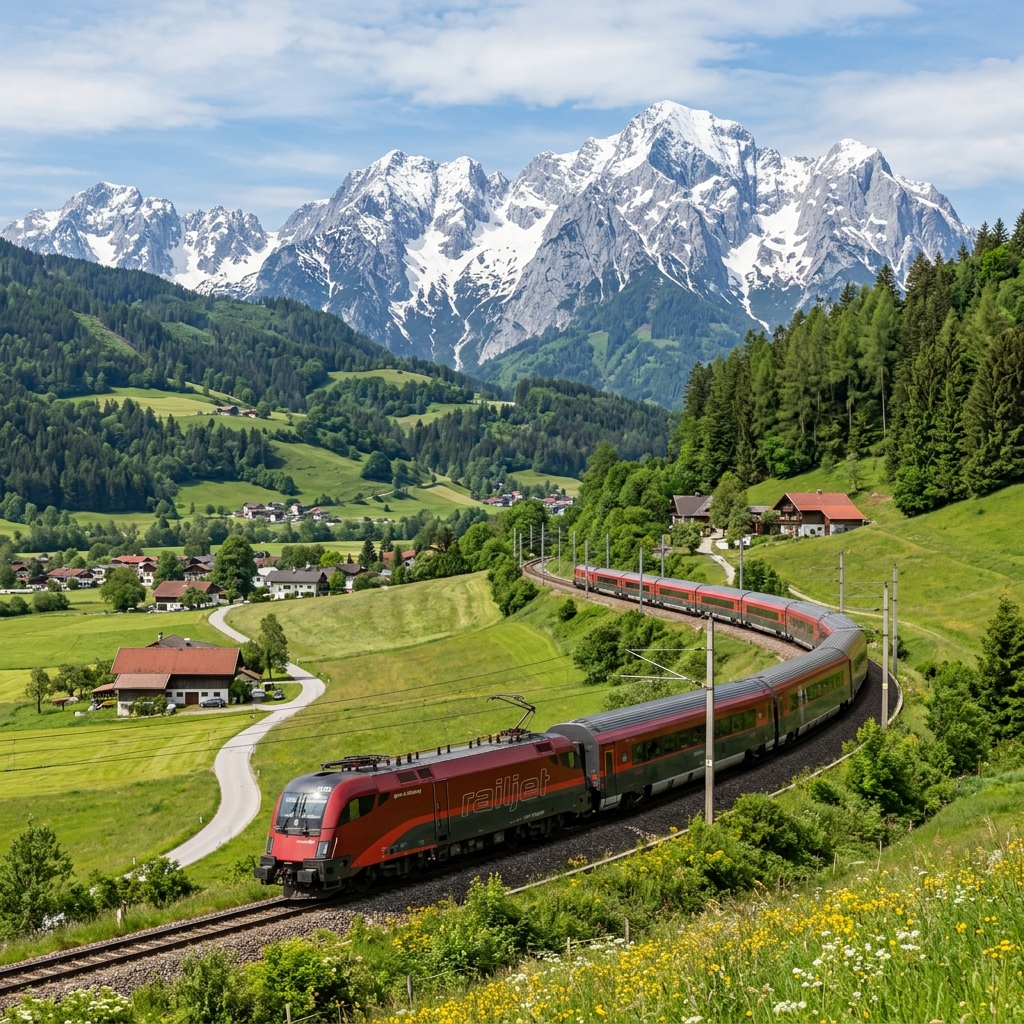
The train from Munich to Vienna takes 4 hours on a good day, and it’s one of the most satisfying rail journeys in Central Europe. The route crosses from Bavaria into Austria just east of Salzburg, threads through the Inn Valley with the Alps visible on either side, and delivers you to Wien Hauptbahnhof in the centre of the city. No airport queues. No taxi from some peripheral airfield. You arrive at a station that opened in 2015 and works beautifully, connected directly to the U-Bahn.
The service is the ÖBB/DB Railjet, a joint Austrian and German high-speed product that runs roughly every hour throughout the day. Advance fares start at around €19 in second class. That price point makes flying the clearly inferior option once you account for airport transfers at both ends. And unlike flying, the journey itself is worth something.
why train travel beats flying across Europe
TL;DR: The Munich to Vienna Railjet takes approximately 4 hours, with roughly hourly departures from Munich Hauptbahnhof throughout the day. Advance fares start from €19 in second class through ÖBB or Trainline. Salzburg is a free stop on most Munich–Vienna tickets, you can break the journey there and continue the same day on any later Railjet at no extra cost. Interrail and Eurail pass holders need a mandatory seat reservation of around €3–€5. (ÖBB, 2026)
How Long Does the Munich to Vienna Train Take?
The Railjet from Munich Hauptbahnhof to Wien Hauptbahnhof covers approximately 445 km in around 4 hours, according to ÖBB’s 2026 published timetables. Trains depart Munich roughly every hour, and the fastest services make only the principal stops, Salzburg, Linz, and St. Pölten, before arriving in Vienna. A four-hour journey between two of Central Europe’s greatest cities, with the Austrian Alps as part of the deal, is not a compromise. It’s a feature.
The route calls at Salzburg Hauptbahnhof approximately 1 hour 50 minutes from Munich, then continues to Linz Hauptbahnhof around 3 hours in, before the final run east to Vienna. Some services make additional stops, adding 10–20 minutes. Check the specific train you’re booking rather than assuming all departures are identical.
[IMAGE: A Railjet train in ÖBB red livery at a station platform in Austria on a clear day, search Unsplash: “ÖBB Railjet train Austria platform”]
How Much Does the Munich to Vienna Train Cost?
Advance tickets on the Munich–Vienna Railjet start from around €19 in second class when booked through ÖBB.at or a recognised booking platform, with flexible fares reaching €80 or more for walk-up travel on busy days (ÖBB, 2026). That bottom price point makes this one of the cheapest ways to travel between two major European capitals, and it’s available genuinely, not just in theory, if you book three to four weeks ahead.
Dynamic pricing applies throughout: Friday afternoons and Sunday evenings are the most expensive departure windows. Mid-week morning trains are generally the cheapest. Business class (first class in ÖBB terminology) is available from around €49 advance and provides noticeably more space, a welcome drink service, and access to the quieter upper deck on some Railjet sets.
| Ticket type | Typical advance price | Flexibility |
|---|---|---|
| Economy (Sparschiene) | From €19 | Non-refundable, fixed train |
| Standard second class | €35–€55 | Limited changes |
| First class advance | From €49 | Seat selection, quieter carriage |
| Flexible walk-up | €70–€90+ | Any Railjet, same day |
Booking platforms:
- ÖBB.at, official Austrian Railways site, widest allocation of cheap advance fares
- bahn.de, DB’s German booking site; useful if you’re starting from within Germany
- ****, single interface for multi-leg European itineraries, useful for combining this route with connecting trains
Can You Stop in Salzburg on the Way?
Yes, and it’s one of the better travel hacks on this route. Most Munich–Vienna Railjet tickets allow a stop in Salzburg at no extra cost: you board at Munich, disstart in Salzburg, spend a few hours in the city, and reboard any later Railjet to Vienna on the same day (ÖBB, 2026). No extra ticket required. The ticket covers the full Munich–Vienna journey, and the intermediate stop is yours to use.
This works because ÖBB tickets are generally valid for travel on any Railjet departing Salzburg to Vienna on the same booking day, not just the specific train you originally took from Munich. Confirm this when booking, the wording on some ticket types specifies a fixed train end-to-end. Look for “Sparschiene mit Zwischenstopp” or check flexibility terms before purchasing.
What can you actually do with 4–6 hours in Salzburg? More than most people expect. The Hohensalzburg Fortress is 25 minutes’ walk from the station and offers views of the city and surrounding Alps. Mozart’s Geburtshaus (birthplace) on Getreidegasse takes 45 minutes and needs no advance booking midweek. The Old Town is compact enough to cover on foot. And the Kaffeehaus culture here is as serious as Vienna’s, allow an hour for coffee and cake at Café Tomaselli, open since 1703. That’s a genuinely satisfying half-day.
What to Do in Salzburg with 4–6 Hours
Hohensalzburg Fortress sits on a rocky promontory above the Old Town and is one of the best-preserved medieval castles in Central Europe. Built from 1077, it’s a 25-minute walk from Salzburg Hauptbahnhof or a short funicular ride from the Festungsgasse. Allow 90 minutes inside and on the ramparts. Entry costs around €13–€16 depending on whether you include the interior rooms (Salzburg Tourism, 2026).
Mozart’s Birthplace at Getreidegasse 9, the “Geburtshaus”, houses the composer’s childhood instruments, portraits, and original correspondence over four compact floors. Skip the queue by arriving before 10am or after 3pm. Entry runs around €12 for adults (Mozarteum Foundation, 2026).
The Altstadt (Old Town) is a UNESCO World Heritage Site and small enough that an unhurried wander covers the key points, Mozartplatz, the Cathedral, the Residenz courtyard, in under two hours. The covered market arcade on Getreidegasse is worth ducking into. Avoid the souvenir chocolate balls unless you genuinely enjoy them.
Café Tomaselli, on Alter Markt, has been serving coffee since 1703 and is the oldest coffeehouse in Salzburg. An Einspänner (espresso with whipped cream) and a slice of Salzburger Nockerl is the correct order. Budget 45 minutes and resist any urge to hurry.
slow travel and the art of the long stop
What Is the Railjet Like on Board?
The Railjet is ÖBB’s flagship intercity product, and it shows. Second-class seats are wide by European rail standards, with fold-down tables, power sockets at every seat, and overhead luggage racks that actually accommodate a full-size rolling bag (ÖBB Railjet overview, 2026). The train is air-conditioned throughout and runs quietly at speed. Business travellers work the full journey without obvious difficulty.
We’ve found the Railjet’s bistro car to be one of the better on-train food options in Central Europe. It sells Austrian-style hot meals, Wiener Schnitzel, Käsespätzle, rather than just sandwiches and snacks. Prices are airport-adjacent (around €10–€16 for a main), but the quality is noticeably better than most train cafe cars. The coffee is proper espresso.
Classes and Comfort Breakdown
Second class (Economy) covers most travellers’ needs without compromise. Seats are arranged 2+2, with good legroom on the upper deck of double-deck sets. The quiet zone in coach 33 is worth booking if you’re working or travelling overnight on a connecting Nightjet.
First class (Business) adds wider seats in a 1+2 layout, a welcome drink, and a more formal service style. It’s the right choice for a business trip or if you want guaranteed solitude. On double-deck sets, first class occupies the upper deck, which also gives you marginally better views of the Alps around Salzburg.
Luggage policy is generous: two large bags plus a personal item per passenger. Bicycles require advance booking and a fee. No weight limit is explicitly enforced, though standard rail guidelines apply.
[IMAGE: Interior of an ÖBB Railjet second-class carriage with wide seats, power sockets, and a fold-down tray table, search Unsplash: “train interior Austria comfortable seats”]
What Is the Scenery Like Between Munich and Vienna?
The Munich–Vienna Railjet passes through some of the finest field in Central Europe, and the section around Salzburg is the highlight. The train leaves Munich through the flat Bavarian plain, and for the first hour the scenery is pleasant but unremarkable: farmland, small towns, the occasional church spire. Then, south of Rosenheim and into the Inn Valley, the Alps begin to declare themselves.
Around Salzburg, the mountains press close. On a clear day, the Untersberg massif is clearly visible to the south as you pull into Salzburg Hauptbahnhof. Continuing east, the train follows the Salzach River valley before turning northeast toward Linz. This corridor, the Inn and Salzach valleys, is the scenic centrepiece of the journey. Plan to be at the window between roughly the 1h 30m and 2h 30m marks.
East of Linz, the landscape opens into rolling Austrian farmland, the Danube basin approaching Vienna. It’s gentler, less dramatic, but has its own calm. St. Pölten, the last major stop before Vienna, is unremarkable from the window. Then the outer suburbs assemble, the train slows, and Wien Hauptbahnhof materialises as the journey ends exactly where it should.
The segment from Salzburg to Linz, roughly 130 km, traces a corridor that follows or parallels three river valleys in under 70 minutes. Most passengers are on their phones. Looking up costs nothing and misses less than you’d think.
Europe’s most scenic train routes, when the field is the point
What Is Wien Hauptbahnhof Like on Arrival?
Wien Hauptbahnhof, the main Vienna station, opened fully in 2015 after a decade of construction and is one of the finest new railway stations in Europe. Around 150,000 passengers pass through it daily, and it handles every major international route into the city, including ÖBB Nightjets from Hamburg, Rome, Amsterdam, and Paris (ÖBB, 2026). There is no ambiguity about which station you want, everything arrives here.
The station is compact and well-signed. A large shopping concourse occupies the ground level, with platforms above. Everything from luggage storage to ATMs, pharmacies, supermarkets, and a reasonable selection of cafes and restaurants is available within the station building. First-time arrivals typically find it far easier to handle than older European terminals.
Onward connections from Wien Hauptbahnhof:
- U-Bahn U1 (red line) departs from directly beneath the station and reaches Stephansplatz, the geographic and symbolic heart of Vienna, in 4 stops, approximately 10 minutes
- Tram lines serve the outer Ring and southern districts
- S-Bahn regional services connect to Vienna Airport (Schwechat) in around 25 minutes
- Night trains depart from here to most of Europe’s major cities, see our night trains in Europe guide for the full Nightjet network
arriving in Vienna and settling
What Is Worth Seeing in Munich Before You Leave?
Munich is rarely just a transit point, it deserves a day or two in its own right. The city is the capital of Bavaria and carries its own distinct identity quite separate from the rest of Germany: Catholic, beer-focused, architecturally confident, and positioned physically between the Alps and the North European plain in a way that shapes the character of everything here.
Marienplatz is the civic centre, a large square dominated by the neo-Gothic Neues Rathaus, whose Glockenspiel tower puts on a mechanical chimes display at 11am and noon daily. It’s unambiguously touristy, but the square itself is beautiful and the surrounding streets (the Kaufingerstrasse pedestrian zone, the Viktualienmarkt a short walk south) are genuinely worth exploring. The Viktualienmarkt is Munich’s daily food market, open Monday–Saturday, and excellent for a late breakfast of pretzels, smoked fish, and Weisswurst before a morning train.
The English Garden (Englischer Garten) is larger than Central Park in New York and sits in the northeast of the city, a 20-minute walk or short U-Bahn ride from Marienplatz. It has a beer garden (Chinesischer Turm, open year-round), a river-fed artificial surf wave at the Eisbach where surfers ride a standing wave under a bridge, and enough footpaths to lose an afternoon without any plan.
The Hofbräuhaus on Platzl is the most famous beer hall in the world and, yes, it’s worth an hour even if the tourist-to-local ratio is unfavourable. The building dates to 1897, the ceiling paintings are original, and the one-litre Masskrug steins remain €10–€12 depending on the season (Hofbräuhaus München, 2026). Go at lunch on a weekday to find it at its most manageable.
[IMAGE: Aerial view of Munich’s Marienplatz and the Neues Rathaus Glockenspiel tower on a sunny day, search Unsplash: “Munich Marienplatz aerial Neues Rathaus”]
Using an Interrail or Eurail Pass on This Route
Interrail and Eurail pass holders can use either pass on the Munich–Vienna Railjet, but a seat reservation is compulsory and cannot be skipped. The reservation costs €3–€5 per journey, booked through ÖBB, the Interrail app, or any staffed ticket window (Interrail, 2026). This is among the cheapest mandatory reservation fees in Europe, significantly lower than the €35 charged on Eurostar routes.
Given that Munich–Vienna advance point-to-point tickets start at €19, the pass is most cost-effective here if you’re already using it across multiple countries and would otherwise pay full flexible fares. If this is your only or primary long-distance segment, buying a direct ticket is likely cheaper than a pass day plus the reservation fee. Our full breakdown at is the Eurail pass worth it? runs the numbers in detail.
Booking the reservation: Log into the Interrail app, handle to “Seat Reservations,” and search Munich HBF to Wien HBF. The system shows available Railjet departures and charges the reservation fee to your payment card. You’ll receive a reservation confirmation to show alongside your pass. Keep both on the same phone screen, controllers check both documents.
how Interrail and Eurail passes work in practice
Tips to Know Before You Board
Book through ÖBB first. The cheapest Sparschiene fares appear on ÖBB.at earliest and in the largest quantities. Third-party sites sometimes show higher starting prices because the cheapest allocation has already moved. Check ÖBB.at first, then compare.
The booking window opens 180 days ahead. For summer or Christmas travel, the €19 fares go quickly, set a calendar reminder for the 180-day mark before your intended travel date.
Validate your ticket if printing. Mobile tickets (on the ÖBB app) require no validation. Printed tickets should be kept intact, ÖBB conductors check on every Railjet service, usually within the first 30 minutes of departure. International trains don’t always have gates, so this is how the system is enforced.
The quiet zone is real and enforced. Coach 33 on most Railjet services is a designated quiet zone. Mobile calls are discouraged and the general noise level is noticeably lower. Book it if you’re working or travelling with someone who needs to sleep.
Luggage goes in the rack at the end of the carriage rather than overhead for larger bags. The overhead bins handle day bags comfortably; rolling suitcases belong at the carriage-end racks near the doors. Put your bag there when you board and collect it before your stop, give yourself 2–3 minutes before arrival at Salzburg or Vienna.
Related Reading
- Vienna for Slow Travellers: The City That Invented the Art of Sitting Down, Vienna has been perfecting the café, the concert hall, and the long afternoon for two centuries.
- Germany by Train: The ICE Network, the Deutschland-Ticket, and How to See the Country by Rail, Germany’s rail network is one of Europe’s largest, and one of its most discussed, debated, and occasionally delayed.
- Prague to Berlin by Train: The 4-Hour Journey Worth Taking, Prague to Berlin by train takes 4 hours and costs from €20 advance.
Frequently Asked Questions
How often do trains run from Munich to Vienna?
Railjet services depart Munich Hauptbahnhof for Vienna roughly every hour throughout the day, from early morning until early evening. Total daily departures run to around 12–14 services depending on the day of the week (ÖBB, 2026). This frequency means missing one train is not a crisis, you’re rarely waiting more than an hour for the next.
Do I need to book in advance for the Munich to Vienna Railjet?
You don’t need to book in advance to travel, walk-up tickets are available on the day. But advance booking matters for price: Sparschiene fares from €19 require booking at least a few days ahead and sell out on popular dates. Walk-up second-class fares can exceed €70. For summer travel or holiday periods, book 4–8 weeks out at minimum.
Is the Salzburg stop free on a Munich to Vienna ticket?
On most ÖBB Sparschiene Munich–Vienna tickets, yes, you can disstart in Salzburg and continue on a later Railjet to Vienna on the same day at no extra cost. This is sometimes described as a “Zwischenstopp” (intermediate stop). Not all ticket types allow it, check the conditions of your specific fare when booking, and confirm at the ÖBB ticket desk in Munich if unsure. (ÖBB, 2026)
What is the best seat on the Munich to Vienna Railjet for scenery?
Sit on the south-facing side (left side when travelling eastbound from Munich toward Salzburg) for the best Alpine views through the Inn Valley. Window seats in second class on the upper deck of double-deck Railjet sets give the widest sightlines. The section from roughly Rosenheim to Salzburg is the most visually rewarding, be at the window from around 80 minutes into the journey.
Can I take my bicycle on the Munich to Vienna Railjet?
Bicycles are permitted on ÖBB Railjet services with advance booking and payment of a bicycle supplement, typically around €8–€10 (ÖBB, 2026). Space is limited, book the bicycle reservation simultaneously with your ticket. Folding bicycles that fit in a standard bag travel free as normal luggage without a reservation.
A Journey That Earns Its Four Hours
Four hours is the right length for this route. Long enough to read properly, eat something real in the bistro car, and watch the field shift from Bavarian farmland to Austrian Alps to Danubian plain. Short enough that it doesn’t feel like a commitment.
Munich and Vienna are different cities in ways that four hours of train travel somehow makes clearer. Munich is confident, Bavarian, beer-and-pretzels proud. Vienna is something else, quieter about its own sophistication, older about it, content to let the coffeehouse and the Staatsoper and the Naschmarkt do the explaining. Arriving by train at Wien Hauptbahnhof, stepping onto the U1 platform, and surfacing four stops later at Stephansplatz is the correct way to experience the transition.
Book the train. Use the Salzburg stop if the timetable allows it. Sit on the south side of the carriage east of Rosenheim. And if you’re continuing further, to Budapest, to Prague, to somewhere connected by rail, Vienna’s Hauptbahnhof has a platform for almost every direction.
what to do in Vienna once you arrive
continuing east from Vienna to Budapest
overnight trains from Vienna and beyond
the most scenic train journeys you can take from Central Europe
Citation Capsule, Munich to Vienna Railjet: The ÖBB/DB Railjet connects Munich Hauptbahnhof with Wien Hauptbahnhof in approximately 4 hours, via Salzburg and Linz, with roughly hourly departures throughout the day. Advance Sparschiene fares in second class start from around €19. Interrail and Eurail pass holders require a mandatory seat reservation of €3–€5 per journey. (ÖBB, 2026)
Citation Capsule, Salzburg stopover: On most ÖBB Munich–Vienna through tickets, passengers may disstart at Salzburg Hauptbahnhof and reboard any later Railjet to Vienna on the same calendar day at no extra charge. Salzburg’s Old Town is a UNESCO World Heritage Site; Hohensalzburg Fortress, Mozart’s Birthplace, and Café Tomaselli (open since 1703) are all reachable within 4–6 hours. (Salzburg Tourism, 2026)