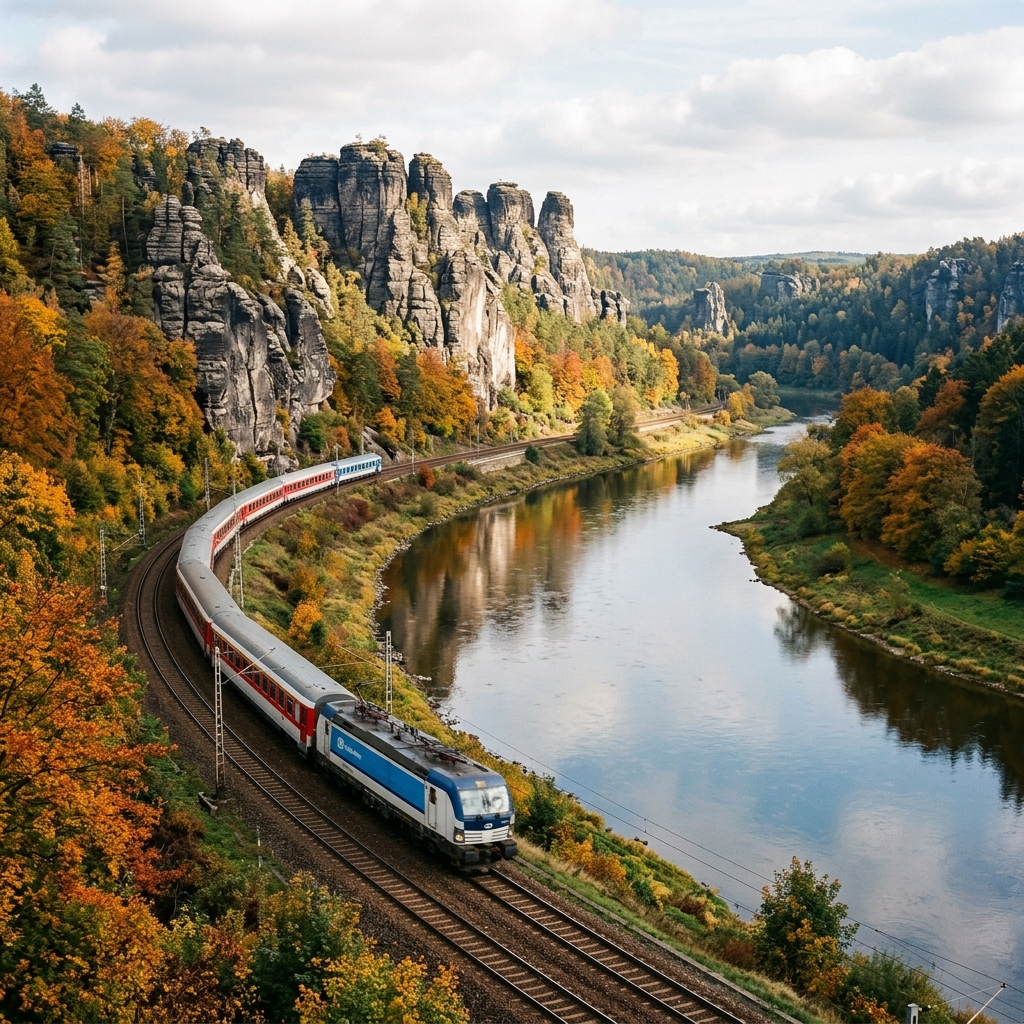
The train between Prague and Berlin covers the distance in four hours and passes through some of central Europe’s most compelling landscapes on the way. It is not a high-speed journey — neither country has yet built the fast infrastructure that would reduce the crossing to two hours — but it is a proper train journey in the old sense: time enough to eat something, read, watch the Elbe valley open up around you, and arrive in a different country having absorbed the space between.
Praha Hlavní Nádraží — Prague’s main station — is one of the finest pieces of transport architecture in Europe. The 1909 Art Nouveau building (the upper hall) survived Communist-era alterations and has been restored; stepping into it before boarding is the right beginning to a rail journey with architectural sensibility.
context for wider European rail travel
TL;DR: Prague to Berlin takes approximately 4 hours on EC or Railjet direct services. Advance fares from €20–30 via DB Navigator or CD.cz. The European Sleeper night train (from €49 couchette) runs the same corridor overnight. Dresden Hauptbahnhof is a natural stopover at the two-hour mark, perfectly placed between the two cities.
The Journey: Praha Hlavní Nádraží to Berlin Hauptbahnhof
Praha Hlavní Nádraží (Praha hl.n.)
Prague’s main station is two buildings in one. The upper level — the original Art Nouveau terminus, built between 1901 and 1909 by architect Josef Fanta — retains its ornate dome, moulded plasterwork, and the quality of light that only a well-made glass ceiling produces. It was the backdrop to departures during the Habsburg era, the German occupation, and the Communist decades. The lower concourse, added in the 1970s, is functional; the upper hall is the reason to arrive early.
The station is served by Prague Metro line C (Hlavní Nádraží stop), a two-minute walk from the main hall. From Wenceslas Square (Václavské náměstí), allow 10 minutes. The station has left-luggage facilities, an adequate range of food options, and — importantly for onward European connections — direct ticketing for most ČD and DB services at the international ticket windows.
The Operators: ČD, DB, and Railjet
The Praha–Berlin corridor is operated jointly by Czech Railways (ČD) and Deutsche Bahn (DB). The primary services are:
- EC (EuroCity) trains — through-running international services, operated on different legs by ČD and DB rolling stock depending on the specific service
- Railjet — Austrian Federal Railways (ÖBB) flagship service, which runs select Praha–Berlin departures; comfortable, with a bistro and first-class quiet zones
Roughly 4–6 direct services run daily in each direction. Journey times range from 4h to 4h 20m depending on the specific departure and stop pattern.
[IMAGE: View from train window over Elbe valley, Saxon Switzerland sandstone formations — search terms: Saxon Switzerland Elbe valley sandstone formations train window]
Booking: CD.cz vs DB Navigator vs Omio
CD.cz (Czech Railways)
The official Czech Railways booking site (cd.cz) is available in English and covers the full Praha–Berlin journey as a single international ticket. ČD’s domestic advance fares (for the Czech portion of the journey) are often cheaper than anything available through a third-party aggregator. Booking the full through-journey here gives you a single ticket; any connection delays become ČD’s responsibility.
DB Navigator
Deutsche Bahn’s app and website (bahn.com in English) is arguably the most useful booking tool for this corridor because it gives access to Sparpreis saver fares on the German portion — sometimes from €19.90 for the Berlin–Dresden section — and bundles through-ticketing across the border. DB also shows all available departures across operators in one interface. For travellers who will continue by train within Germany after Berlin, a DB through-ticket simplifies the onward journey.
Omio
Omio aggregates ČD, DB, and several bus operators (Flixbus, RegioJet) on the Praha–Berlin corridor. It’s useful as a comparison tool to see all options on a single screen, including the considerably cheaper bus alternatives (Praha–Berlin by FlixBus runs approximately 4h 30m and costs €10–20). Omio charges a booking fee; for the cheapest fares, book direct with the operator.
Flixtrain
Flixtrain launched limited Prague–Berlin services but operates mainly on the German domestic network. For this specific corridor, the bus service (FlixBus) is more frequent and cheaper; the Flixtrain option is not consistently available.
The Night Train: European Sleeper
The European Sleeper — launched in May 2023 by a Dutch-Belgian private operator — revived overnight rail between Brussels, Amsterdam, Berlin, and Prague after a years-long gap. The service runs three times weekly in each direction.
Route: Brussels Midi → Antwerp → Amsterdam → Utrecht → Bad Bentheim → Hannover → Berlin Hauptbahnhof → Berlin Ostbahnhof → Dresden Hauptbahnhof → Praha Holešovice → Praha Hlavní Nádraží
From Berlin Hauptbahnhof, departure is in the late evening (approximately 9:45pm); arrival in Prague is early morning (approximately 5:50am Praha Holešovice, 6:04am Praha Hlavní Nádraží). The return from Prague departs around 10:30pm and arrives Berlin around 6:45am.
Accommodation options:
- Couchette berth (shared 6-berth compartment): from approximately €49–69
- Private sleeper (2-berth compartment with lockable door): from approximately €99–159
- Seated (reclining seat): from approximately €39
Book at europeansleeper.eu. The service has been well-received for its service quality and comfort; it typically sells out well in advance on popular dates. This is the most interesting version of the Praha–Berlin journey if your schedule allows for an early-morning arrival.
the wider revival of European night trains
Saxon Switzerland: The Section Worth Watching
Between Dresden and the Czech border, the train enters the Elbe valley and follows the river through the Sächsische Schweiz (Saxon Switzerland) National Park — a landscape of eroded sandstone formations that rise above the valley in columns, arches, and flat-topped plateaux.
The formations are called Elbsandsteingebirge — Elbe sandstone mountains — and they are the visual core of the journey. Two 18th-century Swiss painters working in the area coined the “Switzerland” name when the rock towers reminded them of home; the name has stuck for 250 years. The Bastei Bridge (a stone arch crossing between rock formations 194 metres above the river) is the park’s most photographed landmark, visible distantly from the train.
Seating strategy: Sit on the right side of the train heading from Prague to Berlin (window seat, right direction of travel) for the best views of the valley and formations. From Berlin to Prague, sit on the left side. The relevant section lasts approximately 45–60 minutes.
The section immediately before Dresden — the final approach through the Elbe meadows — is also worth attention: the skyline of Dresden appears ahead with the Frauenkirche dome and the Hofkirche tower visible above the river. It’s one of central Europe’s better railway approaches to a city.
Dresden: The Perfect Stopover
Dresden occupies almost exactly the midpoint between Prague and Berlin: about two hours from each city. Stopping here for one night (or even a single extended afternoon) converts a journey into a layered experience rather than a transit.
The city’s story is one of extraordinary destruction and extraordinary reconstruction. The Allied bombing of February 13–15, 1945 killed an estimated 22,700 to 25,000 people and destroyed approximately 1,600 acres of the city centre, including almost the entire baroque Altstadt. The East German government rebuilt utilitarian districts and left the ruins of the Frauenkirche as a deliberate war memorial — a pile of rubble in the middle of the city — until reunification made funding available. The Frauenkirche was rebuilt stone by stone between 1994 and 2005, its exterior deliberately using a mix of original blackened stones (recovered from the rubble and catalogued) and new pale sandstone that will slowly weather to match. Up close, the patchwork is visible; from a distance, the dome is complete.
The Zwinger — a baroque palace and garden complex built from 1710 as an orangery and festival space for Augustus the Strong, Elector of Saxony — survived the war relatively intact and houses the Dresden Old Masters Picture Gallery, including Raphael’s Sistine Madonna. The Semper Oper (Dresden State Opera) on the adjacent Theaterplatz is one of the great opera houses of Europe; evening performances are available when booked in advance.
Practical notes for a Dresden stopover:
- Dresden Hauptbahnhof is 10 minutes by tram from the Altstadt
- Advance tickets for the gallery and Frauenkirche tower at dresden.de
- Hotel rates are significantly lower than Berlin or Prague; a good hotel in the Altstadt or Neustadt runs €70–110 per night
- The Neustadt neighbourhood (north of the Elbe) is Dresden’s bohemian quarter — bars, independent restaurants, weekend flea markets
Book Prague–Dresden and Dresden–Berlin as separate Sparpreis tickets on DB for the potentially lowest combined fare.
[IMAGE: Dresden Frauenkirche and Altstadt reflected in the Elbe at dawn — search terms: Dresden Frauenkirche Elbe river reflection morning baroque]
Berlin Hauptbahnhof: Arriving in the Capital
Berlin Hauptbahnhof — opened in 2006 on the site of the former Lehrter Stadtbahnhof — is an architectural statement in glass and steel: five levels crossing at right angles (the elevated east-west rail tracks intersecting with the below-ground north-south U-Bahn and S-Bahn), a 300-metre glass canopy overhead, and a transparency that makes it feel nothing like a transit building and everything like a civic one.
The station connects to nearly every part of Berlin directly: S-Bahn lines S5, S7, and S75 run east toward Alexanderplatz and west toward Spandau; U-Bahn line U55 (now extended as part of line U5) connects south; trams and buses complete the coverage. From Hauptbahnhof to Mitte or Prenzlauer Berg is 10–15 minutes by S-Bahn.
Berlin: Slow Travel Beyond the Tourist Circuit
Berlin is a city where a week disappears without effort. The major monuments — the Brandenburg Gate, the Holocaust Memorial, Checkpoint Charlie, the East Side Gallery — are worth the half-day they take. What follows is harder to summarise but more valuable.
Prenzlauer Berg
The neighbourhood immediately north of Mitte, Prenzlauer Berg was East Berlin’s bohemian quarter under the GDR — rents were low, the buildings were decaying, and artists and dissidents moved in. After reunification, it gentrified substantially, but the physical fabric of the pre-war Wilhelmine buildings survived: five-storey tenements with ornate facades and spacious interior courtyards (Hinterhöfe), now full of independent cafés, bookshops, and the Sunday Mauerpark flea market (Europe’s most famous, held every Sunday year-round).
Kastanienallee is the main boulevard; the streets around Helmholtzplatz are the neighbourhood at its most itself on a Sunday morning — late brunch, the market, no urgency.
Kreuzberg and Neukölln
Kreuzberg was West Berlin’s immigrant district, pressed against the Wall on three sides — cheap, neglected, and thereby full of the people who couldn’t afford anywhere else. It’s now one of Berlin’s most dynamic areas: Turkish-German community businesses alongside high-end restaurants, the Tuesday and Friday Türkenmarkt on the Maybachufer canal, the Jewish Museum (Daniel Libeskind’s building is one of the most significant pieces of contemporary architecture in Europe), and the Bergmannstrasse for cafés and bookshops.
Neukölln to the south follows a similar trajectory a decade behind — more residential, cheaper, with the Reuterkiez as its most active corner.
Tempelhof Field
Tempelhof was Berlin’s main airport, opened in 1936 in the Nazi megalomaniac style (the terminal building is 1.2km long, one of the largest buildings in the world by floor area), and a critical node for the 1948 Berlin Airlift. It closed as an airport in 2008 and opened as a public park in 2010.
The park is now 386 hectares of former airfield: wide-open, wind-swept, with the intact runways still crossing it. Berliners cycle, barbecue, kite, rollerblade, and garden on their allotted community plots along the old taxiways. It’s unlike any park in any other city — a space that somehow manages to contain layers of history (Nazi construction, Cold War crisis, 21st-century park) in a single unobscured landscape.
Free entry. Open daily from dawn to dusk.
The Flea Markets
Berlin’s flea markets are where the city’s obsession with objects, history, and recycling becomes tangible. The main ones:
- Mauerpark Flea Market (Prenzlauer Berg) — Sundays, year-round; mostly antiques and collectibles plus the famous outdoor karaoke amphitheatre from noon onwards
- Arkonaplatz (Prenzlauer Berg) — Sundays; smaller, more curated, books and design objects
- Flohmarkt am Boxhagener Platz (Friedrichshain) — Sundays; good mix of junk and genuine finds
- Flohmarkt im Mauerpark Antikmarkt — separate from the flea market, more professional dealers
an overview of night trains across Europe Kraków as an extension of this journey
Related Reading
- Prague by Train: Getting There, Getting Around and Getting Under Its Skin — Prague is 4 hours from Vienna, 4.
- Germany by Train: The ICE Network, the Deutschland-Ticket, and How to See the Country by Rail — Germany’s rail network is one of Europe’s largest — and one of its most discussed, debated, and occasionally delayed.
- Munich to Vienna by Train: Railjet Times, Tickets and the Salzburg Option — The Railjet from Munich to Vienna takes 4 hours and costs from €19.
Frequently Asked Questions
How long does the Prague to Berlin train take?
Direct EC and Railjet services take approximately 4 hours from Praha Hlavní Nádraží to Berlin Hauptbahnhof, stopping at Dresden Hauptbahnhof around the two-hour mark. Some services take 4h 15m–4h 20m depending on the specific departure. Roughly 4–6 direct services run daily in each direction. The European Sleeper night train covers the same route overnight, departing Berlin around 9:45pm and arriving Prague around 6am.
How much does the Prague to Berlin train cost?
Advance fares start from €20–30 via DB Navigator or CD.cz, with some Sparpreis fares on the German portion from €19.90. Full flexible fares run €50–80. The European Sleeper night train starts from approximately €49 for a couchette berth. Booking through DB Navigator or directly at CD.cz gives the best access to advance pricing; third-party platforms like Omio charge a booking fee but allow easy cross-operator comparison.
Is there a night train from Prague to Berlin?
Yes. The European Sleeper launched in 2023 and runs Brussels–Amsterdam–Berlin–Prague three times weekly. From Berlin Hauptbahnhof, the overnight departure is approximately 9:45pm with arrival at Praha Hlavní Nádraží around 6am. Couchette berths from €49; private sleeper compartments from approximately €99. Book at europeansleeper.eu; popular dates sell out weeks in advance.
Is Dresden worth a stopover?
Strongly so. Dresden sits exactly at the midpoint of the journey — about 2 hours from Prague and 2 hours from Berlin — and its baroque Altstadt is one of the most remarkable urban reconstructions in Europe. The Frauenkirche (rebuilt stone-by-stone from wartime rubble), the Zwinger palace and Old Masters Gallery, and the Semper Oper justify at least one night. Hotel rates are lower than both Prague and Berlin. Book the Prague–Dresden and Dresden–Berlin segments separately on DB for the best combined advance fare.
What is Saxon Switzerland National Park like from the train?
The Elbe valley section between Dresden and the Czech border is the visual highlight of the journey: dramatic sandstone formations rising above the river as the train follows the Elbe through the Sächsische Schweiz (Saxon Switzerland) National Park. Sit on the right side of the train heading from Prague to Berlin; left side heading from Berlin to Prague. The section lasts approximately 45–60 minutes and is one of central Europe’s best train window landscapes.
Four Hours Well Spent
The Praha–Berlin EC or Railjet is not a high-speed transit — no 300 km/h sprint through a tunnel, no disappearing landscape. It is an old-fashioned international train in the best sense: four hours of varied central European landscape, a natural stop in a historically layered city, and an arrival in a capital that will give back whatever time you bring to it.
The great gain of the journey over the flight — and Praha–Berlin is a route where many travellers still default to Ryanair or easyJet — is the Saxon Switzerland section. You cannot see the Elbe gorge from an aircraft window. You cannot step off at Dresden for an afternoon between the sandstone and the baroque without a car. The train gives you the landscape and the option; the flight gives you neither.
Book via bahn.com or cd.cz. Set a reminder for the right side of the train as you approach Dresden from the south. And if Berlin turns out to need more than three days — which it will — check the Europe by train guide for what comes next. Kraków is an easy rail connection east from Wrocław; Vienna is four hours south. The network goes on from here.
For night train context across Europe more broadly, the night trains in Europe guide covers the full revival. And for Kraków as an eastward extension, the Kraków by train guide has the detail.