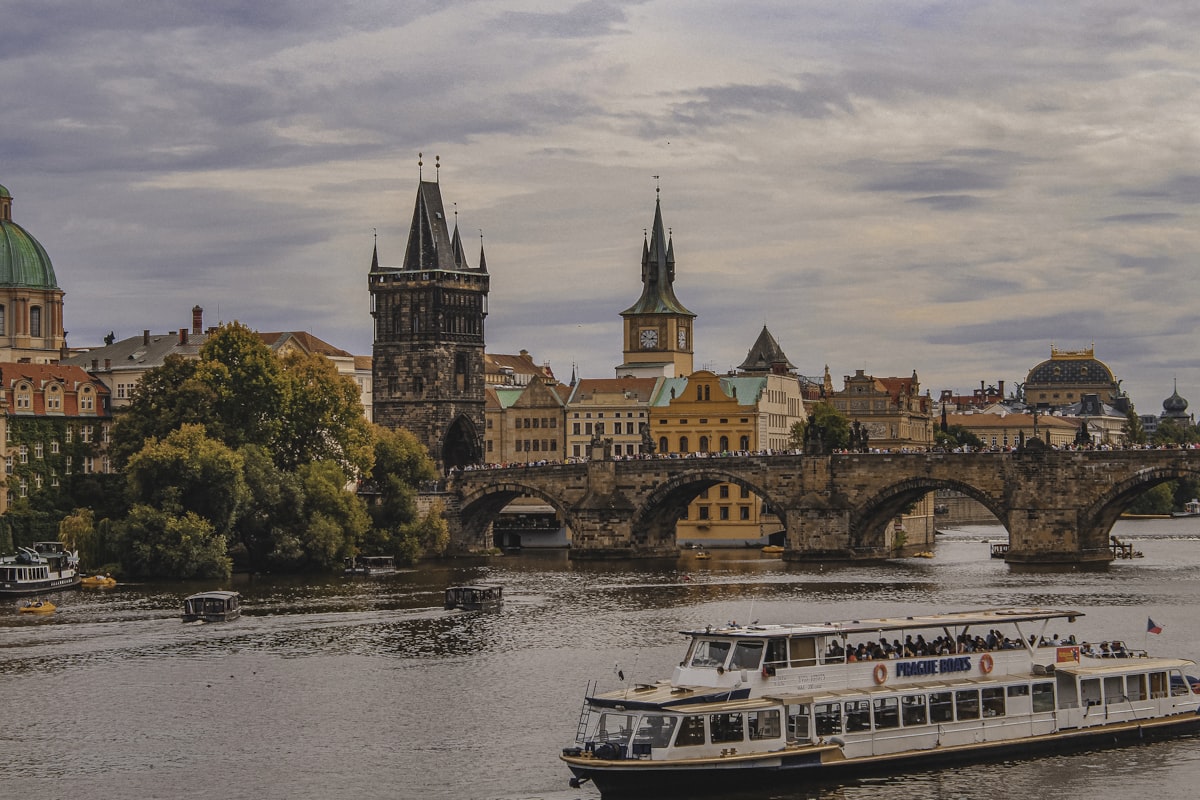
Prague is the most beautiful city in Central Europe. That’s a bold claim, but it’s also one of the few travel clichés that holds up the first time you cross the Charles Bridge at dawn, with the castle above you and the Vltava below, and nobody else around. The problem is that roughly 8 million tourists visit Prague every year, making it the fifth most visited city in the European Union (Prague City Tourism, 2025). On a summer afternoon, the Old Town Square can feel less like a medieval Czech city and more like a very beautiful theme park.
The antidote is not to avoid Prague. It’s to arrive by train, stay longer than you planned, and find the parts of the city that tour groups never reach. Vinohrady, Žižkov, Holešovice. A coffee shop with no English menu. A pub where the Pilsner costs less than a euro fifty.
That version of Prague still exists. You just have to stay long enough to find it.
TL;DR: Prague is reachable from Vienna in 4 hours by Railjet (from around €19), from Berlin in 4.5 hours by EuroCity express (from €19), and from Munich in around 6 hours with a change. Praha Hlavní nádraží puts you a 10-minute metro ride from the Old Town. Plan for 4 nights minimum, 6 or more if you want to actually live there rather than tick it off. Prague is affordable by Western European standards, though prices are rising: expect €60–€100 per night for a mid-range hotel and €10–€20 for a sit-down meal (Numbeo Cost of Living Index, 2026).
Which Train Routes Run Into Prague?
Prague is well connected by rail to most of Central and Western Europe, with fast, direct services from four major cities and good overnight options from further afield. The Czech national operator CD (České dráhy) runs the domestic network, while ÖBB and Deutsche Bahn operate the key international corridors with advance fares starting from €19 (ÖBB, 2026). Here is the full picture.
Vienna to Prague: The Railjet (4 Hours)
The Vienna–Prague Railjet is the headline route. Jointly operated by ÖBB and CD, it covers the 320 km between Vienna Hauptbahnhof and Praha Hlavní nádraží in approximately 4 hours, with roughly five departures daily in each direction. Advance fares start around €19 in second class; walk-up fares run €35–€60 depending on timing.
The Railjet is ÖBB’s premium intercity product: air-conditioned, with power sockets, a restaurant car, and luggage racks that fit proper bags. The route passes through Brno, Czech Republic’s second city, worth a stop in its own right, before arriving in Prague. Austria and Czech Republic are both Schengen, so there are no passport checks.
Berlin to Prague: The EuroCity Through Saxon Switzerland (4.5 Hours)
The Berlin–Prague EuroCity train is, in the opinion of anyone who has done it, one of the best train journeys in Central Europe. The route takes approximately 4.5 hours and runs several times daily, with advance fares from around €19 (Deutsche Bahn, 2026). Trains depart Berlin Hauptbahnhof, pass through Dresden, and then enter the Elbe valley through Saxon Switzerland before crossing into the Czech Republic.
Saxon Switzerland, the Sächsische Schweiz, is a field of sandstone spires, forest-covered plateaux, and river gorges that looks more like something you’d expect in Arizona than twenty minutes outside Dresden. From the train window you watch the formations emerge from the treeline above the Elbe, one improbable pillar after another. The section between Dresden and Bad Schandau is roughly 40 minutes of genuine spectacle.
Then the train crosses the border into Bohemian Switzerland on the Czech side, where the field continues the same drama under a different name. If you happen to find yourself with a beer from the restaurant car and a window seat on this section, you’re experiencing one of the better 90 minutes available to a European train traveller.
[IMAGE: The Elbe valley in Saxon Switzerland seen from a train window, with sandstone rock formations rising above forested slopes, search terms: Saxon Switzerland Elbe valley train journey sandstone]
Munich to Prague: Around 6 Hours with a Change
The Munich–Prague connection is less clean than Vienna or Berlin but manageable. There is no single direct express, the most common routing goes via Nuremberg or via Passau/Pilsen, with a journey time of around 6 hours depending on connection. Fares vary but are generally reasonable booked in advance through DB or CD.
The Pilsen (Plzen) routing is worth knowing about independently: Pilsen is the birthplace of Pilsner Urquell, and the city has its own brewery museum and underground tunnel network. You can break the journey for a half-day and arrive in Prague in the evening having already had a proper beer education.
Warsaw to Prague: Overnight or Long Day (8 Hours)
Warsaw to Prague is a long journey, around 8 hours with the fastest connections, but an overnight option exists. The EuroNight service running parts of this corridor means you can board in Warsaw in the evening and arrive in Prague in the morning, saving a hotel night. Check CD and PKP Intercity for current overnight scheduling, as service patterns on this route shift seasonally.
Budapest to Prague: 7 Hours via Vienna or Bratislava
Budapest connects to Prague in around 7 hours via the direct EC service through Brno, or via Vienna on the Railjet. The direct routing through Brno is the more interesting journey; the Vienna connection is faster if you book the segments well. Either way it’s a full day’s travel, the kind that benefits from a good book, a packed lunch from a Budapest market, and a train window facing the Bohemian countryside in the late afternoon.
Budapest by train, routes, food and what to do
What Is Praha Hlavní Nádraží Like?
Praha Hlavní nádraží, Prague’s main station, is one of the unsung architectural pleasures of Central European rail travel. The building has two distinct personalities. The lower levels, rebuilt in the 1970s, have the functional bleakness of late-socialist public infrastructure. But the upper hall, built between 1901 and 1909 in Art Nouveau style by architect Josef Fanta, is quietly extraordinary: a curved facade with floral ironwork, mosaic details, and a central dome that no number of fast-food concessions can fully diminish.
Arrive with enough time to look up at the upper hall before taking the metro. It’s the kind of architecture that most cities would frame as a centrepiece; here it sits above a supermarket and a luggage storage office, more or less ignored.
The station sits on metro line C (red line). Muzeum station, the interchange with line A, is three stops away and puts you directly on Wenceslas Square. From there it’s a 15-minute walk to the Old Town Square. The logistics are painless.
[IMAGE: The Art Nouveau upper hall of Praha Hlavní nádraží railway station, with curved ironwork detailing and the central dome, search terms: Praha Hlavní nádraží Art Nouveau interior station Prague]
How Do You Get Around Prague?
Prague’s public transport system is excellent, cheap, and runs on a straightforward zone-based fare structure. A 90-minute transfer ticket costs 40 CZK (around €1.60 as of 2026), covering metro, tram, and bus within the time window (Prague Public Transit DPP, 2026). A 24-hour pass runs 120 CZK (roughly €5). The metro covers three lines; trams are the more atmospheric option for shorter hops across the centre.
The Old Town is largely pedestrianised and best explored on foot. The Castle District on the opposite bank requires either a tram (line 22 is the classic route) or a walk up the hill from the river. Taxis are available but app-based Bolt is more reliable and cheaper than hailing one on the street.
One practical note: Prague is notoriously hilly on the Hradcany (Castle) side and deceptively flat on the Stare Mesto (Old Town) side. Comfortable shoes matter more here than almost any other European city.
What Should You Do in Prague as a Slow Traveller?
The Old Town: Worth It, But Do It on Your Terms
The Old Town (Stare Mesto) is genuinely spectacular and also, in July, genuinely overwhelming. The Astronomical Clock draws a crowd every hour on the hour; the Charles Bridge is lined with painters, musicians, and tour groups from 9am until dark. None of this makes them not worth seeing. It makes them worth seeing at the right time.
The Astronomical Clock, built in 1410 and one of the oldest working astronomical clocks in the world, is best appreciated before 8am when the square is still quiet enough to study it properly. The Charles Bridge at dawn, similarly, is a different place entirely from the Charles Bridge at noon. These are not just photographic tips; they’re the difference between feeling the history and feeling the crowd.
The Old Town Hall, the Tyn Church, Josefov (the old Jewish Quarter with its six synagogues and medieval cemetery), budget two full days for this area, but distribute them across your stay rather than cramming both into day one.
[IMAGE: The Charles Bridge in Prague at dawn with no crowds, the castle visible in the mist behind, lanterns still lit, search terms: Charles Bridge Prague dawn empty morning fog]
The Castle District: The View Is Real, the Crowds Are Also Real
Prague Castle (Prazský hrad) is the largest ancient castle complex in the world by area, covering approximately 70,000 square metres (Prague Castle Administration, 2025). That’s worth stating plainly because most people think of it as a single building rather than an entire fortified hilltop city containing three churches, a palace, a vineyard, and multiple museums.
The views from the castle district across the red rooftops of Mala Strana (the Lesser Town) and the river bend below are the best free panorama in Prague. The entry to the castle grounds themselves is free; specific buildings require tickets. St Vitus Cathedral is the main draw, a Gothic structure begun in 1344 and not completed until 1929, with stained glass designed by Alfons Mucha in the third chapel from the left that is worth the queue.
Go on a weekday, arrive when the castle opens at 9am, and leave before noon. The area around the main gate is the most congested point in all of Prague between 10am and 4pm in high season.
Vinohrady and Žižkov: Where Prague Actually Lives
Vinohrady and Žižkov are adjacent neighbourhoods east of Wenceslas Square that most tourist itineraries don’t mention. They should. Vinohrady, literally “vineyards”, is a late 19th-century residential district of wide boulevards, Art Nouveau apartment buildings, and cafes that have a morning clientele of actual Czech people rather than travellers.
Žižkov immediately north is rougher-edged and more interesting for it: a working-class neighbourhood that resisted the grand 19th-century planning that smoothed out Vinohrady, and which now has a dense concentration of pubs, bars, and independent restaurants. The Žižkov TV Tower, a 216-metre telecommunications structure built between 1985 and 1992 and decorated with crawling infant sculptures by artist David Cerny, is either hideous or magnificent depending on your tolerance for late-socialist brutalism. It has a viewing platform and a restaurant.
From Vinohrady, a tram or a 20-minute walk brings you to Riegrovy Sady park, a hillside garden with a beer garden at the top that looks west across the city toward the castle. On a clear afternoon this is one of the best views available without paying for it, and the Pilsner costs about €1.80.
going beyond tourist itineraries
Holešovice and Dejvice: The Locals’ Prague
North of the river, Holešovice was a 19th-century industrial district that has become, in the last decade, Prague’s most interesting neighbourhood for food and creative culture. The DOX Centre for Contemporary Art sits here, alongside a covered market (Hala 22 in the Holešovice market complex), independent coffee shops, and a food hall that serves excellent Vietnamese food, a reflection of Prague’s significant Vietnamese community, one of the largest in Central Europe.
Dejvice, further northwest, is quieter and more residential, populated largely by university staff and diplomatic community. It’s worth a visit primarily for Dejvicka market on Saturday mornings and for the genuinely unhurried pace that tells you you’ve left the tourist circuit entirely.
What Should You Eat and Drink in Prague?
Czech food is reliable, honest, and almost entirely absent from the international culinary conversation. That’s a shame. It’s a cuisine built for cold weather and long afternoons.
The Dishes Worth Seeking Out
Svíčková is the defining Czech dish: beef sirloin slow-cooked in a cream sauce made from root vegetables, served with bread dumplings (knedlíky), a slice of lemon, and a spoonful of cranberry sauce. The combination of rich cream, slight sweetness from the cranberry, and starchy dumpling is stranger than it sounds and better than you’d expect. A proper svíčková at a neighbourhood restaurant costs €8–€14.
Goulash (guláš) in the Czech version is thicker and spicier than the Hungarian original, served with bread or dumplings. It’s the standard pub dish and costs €6–€10 almost everywhere outside the tourist core.
Bramboráky are potato pancakes, fried, seasoned with garlic and marjoram, eaten as a snack or starter. Simple, cheap, and consistently satisfying.
Trdelník, the spiral pastry you’ll see sold on every corner of the Old Town, is worth mentioning specifically to warn you off it. It’s a Slovak-origin sweet bread that has nothing to do with Prague’s food culture and exists entirely as a tourist product. The versions stuffed with ice cream are a recent invention with no historical basis whatsoever. Skip it.
[IMAGE: A plate of svíčková, Czech beef sirloin in cream sauce with bread dumplings and cranberry, served on a wooden table in a Prague restaurant, search terms: svíčková Czech dish beef cream sauce dumplings Prague]
Czech Beer Culture
Czech Republic has the highest per-capita beer consumption in the world, 129 litres per person annually (Kirin Beer University Report, 2024). That’s not a trivia point; it’s context for why the beer here is exceptionally good and exceptionally cheap.
Pilsner Urquell (Plzenský Prazdroj) is the original Pilsner, brewed in Plzen since 1842 and the source from which the entire global lager category descends. It’s widely available in Prague and tastes noticeably different on draught from the bottled export version.
Kozel (meaning “goat”) is a darker, maltier option, Cerny Kozel (black Kozel) is a Czech dark lager that bears no resemblance to stout and is the right choice on a cold evening.
Bernard is an independent Czech brewer producing unfiltered, unpasteurised lagers that you’ll find in the better pubs and restaurants throughout the city. If you see Bernard on tap, order it.
A half-litre of draught beer in a neighbourhood pub runs about 45–65 CZK (roughly €1.80–€2.60). In tourist-facing bars on the Old Town Square, the same beer costs two to three times more. The geography of Czech beer pricing is very direct: the further you walk from the Astronomical Clock, the less you pay.
Prague’s Coffee Scene
Prague has developed a serious third-wave coffee culture over the past decade, centred on a cluster of independent roasters and specialty cafes that would not look out of place in Copenhagen or Melbourne. EMA Espresso Bar, Kavárna co hledá jméno, and Quentin Café are among the most serious; a flat white runs around 90–110 CZK (€3.50–€4.50).
This matters as a slow travel indicator: the presence of a genuine local coffee scene means the neighbourhood has daytime infrastructure for working, reading, and spending three hours over two coffees without anyone asking you to leave. Vinohrady has the highest concentration of these cafes. Use them.
What Are the Best Day Trips from Prague by Train?
Kutná Hora: Bone Church and Medieval Silver (1 Hour)
Kutná Hora is the single best day trip from Prague and one of the stranger places in Central Europe. The town, 70 km east of Prague, was a major silver-mining centre in the 13th and 14th centuries, for a period, the second most important city in Bohemia and a significant source of the Holy Roman Empire’s silver coinage. Direct trains run from Praha Hlavní nádraží roughly every two hours, with a journey time of about 1 hour and fares under €6 (CD Czech Railways, 2026).
The headline attraction is the Sedlec Ossuary, the bone church. An ossuary chapel whose interior is decorated with the bones of approximately 40,000 people, arranged into chandeliers, wall garlands, and a central chandelier designed to contain every bone in the human body. It’s not a horror attraction. It’s a 15th-century monk’s meditation on mortality that became a 19th-century artistic project, and it’s quietly extraordinary. Entry costs around €5.
The rest of Kutná Hora rewards a full day: the Gothic Cathedral of St Barbara (a UNESCO World Heritage Site with extraordinary vaulted ceilings begun in 1388), the medieval silver mine tours, and a lunch in the town square that costs roughly half of what the same meal would in central Prague.
[IMAGE: The bone chandelier inside the Sedlec Ossuary in Kutná Hora, made entirely of human bones with a vaulted Gothic ceiling above, search terms: Sedlec Ossuary Kutna Hora bone church chandelier]
Ceský Krumlov: The Castle Town (3 Hours)
Ceský Krumlov is a UNESCO World Heritage town in southern Bohemia built around a bend of the Vltava river and dominated by a castle that is, by objective assessment, one of the most photogenic buildings in Central Europe. The journey from Prague takes around 3 hours by a combination of direct bus (RegioJet runs frequent services) or train via Ceske Budejovice, confirm current routing and timing through CD or RegioJet before you go.
The castle itself has a remarkable Baroque theatre and an extensive garden with a revolving auditorium. The town below the castle is small enough to cover on foot in a morning but atmospheric enough to justify staying overnight rather than rushing back to Prague.
Note: Ceský Krumlov has become significantly more visited in recent years. It’s busy in summer. Go on a weekday if you can, or plan an overnight stay to experience it after day-trip coaches leave in the late afternoon.
How Long Should You Stay in Prague?
Four nights is the honest minimum for a slow traveller who wants to see something beyond the tourist core. That’s enough time to cover the Old Town properly (two mornings), cross the river to the castle district, spend an afternoon in Vinohrady and Žižkov, and take the Kutná Hora day trip. It is not enough time to feel like you’ve actually settled in.
Six nights is better. It gives you a second day trip, the ability to revisit the Charles Bridge at different times of day, a Saturday morning in Holešovice market, and the particular pleasure of becoming a regular at a coffee shop or pub, the point at which slow travel stops being a concept and becomes an experience.
Prague is affordable by Western European standards, though the gap is closing. As of 2026, a mid-range hotel runs €60–€100 per night; a full dinner with drinks at a neighbourhood restaurant costs €15–€25 per person; public transport is negligible at €5 per day (Numbeo, 2026). The financial logic strongly favours staying longer over shorter.
Related Reading
- Prague to Berlin by Train: The 4-Hour Journey Worth Taking, Prague to Berlin by train takes 4 hours and costs from €20 advance.
- The Adriatic Coast by Train and Ferry: Italy to Croatia Slow, Travel the Adriatic slow: Italy’s coastal rail line from Bologna to Bari, then overnight ferry to Split and…
- Amsterdam to Paris by Train: Thalys Guide, Times & Tickets, Amsterdam to Paris by train takes just 3h 17m on Eurostar.
Frequently Asked Questions
How do I book Vienna to Prague train tickets?
Book directly through ÖBB up to 180 days in advance, or through Trainline for a single booking interface that covers multiple operators. Advance fares start at around €19 in second class. Seat reservations are included in the ticket price on Railjet services. Mobile tickets are accepted, no printing required (ÖBB, 2026).
European train booking explained
Do I need a visa to visit Czech Republic?
Czech Republic is a member of the Schengen Area. EU and EEA passport holders enter without formality. US, Canadian, Australian, and most other Western passport holders can visit for up to 90 days in any 180-day period without a visa. UK passport holders have the same 90-day access post-Brexit. Always check the current entry requirements for your specific nationality before travel.
Is Prague safe for solo travellers?
Prague is broadly safe and widely travelled by solo visitors. The main risks are petty theft in heavily touristed areas (particularly around the Old Town Square and on tram line 22 near the castle) and overpriced taxis near major tourist sites. Use Bolt rather than hailing cabs on the street. Keep bags close in crowds. The city is well-lit, walkable, and has good late-night public transport.
What currency does Czech Republic use?
Czech Republic uses the Czech Koruna (CZK), not the euro. As of early 2026, approximately 25 CZK equals €1, though rates fluctuate. ATMs are widely available throughout Prague. Avoid airport and hotel exchange counters, rates are considerably worse than bank ATMs or Revolut-style multi-currency cards. Most restaurants and shops accept credit cards; smaller pubs and market stalls prefer cash.
What is the best time of year to visit Prague?
May, June, and September are the ideal months, mild weather, full city life, and manageable crowds compared to July and August, when Prague is at peak tourist volume. December has a well-regarded Christmas market in the Old Town Square, though accommodation prices rise sharply around it. March and April are quiet and increasingly mild; the downside is that some outdoor attractions have shorter hours.
Arriving in Prague on Your Own Terms
Prague rewards the traveller who refuses the first version of it, the one sold on every Instagram grid and tour bus window. That version is real and beautiful and surrounded by 500 people taking the same photograph.
The second version takes longer to find. It involves walking east from Wenceslas Square when everyone else is walking west. It involves choosing a pub with no English menu on purpose. It involves arriving by train rather than by budget airline, stepping off the platform at Hlavní nádraží, looking up at the Art Nouveau dome, and deciding before you’ve even left the station that you’re staying longer than you planned.
Four hours from Vienna. Four and a half from Berlin. Worth every one of them.
planning a Central European rail itinerary night train options into Central Europe
Citation Capsule, Train routes to Prague: The Vienna–Prague Railjet, jointly operated by ÖBB and CD, covers 320 km in approximately 4 hours with advance fares from around €19. The Berlin–Prague EuroCity takes approximately 4.5 hours via Dresden and Saxon Switzerland, with advance fares also from €19. Both routes run multiple daily departures. Praha Hlavní nádraží connects to the city centre by metro line C (ÖBB, 2026; Deutsche Bahn, 2026).
Citation Capsule, Saxon Switzerland train section: The Berlin–Prague EuroCity passes through the Elbe valley in Saxon Switzerland between Dresden and the Czech border, approximately 40 minutes of sandstone spire formations and forest-covered gorges. This section, combined with the Bohemian Switzerland continuation on the Czech side, makes the Berlin–Prague route one of the most scenically dramatic rail corridors in Central Europe. No detour or special reservation is required, it’s simply the direct route (Deutsche Bahn, 2026).
Citation Capsule, Czech beer: Czech Republic records the highest per-capita beer consumption globally at 129 litres per person annually. Pilsner Urquell, brewed in Plzen since 1842, is widely credited as the world’s first golden lager and the template for the broader global Pilsner style. A half-litre of draught beer in a Prague neighbourhood pub runs approximately 45–65 CZK (€1.80–€2.60) in 2026 (Kirin Beer University Report, 2024; Numbeo, 2026).