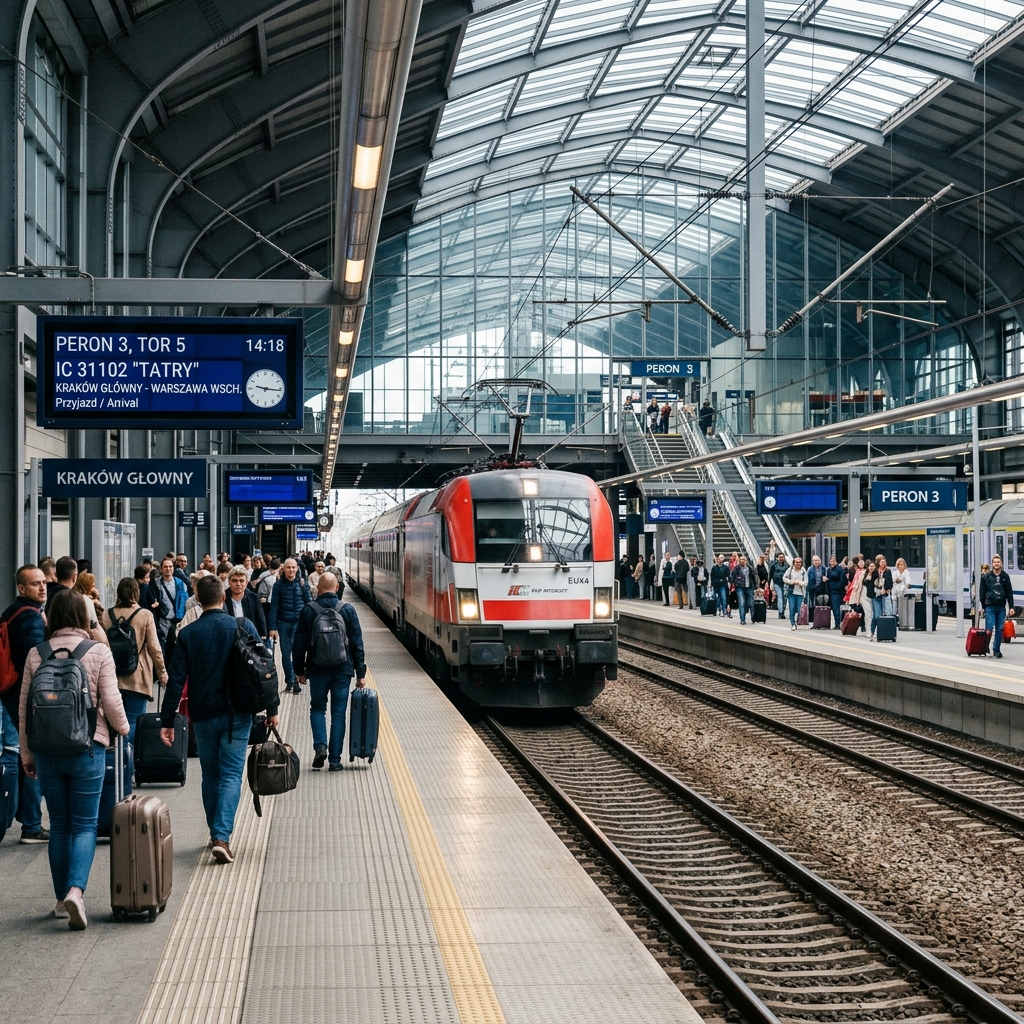
Krakow is one of those cities that ruins other cities for you. Not through any particular monument or attraction — though it has those in abundance — but through a quality of accumulated beauty that is simply unusual in central Europe. Most of the old towns that call themselves beautiful were rebuilt after 1945. Krakow’s wasn’t. The medieval core survived the Second World War almost entirely intact, which means you are walking through stone that has actually been there since the fourteenth century, not stone that was reassembled to approximate what had been there.
Getting to Krakow is straightforward from most of central Europe, and the train is almost always the right choice. This guide covers the main routes, what to expect at the station, and how to use the city’s own rail connections to see more than just the city itself.
TL;DR
Krakow is served by direct trains from Warsaw (2h 15m), Prague (7h with one change), Vienna (overnight or ~7h daytime with change), and Budapest (8–10h with change). All trains arrive at Krakow Główny, which connects directly to the city’s tram network. Tickets from Warsaw start around 89 PLN (€20) booked in advance. Book via PKP Intercity for domestic Polish trains, or ÖBB and RailEurope for international routes.
Getting to Krakow by Train
Warsaw to Krakow: The Fast Option
The Warsaw to Krakow corridor is one of Poland’s premium rail routes, served by PKP Intercity’s Express InterCity Premium (EIP) trains — the closest thing Poland has to high-speed rail, running at up to 200 km/h on the upgraded central main line.
Journey time: 2 hours 15 minutes on the fastest EIP services; 2 hours 30–45 minutes on standard Express InterCity (EIC) trains.
Frequency: 15–20 departures daily from Warsaw Centralna, spread from early morning to late evening.
Price: Tickets start around 89–150 PLN (€20–35) for advance EIP purchases; flexible fares and last-minute tickets run 150–250 PLN (€35–60). First class is available and genuinely comfortable — wide seats, table service on some services, quieter carriages.
Booking: PKP Intercity’s website and app are functional in English. Tickets open 30 days ahead for most services. For summer travel and Polish public holidays, book the moment the window opens.
| Service | Journey Time | Frequency | Price from |
|---|---|---|---|
| EIP (Express IC Premium) | 2h 15m | ~10/day | 89 PLN (€20) |
| EIC (Express InterCity) | 2h 30–45m | ~8/day | 79 PLN (€18) |
| IC (InterCity) | 3h+ | Several | 49 PLN (€11) |
The trains themselves are solid — not the Frecciarossa, but comfortable, air-conditioned, with power sockets and a bistro car. The landscape between Warsaw and Krakow is mostly flat Polish farmland, which turns gently more interesting as you approach the Małopolska region and the Tatra foothills begin to appear on the southern horizon.
Prague to Krakow: The Mountain Route
The Prague to Krakow journey requires a change, typically at Ostrava or Bohumin, but the connection is smooth and the combined journey time is under 7 hours — manageable as a daytime trip, and a route that passes through genuinely beautiful terrain in the Czech and Polish Beskid mountains.
Journey time: 6–7 hours total, with one change.
Price: From around €25–40 booked in advance via Czech Railways (CD) or RailEurope.
Recommended: Take the morning departure from Prague’s main station (Praha Hlavní Nádraží) to arrive in Krakow by mid-afternoon. The 7:30–8:30 a.m. trains from Prague work well for this.
The crossing into Poland from the Czech Republic through the Beskid mountains is genuinely scenic — green hills, small border towns, a sense of crossing from one Central European world into another. It’s the kind of journey that reminds you why you chose the train.
Vienna to Krakow: Overnight or Daytime
Overnight: The ÖBB EuroNight service (EN 447) runs from Vienna Hauptbahnhof to Krakow Główny, departing Vienna in the evening and arriving Krakow the next morning — typically 7–8 hours, which means you lose no daytime to travel.
Sleeper compartments include couchettes (6-berth, the budget option) and proper sleeper cabins (2–3 berth, with bedding). Prices: couchettes from around €45–60 per person; sleeper berths from €80–120. Book through ÖBB — these trains fill quickly in summer.
Daytime: There are faster daytime options involving a change at Katowice, total journey around 6 hours. Generally the overnight is more popular for this distance — you sleep; you arrive.
Budapest to Krakow
This is the most involved of the main routes — typically 8–10 hours with one or two changes (often at Katowice or Rzeszów). It is doable in a day but makes more sense as an overnight if you can plan around it. Alternatively, consider routing via Vienna or Bratislava for smoother connections.
Prices start around €30–50 for daytime routes; book through RailEurope for cross-border tickets.
Krakow Główny: What to Expect at the Station
Krakow’s main station — Krakow Główny — occupies a curious position: it is embedded within the Galeria Krakowska, a large modern shopping mall that wraps around and above the historic station building. The combination is less jarring in practice than it sounds. The platforms are underground; the mall provides shelter, facilities, and the sort of coffee that will see you through.
Facilities at Krakow Główny:
- Left luggage (przechowalnia bagażu) — staffed and coin-locker options, €2–4 per bag
- ATMs — several in the mall, including at the platform level
- Cafés and restaurants — everything from fast food to a decent sit-down option
- Tourist information — a regional tourist office is near the main exit
- Taxi rank and tram stops — directly outside the main entrance
Getting to the Old Town from the station: The historic centre is about 1.5 km from the station — a 15–20 minute walk along ul. Pawia and through the Planty park that rings the Old Town. The walk is pleasant. Trams (lines 1, 6, 8, 13, 18) also stop outside the station and take 5–8 minutes to central stops. Avoid taxis from the station rank — rideshares (Bolt, Uber) are significantly cheaper.
What to Do in Krakow
Krakow rewards the approach of the slow traveler — it is a city for walking, for sitting in courtyards, for eating well and unhurriedly, not for ticking monuments.
Wawel Castle and Cathedral
The Wawel is the gravitational centre of Polish history — the royal residence from the 11th to the 17th century, a cathedral that houses the tombs of Polish kings and national heroes (Kościuszko, Piłsudski, John Paul II). Entry to the castle courtyard is free; the royal chambers, treasure, and armoury require tickets (€5–10 each). The views over the Vistula from the castle walls are exceptional.
The Main Market Square (Rynek Główny)
The largest medieval market square in Europe — and one of the most beautiful. The Cloth Hall (Sukiennice) at its centre was built in the 14th century and has housed market stalls ever since. St. Mary’s Basilica on the square’s eastern side has an extraordinary Gothic altarpiece by Veit Stoss, unveiled in 1489. A trumpet call (the hejnał) sounds from the church tower every hour — a tradition dating to the 13th century.
Kazimierz: The Jewish Quarter
Krakow’s former Jewish district, a short walk south of the Old Town, is now the city’s most interesting neighbourhood for food, bars, and authentic urban texture. Before World War Two, Kazimierz was home to some 65,000 Jewish residents; the area’s synagogues, cemeteries, and cultural institutions preserve that history without sanitising it. The Galicia Jewish Museum on ul. Dajwór is one of the most thoughtful Holocaust memorial museums in Europe.
Food in Krakow
Krakow’s food scene has improved dramatically in the past decade. The staples — pierogi (dumplings), żurek (sour rye soup served in a bread bowl), bigos (hunter’s stew), oscypek (smoked sheep’s cheese from the Tatras) — are available everywhere, but the difference between tourist-trap and genuine is significant.
Where to eat: The area around Plac Nowy in Kazimierz has the most honest food at honest prices. Zapiekanka (toasted baguettes with toppings) from the round market hall at Plac Nowy is cheap, excellent, and the correct thing to eat standing up at midnight. For a proper sit-down meal, the streets surrounding Plac Szczepański in the Old Town have a concentration of good restaurants.
Day Trips from Krakow by Train
Krakow’s position makes it an ideal base for some of the most significant day trips in central Europe.
Auschwitz-Birkenau
The Auschwitz Memorial and Museum — the Nazi German concentration and extermination camp complex at Oświęcim, 70 km west of Krakow — is among the most important historical sites in the world. It is also one of the most visited, and requires careful planning.
By train: Regional trains from Krakow Główny to Oświęcim run several times daily, journey time approximately 1 hour 30 minutes, tickets around 12–16 PLN (€3–4). The Auschwitz I site is a 15-minute walk from Oświęcim station; the larger Birkenau (Auschwitz II) camp is an additional 3 km, served by a free shuttle bus.
Essential: Entry to the Memorial is free but requires a pre-booked timed slot. Individual visitors should book via the Auschwitz Memorial website — slots fill months ahead for summer visits. Guided educational tours (included with the timed slot) are available; they are strongly recommended.
Allow a full day. The site covers a large area; it demands time and attention.
Zakopane: Mountain Town in the Tatras
Zakopane — Poland’s mountain capital, sitting at the foot of the High Tatras at 850 metres — is an hour from Krakow by bus (the bus is faster and more frequent than the train on this particular route) and entirely different in character: wooden Zakopane-style architecture, mountain air, hiking trails, thermal pools, and the Tatra National Park beginning at the edge of town.
By train: Trains from Krakow to Zakopane take around 3 hours and require a change at Sucha Beskidzka — functional, but the bus (from Krakow’s main bus station, a 5-minute walk from Główny) takes 2 hours and is the faster option for this specific route. Tickets run 20–30 PLN (€5–7) each way.
The Tatras offer serious hiking in summer and skiing from December to March. The Morskie Oko lake — a 9 km round-trip walk from the nearest bus stop — is the classic Tatra excursion and genuinely spectacular.
Wieliczka Salt Mine
The Wieliczka Salt Mine, a UNESCO World Heritage Site 13 km from Krakow, is a labyrinthine underground world of salt-carved chapels, statues, and a functioning lake 135 metres below the surface. The St. Kinga’s Chapel, decorated entirely in salt carvings, is one of the most surprising interiors in Poland.
Getting there: Frequent regional trains from Krakow Główny to Wieliczka Rynek Kopalnia take 15 minutes. Tickets 7 PLN (€1.50). The mine entrance is 5 minutes’ walk from the station. Book entry tickets online; the underground tour takes 2–3 hours.
Practical Information
Currency: Poland uses the Polish Złoty (PLN) — not the euro. ATMs are widely available. Approximate rate: €1 = 4.25–4.30 PLN. Credit cards are accepted most places, but carry some cash for markets, small restaurants, and tram tickets.
Trams in Krakow: The tram network is efficient and inexpensive. Single tickets (one journey) cost 4.60 PLN (€1.10); 20-minute tickets for multiple journeys cost 5 PLN. Buy via the JAKDOJADE app or from ticket machines at stops. Validate on board.
When to visit: May, June, September, and October are the best months — good weather, manageable crowds. July–August is peak season and the Old Town can feel overwhelmed. December is magical: the Christmas market on the Rynek Główny is one of the best in central Europe. January–February is cold but quiet, with very few tourists.
How long to spend: Three nights is the minimum that allows you to absorb the Old Town, Kazimierz, Wawel, and one day trip. Five nights gives room to breathe.
Related Reading
- Florence to Venice by Train: The Complete Guide — Florence to Venice by train takes just 2 hours on the Frecciarossa.
- Milan to Venice by Train: The Complete Guide — Milan to Venice by train takes just 2 hours 27 minutes on the Frecciarossa.
- Prague to Berlin by Train: The 4-Hour Journey Worth Taking — Prague to Berlin by train takes 4 hours and costs from €20 advance.
Frequently Asked Questions
How long does the train from Warsaw to Krakow take?
The fastest trains from Warsaw Centralna to Krakow Główny take 2 hours 15 minutes on PKP Intercity’s EIP services. Standard Express InterCity trains take 2 hours 30–45 minutes. There are roughly 15–20 departures daily. Fares start from 89–150 PLN (€20–35) booked in advance through PKP Intercity’s website.
Is there a direct train from Vienna to Krakow?
Yes — ÖBB operates a direct overnight EuroNight service from Vienna Hauptbahnhof to Krakow Główny, taking around 7–8 hours. Daytime options involve a change, typically at Katowice, and take around 6–7 hours total. Book through ÖBB or RailEurope; overnight couchettes start around €45–60 per person.
What is Krakow Główny station like?
Krakow Główny is a well-maintained, recently renovated station integrated into the Galeria Krakowska shopping complex. It has clear English-language signage, left-luggage facilities, ATMs, cafés, and a tourist information office. The Old Town is a 15–20 minute walk or 5–8 minutes by tram from the main entrance.
Can I do a day trip from Krakow to Auschwitz by train?
Yes — trains from Krakow Główny to Oświęcim (nearest town to Auschwitz-Birkenau) take around 1 hour 30 minutes and cost roughly 12–16 PLN (€3–4). The Memorial requires a pre-booked timed entry slot from the Auschwitz Memorial website — book months ahead for summer. Allow a full day.
How far in advance should I book trains to Krakow?
For Warsaw to Krakow trains, the booking window opens 30 days ahead; book 2–3 weeks out for regular travel, immediately when the window opens for summer weekends and Polish public holidays. For international trains from Vienna, Prague, or Budapest, book 2–3 months ahead, particularly for overnight sleeper services which fill quickly.
The City That Survived
There is something quietly extraordinary about Krakow’s intact survival — the fact that a city of this age and beauty was not burned or bombed. Walking through the Rynek Główny at dusk, when the light falls on the Cloth Hall and the pigeons lift from the square in a single body, you are in a space that has looked essentially like this for six centuries. That continuity matters more than it might seem to. It means the stones carry genuine weight.
The train journey in — whether from Warsaw in 2 hours, or overnight from Vienna — is part of that transition. You leave one place, cross a landscape, and arrive somewhere that has been arriving at itself for a very long time.
Book your tickets via PKP Intercity for domestic Polish routes, or RailEurope for international connections. For the full context of a central European rail journey, our guide to travelling Europe by train has everything you need.