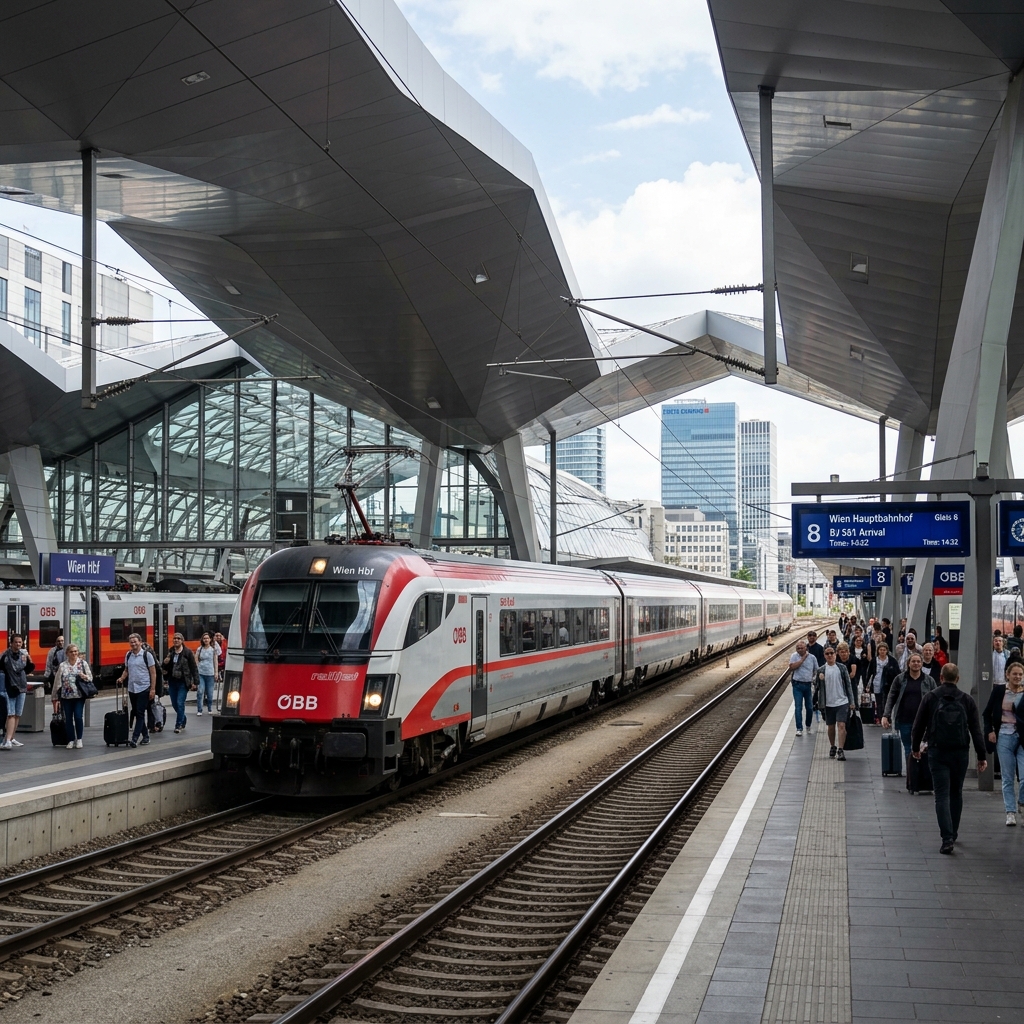
Vienna is a city that does not try to impress you. It simply is, and that is more unsettling than any spectacle. The coffee houses expect you to sit for two hours over a single Melange. The Staatsoper sells standing tickets for four euros. The wine taverns on the hillsides above the city only open when a pine branch hangs outside the door, and they close when the barrel runs dry. These are not tourist attractions. They are how the city lives.
Getting here is easy. Vienna sits at the geographic centre of Europe’s rail network, connected to Budapest in 2 hours 40 minutes, Salzburg in 2 hours 30 minutes, Munich in under 4 hours, and Prague in around 4 hours. It is also one of the principal hubs of the ÖBB Nightjet network, meaning you can wake up in Vienna having boarded an overnight train in Hamburg, Amsterdam, Paris, or Rome. The city rewards the traveller who arrives by rail. The pace of the train matches the pace of the place.
TL;DR: Vienna is reachable by train from Budapest (2h 40min from around €19), Bratislava (1h), Salzburg (2h 30min), Munich (under 4h), and Prague (around 4h). Wien Hauptbahnhof opened in 2015 and handles everything in one place. Plan for at least 4 nights, 6 or 7 lets the city open up properly. Standing tickets at the Staatsoper cost from €4, and Viennese coffeehouse culture is listed by UNESCO as an intangible cultural heritage (UNESCO, 2011).
Why Is Vienna One of Europe’s Great Train Destinations?
Vienna’s position on the European rail map is almost too convenient to believe. Wien Hauptbahnhof, the city’s main station, opened in 2015, handles roughly 150,000 passengers per day and connects Austria to ten neighbouring countries by direct rail (ÖBB, 2026). The station is also a major Nightjet hub, meaning overnight trains from five different countries terminate and originate here. No other city of Vienna’s size sits at quite this many intersections simultaneously.
The practical effect is that Vienna fits into almost any Central European rail itinerary without awkward detours. Budapest to Salzburg? Change in Vienna. Prague to Ljubljana? Vienna is the natural midpoint. Come for four nights, leave by train in any direction, and continue. The city earns its position on the route rather than being added to it as an obligation.
Vienna is the only major European capital where the overnight train network genuinely serves you in all four cardinal directions. East to Budapest and Bratislava, west to Munich and Zurich, north to Prague and Hamburg, south to Rome. That geographic reality shapes what kind of trip Vienna can be, not a destination you fly into and fly out of, but a pivot point in a longer journey.
planning a European rail itinerary
How Do You Get to Vienna by Train?
Budapest to Vienna: The Railjet Flagship Route
The ÖBB Railjet from Budapest-Keleti to Wien Hauptbahnhof runs in 2 hours 40 minutes with services roughly every two hours throughout the day. Advance fares start around €19 in second class, with standard pricing around €35–€55 (ÖBB, 2026). This is the headline route in both directions, fast, comfortable, and far more pleasant than flying once you account for airport transfers at both ends.
The Railjet is ÖBB’s flagship intercity product. Leather seats, individual power outlets, a bistro car with Austrian food and wine, and a dedicated quiet zone carriage make the journey feel like it costs more than it does. There is a border check at Hegyeshalom, Hungary is Schengen but not Schengen-smooth for all documents, so have your passport or ID accessible. The crossing takes five minutes and rarely causes delay.
all you need to know about Budapest by train
Salzburg to Vienna: 2 Hours 30 Minutes Through Alpine Country
Salzburg to Vienna takes 2 hours 30 minutes by direct Railjet or ICE service, with trains running frequently throughout the day. Advance fares through ÖBB start from around €14; walk-up fares run €25–€45 (ÖBB, 2026). The route crosses the Austrian flatlands east of the Alps and is straightforward to book through ÖBB directly. It is also one of Austria’s busiest domestic rail corridors, which means capacity is high and delays are rare.
If you are building a Salzburg-Vienna itinerary, the train genuinely has no competition. The road between the two cities is heavily trafficked and the journey by car takes over three hours in good conditions. The train is faster, cheaper when booked ahead, and deposits you directly into central Vienna rather than a car park on the edge of it.
Munich to Vienna: Under 4 Hours by ICE
The Munich to Vienna route covers around 480 km in just under 4 hours by direct ICE or Railjet service. Trains run roughly every two hours and are operated jointly by Deutsche Bahn and ÖBB. Advance fares start around €29, though peak-period pricing rises considerably (Deutsche Bahn, 2026). The route passes through Salzburg, making it easy to break the journey there if you want to split the distance.
Munich is a natural gateway for travellers arriving into Central Europe from Western Germany or flying into one of Bavaria’s airports. The train slot is comfortable enough, most people sleep or work, and you arrive at Wien Hauptbahnhof in the early afternoon having departed Munich after breakfast.
Prague to Vienna: 4 Hours by Railjet
The direct Railjet from Prague Hlavni Nadrazi to Wien Hauptbahnhof takes approximately 4 hours and operates several times daily (Czech Railways, 2026). The route passes through Brno, Austria’s second city Linz, and the Moravia countryside, genuinely scenic in the middle section. Fares start around €19–€29 booked well in advance. The Czech Republic is Schengen but not eurozone, so carry your card and check the currency situation in advance if you’re stopping in Prague.
Prague and Vienna share a cultural weight that makes this corridor feel like more than a commuter link. Both cities were capitals of major European empires, both have world-class museums and music scenes, and both repay slow attention. A week split between the two, travelling between them by train, is one of the more satisfying itineraries Central Europe offers.
Bratislava to Vienna: 1 Hour, Europe’s Closest Capital Pair
Bratislava to Vienna is one hour by direct train, making these the two closest national capitals in Europe by any measure. Regular EC and Railjet services connect Bratislava Hlavna Stanica with Wien Hauptbahnhof throughout the day, with fares from under €15 (ÖBB, 2026). The proximity makes a day trip between the two cities entirely natural, though Bratislava deserves at least one overnight if you can manage it.
If you are travelling the Vienna-Budapest corridor, stopping in Bratislava between the two is straightforward, you do not need to backtrack. One train from Budapest to Bratislava, an evening there, then a morning train into Vienna: a three-city itinerary that adds almost no extra time.
Nightjet from Vienna: The Overnight Hub
Vienna is one of the most important Nightjet hubs in Europe. ÖBB Nightjet services depart Wien Hauptbahnhof overnight to Hamburg, Amsterdam, Paris, Rome, and Zurich, plus seasonal and additional connections (ÖBB Nightjet, 2026). The Zurich service takes around 8 hours, arriving in the Swiss morning. The Paris service is approximately 15–17 hours. The Rome service crosses the Brenner Pass overnight and arrives mid-morning.
Booking a Nightjet into or out of Vienna means you can use the overnight hours as both travel time and a hotel night. A couchette from Vienna to Paris costs roughly €49–€99 booked in advance. That replaces both a short-haul flight and a night of accommodation. The arithmetic is compelling.
the complete guide to European night trains
What Is Wien Hauptbahnhof Like?
Wien Hauptbahnhof opened in 2015, replacing the old Südbahnhof that had served Vienna since the 19th century. It is a purpose-built terminal station, all platforms at one level, all under one enormous slanted glass roof, designed to handle everything in a single building (ÖBB, 2015). The design is clean without being cold, and it works in the way that most modern European stations aspire to but do not achieve.
The station contains a shopping mall with over 90 outlets, multiple restaurants and bakeries, a supermarket, pharmacy, currency exchange, and left-luggage facilities. There is free WiFi throughout. U-Bahn line U1 connects directly to the city centre in around 8 minutes to Karlsplatz. The D tram line also stops outside the main entrance and serves the Ringstrasse, which is useful if you’re staying near the first district.
One thing worth knowing: Wien Hauptbahnhof is a terminus, not a through station. Trains from the west (Salzburg, Munich) and south (Italy) arrive here on ground-level platforms and stop. Trains from the east (Budapest, Bratislava, Prague) also terminate here. You do not need to worry about being on the wrong side of the city for different routes, everything comes to the same place.
[IMAGE: The modern glass and steel exterior of Wien Hauptbahnhof in daylight with passengers entering the main hall, search terms: Wien Hauptbahnhof exterior modern station Vienna]
What Is the ÖBB Railjet Like?
The Railjet is ÖBB’s flagship intercity train and the vehicle you will spend most time on if you travel the Austrian rail network. First introduced in 2008, it has been the workhorse of the Vienna-to-everywhere network for nearly two decades. Understanding what the train offers helps you decide what class to book and whether the upgrade to Business is worth it.
Economy class gives you a comfortable reclining seat with a fold-down table, power outlet at every seat, and space for luggage above and below the seat. Carriages are clean and well-maintained. It is a notch above most European second class without being premium. On daytime journeys under four hours, economy is the right call for almost everyone.
First class on Railjet offers wider seats, more legroom, and slightly less crowded carriages. The experience is quieter and the seat pitch is noticeably more generous. Worth booking if you are travelling with a laptop and need space to work, or if you want to eat in the bistro car and return to an undisturbed seat.
The quiet zone is a designated carriage where calls and loud conversation are discouraged. This is one of the most useful features on Austrian long-distance trains and is enforced more consistently than on most European equivalents. If you want to read or sleep, book a seat in the quiet zone explicitly, it is marked when booking through ÖBB.
The bistro car is a full service car with hot food, Austrian wines, Ottakringer beer, coffee, and snacks. Prices are reasonable by railway standards. A Wiener Schnitzel with a beer will cost around €12–€16. It is worth at least one visit.
[CHART: Comparison table, ÖBB Railjet class options, Economy: from €14 advance / First: from €29 advance / Business (select routes): premium supplement, features: power sockets, quiet zone, bistro car availability, Source: ÖBB timetable 2026]
What Should You Do in Vienna as a Slow Traveller?
The Coffee Houses: An Institution, Not a Refreshment Stop
Vienna’s coffeehouse culture is listed as an intangible cultural heritage by UNESCO, a recognition that what happens in a Viennese cafe is not a transaction but a way of organising time (UNESCO, 2011). A single small coffee, a Kleiner Brauner or a Melange, entitles you to sit for as long as you wish. Newspapers hang on wooden racks at the door. Waiters in black uniforms do not ask if you need anything until you ask them first. You are left entirely, deliberately, alone.
Cafe Central on Herrengasse is the most historically weighted of the Vienna cafes. Opened in 1876 inside the Palais Ferstel, it has a vaulted ceiling, marble columns, and a list of former regulars that includes Trotsky, Lenin, Freud, and the young Adolf Hitler, all at various tables, at various points, before the 20th century complicated the world. The coffee is excellent. The Apfelstrudel is one of the best in Vienna. Come between 9am and 11am to get a table without queuing.
Cafe Hawelka on the Dorotheergasse is smaller, darker, and more closely associated with Vienna’s postwar literary and artistic scene. Oswald Hawelka, who ran the place for decades, died in 2011 at age 100. The atmosphere he created, smoky, slightly shabby, intimate, is more or less unchanged. Order the Buchteln if they are available (baked yeast dumplings with jam, served warm, only in the evenings).
Cafe Landtmann, near the Burgtheater on the Ring, is where politicians, journalists, and the city’s professional class have their breakfast meetings. It is slightly more expensive and slightly more formal than the others. Worth visiting once to understand the social calibration of the Viennese coffee house, where every cafe has a different class of regular and the regulars know who they are.
[IMAGE: The elegant interior of Cafe Central Vienna with its vaulted arched ceiling, marble pillars, and guests seated at small cafe tables, search terms: Cafe Central Vienna interior vaulted ceiling coffeehouse]
The Markets: Where Vienna Actually Shops
The Naschmarkt is Austria’s most famous food market and runs along the Wienzeile through the 6th district, six days a week (Monday to Saturday, closed Sunday). Around 120 stalls sell fresh produce, spices, cheeses, Viennese sausages, Middle Eastern and Turkish groceries, olives, pickles, fresh fish, and a great deal of street food prepared on the spot (City of Vienna, 2026). It has been a market in some form since the 16th century.
The best version of a Naschmarkt visit is a weekday morning, before 11am, when the stalls are freshest and the crowds are thinner. Saturday mornings bring a flea market alongside the food market, which extends the browsing considerably. Come hungry and plan to eat rather than buying ingredients to cook.
For a less touristic experience: The Brunnenmarkt in the 16th district (Ottakring) is Vienna’s longest open-air market and primarily serves the neighbourhood’s immigrant community, Turkish, Bosnian, and Serbian traders run most of the stalls. The produce is excellent and prices are noticeably lower than the Naschmarkt. Locals who know both markets often prefer Brunnenmarkt for everyday shopping. Take the U3 to Ottakring and walk south along Brunnengasse.
The KHM: One of the World’s Great Art Collections
The Kunsthistorisches Museum, the KHM, contains one of the greatest collections of Habsburg imperial art in the world, built over four centuries and housed in a building that is itself a statement of imperial ambition. Opened in 1891 on the Ringstrasse, it holds works by Vermeer, Raphael, Velazquez, Caravaggio, Titian, and the world’s largest collection of paintings by Pieter Bruegel the Elder (KHM, 2026). Entry costs around €21 for adults.
Do not try to see everything. The museum contains over 700,000 objects across multiple departments, you could spend a week here and not exhaust it. Instead, choose two or three rooms and spend genuine time with them. The Bruegel collection on the first floor is the reason many serious visitors come. The Egyptian and Near Eastern antiquities on the ground floor are undervisited and extraordinary. Give yourself three hours minimum, take a break in the cafe on the ground floor, and go back if you have time.
[IMAGE: The grand staircase of the Kunsthistorisches Museum Vienna with its ornate marble columns and painted ceiling, search terms: Kunsthistorisches Museum Vienna interior grand staircase]
Walking the Ringstrasse: Architecture as History Lesson
The Ringstrasse is a 5.3 km boulevard built between 1857 and 1914 on the orders of Emperor Franz Joseph I, who demolished the medieval city walls to make space for a monumental statement about Austro-Hungarian power (Vienna Tourism, 2026). What he built, or commissioned, was a concentrated mile of public buildings in competing historical styles: the Parliament in Greek Revival, the Burgtheater in Renaissance, the Rathaus in Flemish Gothic, the Opera in French Renaissance, the KHM and Natural History Museum in Baroque. All within walking distance of each other, all built within a fifty-year window.
Walking the Ring takes around 90 minutes at a thoughtful pace. Start at the Opera, walk the full loop, and treat each building as a chapter in the story of a dying empire trying to look eternal. It is one of the most instructive walks in European architecture. The buildings are still in use, parliament meets in the Parliament building, the Rathaus hosts the mayor, the Opera runs nightly performances. Vienna did not build a museum of itself. It just kept using the thing.
European cities worth exploring slowly on a rail trip
The Staatsoper: Standing Tickets from €4
The Vienna State Opera is consistently ranked among the world’s top three opera houses. It stages around 300 performances per year across opera and ballet, with a different production almost every night of the season (Wiener Staatsoper, 2026). Standing tickets, Stehplatz, cost €4 for the rear parterre and up to €8 for the side standing areas, available from 80 minutes before each performance. This is not a well-kept secret among serious opera-goers, but it remains one of the most extraordinary value propositions in European cultural life.
You do not need formal wear for standing areas. A queue forms at the Stehplatz entrance around two hours before performance time. Arrive early for a better position. Some standing regulars tie a scarf to the rail to mark their spot and then leave to eat dinner, this is accepted practice. The acoustic quality in the standing parterre is excellent. You will hear Verdi or Strauss performed at world-class level for the price of a coffee.
A practical note: Check the Wiener Staatsoper’s online calendar before you travel and identify two or three performances during your stay. Standing tickets cannot be booked in advance, they are sold in person only, from the Stehplatz entrance on the southwest side of the building. This forces you to plan around the Opera’s schedule rather than your own, which is exactly the right relationship to have with it.
The Heuriger: Vienna’s Wine Taverns Above the City
The Heuriger is Vienna’s specific contribution to wine culture, a tavern, typically family-owned, that serves wine from the current vintage grown on its own vines, alongside cold food: bread, butter, lard, pickles, cheeses, and occasionally hot dishes. They operate in the wine-growing villages on the edge of the city: Grinzing, Nussdorf, Stammersdorf, and Gumpoldskirchen on the outer southern reaches. The most important detail about a Heuriger is the sign outside the door: a pine branch hanging above the entrance means the tavern is open. No branch, no entry. They close when the wine runs out.
The tradition dates to a 1784 edict by Emperor Joseph II permitting wine growers to sell their own produce directly to the public. It is one of the oldest unbroken hospitality traditions in Austria. The wines are primarily Grüner Veltliner and Riesling from the Vienna wine region, the only major capital in Europe with significant commercial vineyards within city limits (Austrian Wine, 2026).
Get the U4 to Heiligenstadt and walk fifteen minutes to Nussdorf. Mayer am Pfarrplatz is the most famous Heuriger in the area and has the history to justify it, Beethoven lodged here in 1817. It is reliably open and reliably good. For a less famous and more local experience, walk further into Nussdorf and follow the pine branches.
[IMAGE: A traditional Viennese Heuriger wine tavern courtyard in autumn with wooden benches, a pine branch above the door, and guests drinking local white wine, search terms: Heuriger Vienna wine tavern courtyard Austria]
The Food: What to Eat in Vienna
Vienna’s food is serious without being solemn. It draws from an empire that once covered Italy, Hungary, Bohemia, and Croatia, and the cuisines crossed borders along with the politics. What the Viennese kept was the best of it.
Wiener Schnitzel must be veal (not pork, which is a Schweineschnitzel) to be correctly named, pounded very thin, breaded in fine breadcrumbs, and fried in clarified butter until it blisters and waves. The schnitzel at Figlmüller Wollzeile is the benchmark: it overhangs the plate on all sides, costs around €22, and is worth every cent (Figlmüller, 2026). Book ahead for dinner; the lunchtime queue moves faster.
Tafelspitz is boiled beef, specifically, a cut from the rump of the animal, served with a light broth, chive sauce, and Rösti-style fried potatoes. It is the definitive Viennese bourgeois dish: modest in appearance, demanding in technique, deeply satisfying in the eating. Plachutta on Wollzeile is the canonical address.
Sacher Torte is a dense chocolate cake with a layer of apricot jam beneath a hard chocolate glaze, served with unsweetened whipped cream. The original is at Hotel Sacher on Philharmonikerstrasse, where it has been made to the same recipe since 1832. Expect a queue. The cafe inside serves it with coffee; you can also buy a boxed cake to take home or onto the train.
What Day Trips Can You Take by Train from Vienna?
Salzburg: 2 Hours 30 Minutes
Salzburg is the most practical day trip from Vienna and one of the most rewarding. The city is built around the Hohensalzburg Fortress, one of the best-preserved medieval castles in Central Europe, and along the Salzach River, with a Baroque old town that is UNESCO-listed and compact enough to cover comfortably on foot in a day (UNESCO World Heritage, 1997). Mozart was born here, which matters to some people and is inescapable regardless.
The train from Wien Hauptbahnhof takes 2 hours 30 minutes and runs frequently. You can leave Vienna at 8am, be in Salzburg by 10:30am, spend a full day, and return by early evening. Alternatively, stay overnight and treat it as a mini-trip within the trip. The city has a different energy from Vienna, smaller, more compact, slightly more Alpine in character, and rewards being seen with fresh eyes.
Bratislava: 1 Hour
Bratislava is 1 hour from Vienna by direct train and costs almost nothing to reach. The Slovakian capital sits on the north bank of the Danube, with a hilltop castle that predates most of the city visible from trains approaching from the west. The old town is small and walkable. The food is cheap. The craft beer scene has developed sharply in the last decade and is worth exploring.
Bratislava is a natural half-day or day addition to a Vienna trip. It does not need to be turned into a full destination, but dismissing it entirely means missing a city with its own distinct Central European identity. Combined with Budapest and Vienna on a single multi-day rail itinerary, the three cities together make a compelling argument for the slow train approach.
Hallstatt: Around 3 Hours via Attnang-Puchheim
Hallstatt is a village on the Hallstätter See in the Salzkammergut, clinging to a narrow strip of lakefront between steep Alpine cliffs and the water. It is one of the most photographed villages in Austria and one of the most visually extraordinary places in the country. Getting there by train requires a change at Attnang-Puchheim onto the regional Salzkammergut Bahn, then a short ferry across the lake from Hallstatt station, total journey around 3 hours (ÖBB, 2026).
It is not a comfortable day trip from Vienna, three hours each way means you arrive around noon and need to leave by mid-afternoon to make a reasonable return. Better to stay overnight in the village (accommodation is limited but bookable) or base yourself in Bad Ischl and visit Hallstatt as a local excursion. Go mid-week in shoulder season if you can; summer weekends bring tour buses from multiple countries simultaneously and the village’s extraordinary quality gets buried in selfie-stick crowds.
scenic train routes and journeys through the Alps
How Long Should You Stay in Vienna?
Four nights is the honest minimum, long enough to cover the KHM properly, walk the Ring, find a good coffee house, eat Schnitzel at Figlmüller, and get to a Heuriger without rushing any of it. But Vienna is a city that does not give up its best things immediately. The first day is disorientation. The second day is understanding. The third day is the one where the Staatsoper standing ticket feels like it was your idea all along.
Six or seven nights gives you a day trip to Salzburg or Bratislava, a slower morning at the Naschmarkt, a second museum visit, and the kind of wandering that takes you into the 7th or 9th districts where the city lives rather than performs. If you are working with a two-week European rail itinerary, Vienna can justify four to five of those days without apology.
Vienna is not cheap. By Central European standards, it sits at the high end, comparable to Munich or Amsterdam rather than Budapest or Prague. A mid-range hotel runs around €90–€150 per night; a main course at a traditional restaurant, €15–€25; coffee and cake at a proper Kaffeehaus, €7–€12 (Numbeo Cost of Living, 2026). The Opera tickets and the Heuriger are the genuine exceptions to this, and they are memorable enough to justify the rest.
Related Reading
- Vienna for Slow Travellers: The City That Invented the Art of Sitting Down, Vienna has been perfecting the café, the concert hall, and the long afternoon for two centuries.
- Munich to Vienna by Train: Railjet Times, Tickets and the Salzburg Option, The Railjet from Munich to Vienna takes 4 hours and costs from €19.
- The Adriatic Coast by Train and Ferry: Italy to Croatia Slow, Travel the Adriatic slow: Italy’s coastal rail line from Bologna to Bari, then overnight ferry to Split and…
Frequently Asked Questions
How do I book trains to Vienna?
Book directly through ÖBB for the widest range of fares and accommodation types, including Nightjet services. Booking windows open 180 days before departure. Advance fares from Budapest, Bratislava, and Salzburg start around €14–€19; from Munich around €29; from Prague around €19–€29. Trainline carries most ÖBB inventory and is useful if you want a single booking platform for multi-leg journeys (ÖBB, 2026).
Do I need to book a seat reservation on trains to Vienna?
On ÖBB Railjet and ICE services into Vienna, seat reservations are included automatically when you buy a point-to-point ticket through ÖBB or Trainline. If you are travelling on a Eurail or Interrail pass, a mandatory reservation fee applies separately, typically €3–€9 on Railjet services depending on route (Eurail, 2026). Book pass reservations at oebb.at or at any staffed ÖBB ticket office.
What is the best area to stay in Vienna?
The 1st district (Innere Stadt) puts you within walking distance of the Ring, the coffee houses, the Opera, and the KHM, but commands the highest hotel prices in the city. The 7th (Neubau) and 8th (Josefstadt) districts offer excellent restaurants and independent shops at 20–30% lower accommodation prices, with easy U-Bahn access to the centre. Both are good bases for a slow-travel approach, residential enough to feel like the city, central enough to walk to most things.
Is the Viennese coffee house culture really that different?
Yes. The legal and cultural weight behind it is real: UNESCO listed Viennese coffeehouse culture as an intangible cultural heritage of humanity in 2011, specifically recognising the custom of spending extended time at a table with minimal obligation to consume or leave (UNESCO, 2011). The distinction matters for a traveller. You are not expected to turn over the table. You are expected to settle in. The newspaper rack at the door, the glass of water with the coffee, the inattentive waiter, these are not failures of service. They are the service.
Can I visit Vienna on a Eurail pass?
Austria is covered by the Eurail Global Pass and by the Austria-specific national pass. Within Austria, all ÖBB domestic services are included, along with international Railjet services to Germany, Hungary, and Switzerland, though reservation fees apply on most routes (Eurail, 2026). For the Vienna-Budapest corridor specifically, the train is cheap enough that point-to-point tickets (from €19) often pencil out better than a pass reservation plus the pass cost, unless you are combining Vienna with multiple other countries on the same trip.
Interrail vs Eurail, which pass is right for you
Vienna Repays Attention
The traveller who arrives in Vienna expecting to be entertained will be confused. The city does not perform. It proceeds. The coffee house does not greet you. The waiter will come when you signal. The opera house has four euros left in it if you know where to queue. The wine tavern up the hill will be open if the branch is hanging, and you will have to find out for yourself.
That is, in the end, the correct way to encounter a city. Not as a series of performances arranged for your convenience, but as a place with its own rhythms that you are temporarily permitted to join. Vienna’s rhythms are old and self-assured and genuinely pleasurable once you match them. The train helps with this. You arrive without the residue of airport security and middle-seat negotiations. You arrive with the journey still on you, and that is exactly the right state of mind for a city that rewards people who pay attention.
Come from Budapest or Prague or Salzburg. Stay longer than you planned. Take the standing ticket at the Opera and find a Heuriger before you leave.
planning a slow train journey through Central Europe night trains into and out of Vienna
Citation Capsule, Vienna rail connections: Wien Hauptbahnhof, opened in 2015, handles approximately 150,000 passengers daily and connects to Budapest in 2h 40min, Salzburg in 2h 30min, Prague in around 4h, and Munich in under 4h. It is also the primary ÖBB Nightjet hub, with overnight services to Hamburg, Amsterdam, Paris, and Rome. Advance fares on Railjet services from Budapest start from around €19 (ÖBB, 2026).
Citation Capsule, Viennese coffeehouse culture: UNESCO inscribed Viennese coffeehouse culture on its list of intangible cultural heritage of humanity in 2011, recognising the tradition of extended, unhurried time at a coffee house table as culturally significant. The custom includes a glass of water served with every coffee and the implicit right to remain at a table for as long as desired without further obligation to order (UNESCO, 2011).
Citation Capsule, Staatsoper standing tickets: The Vienna State Opera stages approximately 300 performances per year and sells standing tickets (Stehplatz) from €4, available in person from 80 minutes before each performance. The standing parterre at the rear of the stalls offers full acoustic quality. No formal dress code applies to standing areas (Wiener Staatsoper, 2026).