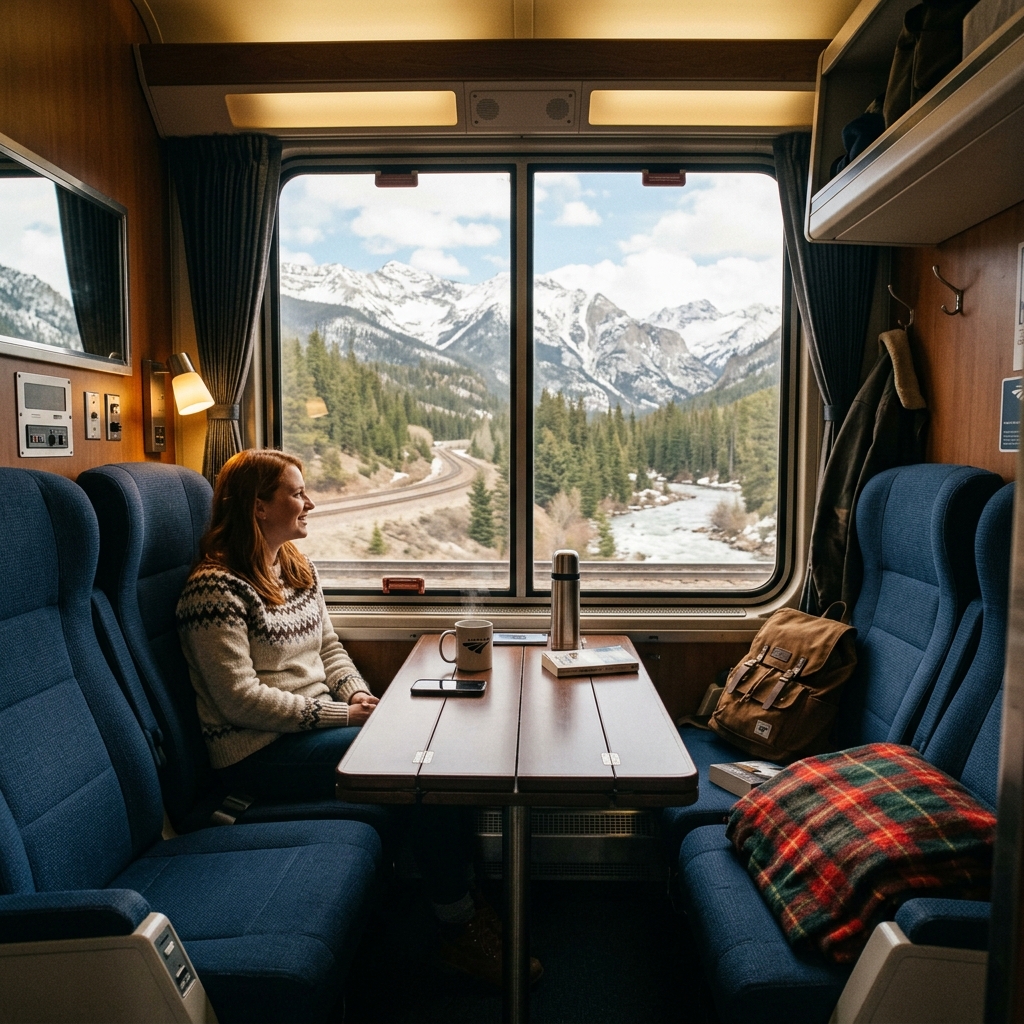
There are two ways to ride the California Zephyr. You can sit in coach for 52 hours, a wide, reclining seat, shared bathrooms, café car sandwiches, and arrive in San Francisco having crossed a continent. Or you can book a roomette: a private cabin, a proper bed, three dining car meals a day, and two nights watching the Rockies and the Sierra Nevada scroll past your window.
The roomette costs more. Whether it costs too much depends on how you count the value. This guide breaks down every detail, dimensions, pricing, what’s included, how upper and lower berths actually differ, and the one booking mistake that leaves people disappointed every summer.
TL;DR: A California Zephyr roomette runs roughly $200–500 per person one-way and includes all meals in the dining car, 8–10 meals over two nights, worth $200+ in food value alone. The cabin measures approximately 3.5 ft x 6.5 ft and sleeps two via upper/lower berths. Book as early as Amtrak allows (up to 11 months out); summer roomettes sell out months in advance (Amtrak.com, 2026).
What Is a California Zephyr Roomette?
A roomette is Amtrak’s entry-level private sleeping cabin on long-distance Superliner trains. According to Amtrak.com (2026), the Superliner roomette accommodates two passengers and measures approximately 3.5 feet wide by 6.5 feet long, compact by hotel standards, but entirely functional for a two-night train journey across America.
By day, two seats face each other beside a large picture window, separated by a fold-down table. An Amtrak car attendant converts the cabin to sleeping configuration each evening. The lower berth forms from the two facing seats; the upper berth folds down from above. Both include fitted sheets, a pillow, and a blanket.
The cabin has a door that closes, genuine privacy, which coach cannot offer. There’s a reading light for each berth, a power outlet, and hooks for coats and bags. Shared shower facilities sit at the end of the sleeping car, bookable through your car attendant.
why private space transforms long journeys
How Much Does a California Zephyr Roomette Cost?
Amtrak uses dynamic pricing, so roomette fares shift with demand and booking timing. Based on Amtrak.com fare data for 2026, the roomette surcharge (on top of the base rail fare) runs approximately $200–500 per person one-way on the full Chicago–Emeryville run, with peak summer dates pushing toward the upper end or beyond.
The base rail fare itself adds roughly $60–150. Total all-in cost for one person: around $260–650 depending on season and lead time. For two people sharing a roomette, you pay two roomette surcharges plus two base fares. That’s the important number to watch, because two roomette fares can approach bedroom territory when sleeper surcharges are high.
Amtrak reported 33 million passengers in FY2024 (Amtrak, 2024), a record that reflects surging demand for long-distance rail. Higher ridership means tighter inventory on popular routes, which directly affects how far ahead you need to book to find a roomette at a sensible price.
What’s Included in the Roomette Price?
The roomette surcharge includes meals, bedding, and lounge access, and that meal inclusion is where the value calculation changes entirely. According to Amtrak’s dining car menu (2026), dining car meals run approximately $15–30 per person for breakfast and lunch, and up to $40 for dinner with a full entrée.
Run the numbers for a two-person, two-night booking. Breakfast, lunch, and dinner each day across roughly two full days of travel works out to 8–10 dining car meals per person. At $15–30 each, that’s $120–300 per person in food alone, included in a roomette surcharge that might be $250–350 per person on an off-peak booking. The meal inclusion doesn’t just add value; on many bookings it effectively pays for the cabin.
Here’s what the roomette surcharge covers:
- All meals in the dining car, breakfast, lunch, and dinner for the duration of the journey
- Bedding, fitted sheets, pillow, blanket, converted by your car attendant each evening
- Turndown service, your attendant makes and unmakes the berths; you don’t handle this yourself
- Access to the Sightseer Lounge Car, the glass-domed upper-level observation car (all passengers have access, but it feels more natural as a sleeper passenger)
- Complimentary non-alcoholic beverages, coffee, tea, juice, and soft drinks throughout the journey
- Priority boarding at major stations
Coach passengers eat from the Café Car only, packaged foods, sandwiches, and snacks. They don’t have access to the dining car.
Roomette vs Bedroom, Which Should You Book?
For two passengers traveling together, the bedroom is worth comparing seriously against two roomette fares. Amtrak’s Superliner bedroom costs roughly $500–1,200 per room one-way, but accommodates up to two adults with a private toilet and sink inside the cabin, eliminating shared facilities entirely.
In practice, the shared shower situation in a roomette car is less of a problem than it sounds. There are one or two showers per Superliner sleeping car, and experienced Zephyr travelers book their shower slot early with the car attendant, typically a 7–8 a.m. slot works well before the morning rush. The showers themselves are clean and functional. For most couples, this is a minor inconvenience rather than a dealbreaker.
The rule of thumb: if two roomette surcharges are within $150 of a bedroom price, book the bedroom. You get a private toilet, more space, and no shared facilities. If there’s a significant price gap, common in shoulder season, the roomette is genuinely fine for most travelers.
What Does the Roomette Look Like? Dimensions and Layout
The Superliner roomette is not spacious. At roughly 3.5 feet wide and 6.5 feet long, it’s closer to a generous boat cabin than a hotel room. But the design is thoughtful, and the space is better used than the numbers suggest.
Daytime Configuration
The two seats face each other with a fold-down table between them. Both seats sit close to the large picture window, which runs most of the wall height. You can sit, read, eat, work, or simply watch the scenery. The table is wide enough for a laptop or a meal tray. Most solo travelers use the second seat as a footrest or bag storage.
Nighttime Configuration
The car attendant arrives around 9–10 p.m. to make up the berths. The lower berth converts from the two facing seats, it’s wider and more comfortable than the upper. The upper berth folds down from a recessed position above.
Here’s what most guides don’t tell you about berth choice. The lower berth is wider and easier to get in and out of, better for sleeping. But the upper berth, when you’re lying propped on one elbow, puts your eyes exactly at window height. On the Colorado sections, if you happen to wake at dawn with the train winding through the canyons, the upper berth view is genuinely extraordinary. Lower for sleeping comfort. Upper for scenic surprises.
The upper berth passenger uses a small fold-out ladder to climb up. There’s a safety net on the open side, a small individual window (separate from the main cabin window), and a reading light with personal controls. Lower berth passengers can see out the main window easily; upper berth passengers have the smaller side window.
Tips for Sleeping in a Roomette
The Zephyr runs on freight tracks, which means track joints, speed variations, and station stops throughout the night. Most people sleep reasonably well regardless, the motion is rhythmic and the berths are comfortable. A few things make a real difference.
Book the lower berth if you can. When reserving online or by phone, request lower berth assignment explicitly. It’s the same price. Lower is wider, has easier access, and converts more smoothly. Your car attendant may accommodate requests at boarding if inventory allows.
Use Amtrak’s quiet hours policy. Amtrak enforces quiet hours in sleeping cars from 10 p.m. to 7 a.m. (Amtrak Conductor Services Policy, 2026). This is actively enforced, not just a printed rule. Car attendants will address noise in the corridor. It makes a genuine difference to sleep quality, the sleeping car is measurably quieter than coach overnight.
Bring earplugs and an eye mask. The train makes noise, track joints, air brakes, the occasional station stop announcement. The berth curtain blocks corridor light but not completely. Both items are small and worth carrying.
Ask your attendant about morning timing. Car attendants begin converting berths back to seats from around 7:30 a.m. Ask yours the evening before what time they’ll need to turn your cabin, this lets you plan your morning without a rushed wake-up.
The overnight in Nebraska. Westbound passengers pass through the Great Plains overnight, which means you’re asleep for the flat sections and awake for Colorado. This scheduling is, in our experience, close to perfect.
Is the California Zephyr Roomette Worth It?
The roomette delivers measurable value when you account for meals. Amtrak’s dining car (2026) prices breakfast items at $8–14, lunch at $12–20, and dinner entrees at $20–35. A two-person journey covering two breakfasts, two lunches, and two dinners each adds up to roughly $160–280 per person in included food value, before accounting for the private cabin itself.
The honest comparison is not “roomette vs coach.” It’s “roomette vs coach plus two nights in a budget hotel plus all your meals.” The Zephyr is a 51-hour journey. If you’d otherwise be spending $120–180 per night on accommodation on the road, the roomette surcharge starts to look quite different.
There’s a less quantifiable argument too. The roomette is the reason the California Zephyr is a journey rather than a commute. Coach across 2,438 miles is an endurance test, achievable, but wearing. The roomette is a place to live for two days. You have a base. You watch the country from your own window. You eat dinner with strangers in a dining car and talk about where you’ve been. That shift, from passenger to traveler, is what the roomette actually sells, and it’s worth more than the spreadsheet shows.
The roomette is probably not worth it if you’re under 25, traveling alone on a very tight budget, or if you genuinely sleep well anywhere and don’t care about the dining car experience. For everyone else, and especially for couples, for travelers over 35, and for anyone who considers themselves interested in the experience of travel rather than just its destination, it’s hard to argue against.
How to Book a Roomette: Best Strategies
Amtrak opens bookings up to 11 months in advance, and for summer travel on the California Zephyr, that’s not too early. According to Amtrak’s booking data (2026), summer sleeper inventory on the Zephyr can sell out 3–6 months before departure, meaning a June trip booked in May may have no roomette availability at any price.
Book at Amtrak.com Directly
There’s no booking advantage to third-party sites for Amtrak. Book at Amtrak.com. The site shows real-time sleeper availability, lets you filter by accommodation type, and allows berth preferences to be noted. The Amtrak app mirrors this functionality and adds live train tracking.
Use Amtrak Guest Rewards Points
Amtrak’s free loyalty program (Amtrak Guest Rewards) accrues points on every journey. Points can be redeemed against roomette surcharges, not just base fares. Members who’ve ridden Amtrak before may have enough points to materially reduce a roomette booking. Enroll before your first trip; points can be added retroactively within a claim window.
Timing by Season
- Summer (June–August): Book 4–6 months out minimum. Roomettes on peak weekend dates sell out fastest.
- Fall (September–October): Book 2–3 months out. Colorado aspens in September are excellent. This is the sweet spot of season and availability.
- Spring (April–May): 6–8 weeks usually sufficient. Good value, lighter crowds.
- Winter (November–March): Most available, often lowest prices. Snow in the Rockies is spectacular; delay risk increases.
Call Amtrak for Complex Bookings
If you want specific berth assignments (lower vs upper) or have questions about group bookings or multi-segment itineraries, calling Amtrak’s reservations line often yields more flexibility than the website. Agents can flag preferences that the online system doesn’t surface as prominently.
Related Reading
- Amtrak Coast Starlight: The Complete Guide to America’s Most Scenic Train, The Coast Starlight runs 35 hours from Los Angeles to Seattle through California’s coast and the Cascades.
- The Best Scenic Train Routes in the USA: A Guide to America’s Great Rail Journeys, Amtrak’s long-distance trains are slow by European standards, frequently delayed, and entirely worth taking.
- The Adriatic Coast by Train and Ferry: Italy to Croatia Slow, Travel the Adriatic slow: Italy’s coastal rail line from Bologna to Bari, then overnight ferry to Split and…
Frequently Asked Questions
Do roomette prices include meals on the California Zephyr?
Yes, meals in the dining car are fully included when you book a roomette. Breakfast, lunch, and dinner are included for the entire journey. Dining car meals cost $15–35 per person if purchased separately (Amtrak.com, 2026), so across a two-night journey, the included meals alone can be worth $150–280 per person.
Can one person book a California Zephyr roomette alone?
Yes. A single traveler can book a roomette and pays the one-person base fare plus one roomette surcharge. You’ll have the cabin to yourself, both seats by day and both berths available at night, though only one will be made up. Solo roomette booking is common and entirely practical. Some solo travelers find the lower berth more comfortable with extra space.
What time does the California Zephyr dining car close?
The dining car typically serves breakfast from around 6:30–9:30 a.m., lunch from 11:30 a.m.–1:30 p.m., and dinner from 5:00–8:00 p.m. (Amtrak.com, 2026). Your car attendant will book your preferred dinner seating time the evening before. Exact hours can vary; confirm with your attendant on boarding.
Is the roomette private? Does it lock?
The roomette has a sliding door that closes fully and a privacy curtain. The door does not have a key lock, it latches from the inside, providing functional privacy rather than a security lock. In practice, this is not a problem on the California Zephyr. Valuables should be kept in the under-seat storage or on your person. The sliding door, when closed, provides genuine acoustic and visual separation from the corridor.
When should I book a California Zephyr roomette?
Book as early as Amtrak allows, up to 11 months in advance. For summer travel (June–August), booking in January or February is advisable. Fall dates (September–October) can often be secured 10–12 weeks out. Spring travel is more forgiving, 6–8 weeks usually works. Never assume availability will hold; roomettes on the Zephyr are the first inventory to sell out on popular dates (Amtrak.com, 2026).
Two Days Well Spent
The California Zephyr roomette is a simple proposition: you pay for a private cabin, and in return you get two nights of slow travel across the American continent, with your meals included and the Rockies outside your window.
It’s not the cheapest way to get from Chicago to San Francisco. It’s not supposed to be. What it offers is something the flight can’t: the experience of watching Nebraska give way to the Rockies, the Rockies give way to Utah’s canyons, and California arrive through a descent of the Sierra Nevada at dusk.
the philosophy behind choosing journey over destination
Book early, request the lower berth, and put yourself in the Sightseer Lounge car well before the train enters Glenwood Canyon. The roomette is waiting for you when you’re done.