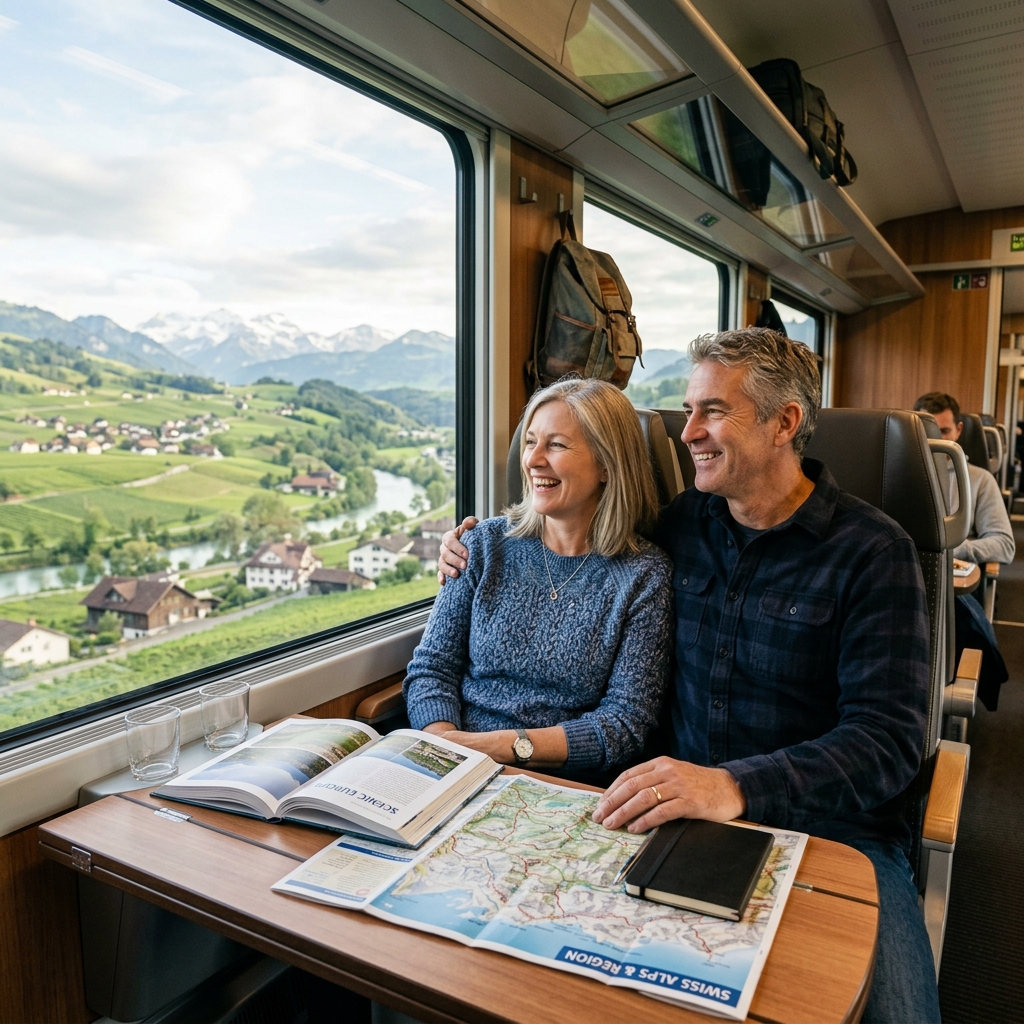
There is a reason the most elegant travelers in Europe’s first-class rail carriages tend to be over 50. They have learned something about what travel is actually for.
They have given up the itinerary that tries to see eight cities in twelve days. They understand that a morning spent sitting in a café watching a Viennese street is not wasted time, it is the point. They know that arriving by train, at a central station, with a bag they can manage themselves, produces a different quality of experience than the airport circus. And many of them have discovered, sometimes by accident, that there is a world of senior rail discounts that makes this style of travel significantly more affordable than it appears.
This guide covers the practical architecture of train travel in Europe for older travelers: the discounts, the accessibility realities, the overnight train question, and the routes most worth doing.
Why Train Travel Suits Older Travelers Better
The comparison that matters is not train versus car but train versus flying.
Flying in the modern era means arriving at an airport 90 minutes before departure, standing in security queues, sitting in cramped seats with no legroom, arriving at an out-of-town airport, and then taking a bus or train to actually reach the city centre, often exhausted. If your connecting flight is early, this means a 04:00 start. The entire experience is designed around throughput, not human comfort.
The train offers a different proposition. You arrive at a central station, often directly walkable to your hotel. The seat has legroom. You can move around. There is a dining car or at minimum a trolley service. The field passes at a pace where you can see it. You arrive, at another central station, often in the evening, in a condition to actually enjoy where you are.
For travelers with joint stiffness, back pain, or any difficulty sitting still for extended periods, the ability to get up and walk to the dining car is not trivial. For those who travel with medication that needs to be kept cool, train journeys are far easier to manage than flights. For anyone who simply does not want the indignity of the full-body scanner, the train is the clear alternative.
The slow travel philosophy, staying longer in fewer places, traveling between them at a pace that allows arrival and departure to be events rather than inconveniences, is structurally suited to the traveler who has left the time-poverty of middle career behind.
Senior Rail Discounts: Country by Country
Germany: BahnCard 50
The BahnCard 50 gives 50% off standard fares on all Deutsche Bahn trains. It costs approximately €255 per year for second class (€505 for first class), but there is a BahnCard 50 available at a reduced rate for those who hold an existing BahnCard 25 or qualify under DB’s senior pricing in some promotions.
At 50% off, a Munich to Berlin ICE fare that might cost €90 standard becomes €45. On a multi-week trip through Germany, this card pays for itself extremely quickly.
The BahnCard is available on the DB website and can be shipped internationally. It also qualifies you for the lower-price savings fares (Sparpreis) that would otherwise be unavailable to you. One BahnCard covers all DB services; Germany’s ICE network is comprehensive and fast.
France: SNCF Avantage Senior
The Carte Avantage Senior, available for travelers over 60, costs approximately €49/year and provides a minimum 30% discount on TGV, Intercité, and Ouigo services. In practice, the best advance-purchase TGV fares are available without the card; the card’s value is greatest on shorter-notice bookings where the cheap early fares have sold out.
The card is purchased on the SNCF Connect website. Given that a Paris–Nice TGV can easily cost €90–130 without discount, one or two journeys typically recover the card’s cost.
France’s TGV network connects Paris to Lyon (2h), Marseille (3h 20m), Bordeaux (2h 05m), and Strasbourg (1h 47m). The Paris–Amsterdam Thalys and Paris–Brussels service are among Europe’s most civilised journeys.
Italy: Trenitalia Carta Argento
The Carta Argento (Silver Card) for travelers over 60 costs €30/year and provides 30% off Trenitalia services including the Frecciarossa high-speed trains. As a baseline, a Rome–Florence Frecciarossa at full price runs €30–80 depending on booking timing; 30% off meaningfully changes the economics of a multi-city Italian itinerary.
The card does not apply to Italo trains (a private competitor). Italo is often cheaper than Trenitalia on competitive routes regardless, so compare prices on both before booking. The Carta Argento is available at Trenitalia ticket offices and online.
United Kingdom: Senior Railcard
The Senior Railcard (available for those over 60) costs £30/year and provides 1/3 off rail fares across most UK services. The annual saving typically exceeds the cost on a single London–Edinburgh or London–Penzance return journey. BritRail passes for international visitors come in Senior versions at reduced prices.
The UK rail network is complex (multiple operators, variable pricing) but the main intercity routes, LNER to Edinburgh (4h 30m), GWR to Cornwall (5h), Avanti to Glasgow (4h 45m from London Euston), are genuinely pleasant on the right rolling stock.
Switzerland: Half Fare Card and the GA Travelcard
Switzerland offers no specific senior discount but the Half Fare Card (Halbtax), approximately CHF 185/year, gives 50% off all Swiss Federal Railways (SBB) services and many boat and cable car connections. For any trip of more than a few days in Switzerland, this card transforms the economics. The scenic rail routes (Glacier Express, Bernina Express, Golden Pass) that Switzerland is known for become significantly more affordable.
The GA (General Abonnement) annual pass covers unlimited travel on all Swiss public transport, at approximately CHF 3,860/year for second class, it only makes sense for residents, but it illustrates the Swiss commitment to rail as infrastructure.
Interrail: 60+ Discount
Interrail passes, which allow unlimited rail travel across participating European countries for a set number of days, are available at a 10% discount for travelers over 60. The Global Pass covers 33 countries; One Country passes are available for individual nations.
The economics of Interrail depend on your itinerary and flexibility. The pass does not include fast-track Shinkansen-style reservations, which must be paid separately; on busy corridors like Paris–Madrid or Paris–Amsterdam, these reservation fees add up. But for spontaneous routing or complex multi-country itineraries, the flexibility has genuine value.
Accessibility on European Trains
Modern European high-speed trains have been designed with genuine accessibility in mind, not as an afterthought.
What Modern Trains Offer
The Trenitalia Frecciarossa, Deutsche Bahn ICE, French TGV, Belgian Thalys, and Austrian Railjet all feature:
- Step-free boarding at platform level (though platform height varies; major stations are consistent)
- Wide carriage doors and accessible lavatories
- Priority seating near carriage entrances
- Dedicated wheelchair spaces with associated companion seating, bookable in advance
- Wide aisles in most classes
The ICE in Germany is particularly well regarded for accessibility. The Frecciarossa on the Rome–Milan corridor is similarly good. On older rolling stock, particularly older regional trains in Southern and Eastern Europe, accessibility is more variable.
Station Assistance Services
All major European rail operators offer a pre-bookable assistance service for passengers who need help boarding, handling connections, or handling luggage.
- Italy: Trenitalia Sala Blu, book 12–24 hours in advance by phone or online; staff meet you at the station entrance
- Germany: DB Mobilitätsservice, book 24 hours ahead; comprehensive service covering the entire DB network
- France: SNCF Accès Plus, 24–48 hours notice; covers major TGV stations
- UK: Passenger Assist, bookable via the National Rail app or phone; covers the entire UK network
These services are free and genuinely useful. They are not only for passengers with deep mobility impairments; they are equally appropriate for anyone who wants to ensure a tight connection is managed smoothly, or who is traveling alone with heavy luggage.
Practical Seating Tips
When booking, select seats near the luggage storage areas at carriage ends, this eliminates overhead bin lifting entirely. First-class carriages on most European trains have seats with wider armrests, more recline, and more space; the price premium on many routes is modest, particularly with a senior discount card.
Request seats with the direction of travel if you are prone to motion discomfort. For window seats, the classic advice applies: the right side facing south usually has better views in the Alps and the Riviera.
Overnight Trains: The Nightjet and Other Options
The Nightjet network, operated by Austrian Federal Railways (ÖBB), has expanded significantly since its relaunch and new rolling stock introduction. Current routes cover:
- Vienna / Zurich → Amsterdam (new double-deck sleepers, 2023–24 rolling stock)
- Vienna → Brussels
- Vienna / Innsbruck → Berlin / Hamburg
- Zurich → Barcelona
- Various Austrian internal overnight services
The new Nightjet carriages are a meaningful upgrade. Private sleeper cabins are lockable from inside, have individual reading lights and climate control, and include linen and a light breakfast. Couchette carriages (4 or 6 berths, curtain rather than lockable door) are cheaper and comfortable enough for most purposes.
For the traveler over 50 who would otherwise be taking a 06:00 flight followed by an hour of ground transport, the overnight train represents something quite different: you board in the evening, have a drink in the lounge car if available, go to sleep in a private cabin, and arrive in the morning at a central city station, rested. The cost of the sleeper cabin, typically €80–150 on most routes, including breakfast, competes favorably with a budget hotel plus a flight plus airport transfers.
Book Nightjet through the ÖBB website or via Rail Europe/Eurail platforms. Sleeper cabins sell out weeks in advance on popular routes, particularly on Friday departures and during holiday periods.
Luggage: The Practical Reality
The luggage challenge on trains is real but manageable.
The core principle: travel with luggage you can handle alone. This means a wheeled carry-on bag (ideally 20–25 litres, or a standard airline carry-on size) that fits in floor-level luggage areas or overhead bins without lifting your arms above shoulder height. A 28-inch checked-bag-sized suitcase becomes genuinely awkward when boarding a busy regional train and finding a spot to stow it.
What helps:
- Many intercity trains have luggage racks at carriage ends with floor-level storage, no lifting needed
- Book seats near these areas when selecting seats
- At major stations, left luggage (deposito bagagli / consigne / Gepäckaufbewahrung) services are available for a fee of around €5–8 per piece per day
- Luggage forwarding services exist in some markets; in Switzerland, SBB will forward bags between stations (Reisegepäck service) reliably and cheaply
The packing principle: Everything you travel with should be liftable by you at your current capacity, whether or not assistance is available. This is not pessimism, it is the operational reality of independent rail travel. For multi-week trips, the discipline of packing light enough to be self-sufficient is the difference between effortless and effortful travel.
Medical Considerations
EHIC and GHIC
The European Health Insurance Card (EHIC, for EU citizens) and the Global Health Insurance Card (GHIC, for UK residents) entitle you to state healthcare in covered countries at the same rate as a local resident. This covers emergency treatment; it does not cover private hospitals, elective procedures, or repatriation.
Carry the card but do not rely on it as your sole medical coverage.
Travel Insurance for Over-50s
Travel insurance becomes both more important and more expensive with age. The key points:
- Declare pre-existing conditions. Non-disclosure voids your policy for related claims. It is not worth the saving.
- Medical repatriation cover: Ensure your policy covers emergency repatriation to your home country at adequate limits (£1M+).
- Single trip vs annual multi-trip: If you travel more than once a year, an annual policy is typically better value.
- Specialist insurers: Companies like Staysure, All Clear, and Saga (UK) or similar specialists in your country offer better pricing for older travelers with medical history than general-purpose insurers, who price age-related risk conservatively.
Prescriptions Across Borders
Carry a minimum of your regular medications for the entire trip plus a buffer. Within the EU, a prescription from your home country doctor is valid at pharmacies, but getting an identical formulation is not guaranteed. Carry the original packaging with the pharmacist’s label. A letter from your GP explaining your conditions and medications is useful for customs if you carry controlled substances.
Five Rail Routes Worth Your Time Over 50
1. The Swiss Scenic Trains
The Glacier Express (Zermatt to St Moritz, 7h 45m through 291 bridges and 91 tunnels), the Bernina Express (Chur to Tirano, crossing the Alps on a UNESCO World Heritage route), and the Golden Pass (Montreux to Interlaken and onwards) form a category of their own. These are trains designed to be the destination, not merely the transport. The panoramic windows, the altitude, the ice and the rock passing at carriage height, these journeys belong on any serious rail traveler’s list. Reserve well in advance; panoramic seats sell out.
2. The Douro Valley, Portugal
The Douro line from Porto Campanhã follows the Rio Douro east through terraced port wine vineyards, climbing slowly into the interior of Portugal. The section from Régua to Pinhão is the most celebrated: the valley narrows, the terraces become vertiginous, and the river below is a deep green. A two-day trip from Porto, train to Pinhão, overnight at a quinta, train back, costs very little and looks like a field painting for most of its length.
3. Andalusia: Seville, Córdoba, Granada
The AVE high-speed network connects Seville and Córdoba (45 minutes), and a new line serves Granada (under 3 hours from Madrid). Spain’s Renfe passes are available for international visitors. An Andalusian rail circuit, Madrid to Córdoba (2h from Puerta de Atocha), Córdoba to Seville (45m), then Seville to Granada (3h by bus since the rail line opened late 2024, or alternative routes), covers three of Europe’s finest cities of Islamic heritage in a manageable sequence. The Alhambra in Granada must be booked months in advance.
4. The West Highland Line, Scotland
Glasgow Queen Street to Mallaig via Fort William: 5h 30m through the Scottish Highlands, past Rannoch Moor, through Glenfinnan (where the Harry Potter viaduct crosses a loch), to the small port town of Mallaig. This is one of the most visually dramatic train journeys in Europe. The Caledonian Sleeper from London Euston overnight to Fort William makes this accessible from the south without a flight.
5. Vienna to Salzburg and Beyond
The Railjet from Vienna to Salzburg takes 2h 20m, fast enough to feel like a day trip, through the rolling Austrian landscape. Salzburg to Munich continues on the same train or an ICE connection. This corridor, complemented by the Nightjet network and the Austrian scenery, represents some of the most civilised train travel in Europe.
The Pace That Makes It Work
The philosopher Alain de Botton, writing about travel, noted that what we seek in a destination is often what we have failed to find at home: a certain quality of attention, a slowness of perception. Speed of transit, he suggested, works against this, we arrive too quickly to properly leave where we came from.
The train, particularly the overnight train, solves this in a way the flight cannot. You leave. The journey takes time. You arrive changed by the passage rather than merely teleported. At 50, 60, or 70, when the accumulation of experience has begun to shift what you want from travel, less novelty, more depth, the train’s pace is not a disadvantage. It is the whole point.
For the philosophy behind this approach to travel, see What Is Slow Travel?. For the specific winter and spring question of mountain rail travel, see The Glacier Express: A Complete Guide. For a guide to slower European travel for older travelers specifically, see Slow Travel for Seniors.
Related Reading
- Solo Female Train Travel in Europe: A Practical Safety Guide, The honest guide to solo female train travel in Europe, safety realities, booking strategies, night train tips, and…
- European Rail Passes: The Complete Buyer’s Guide (Eurail, Interrail, Point-to-Point), Eurail or Interrail?
- Interrail vs Eurail: What’s the Difference and Which Should You Buy?, Interrail and Eurail are the same pass, different eligibility.