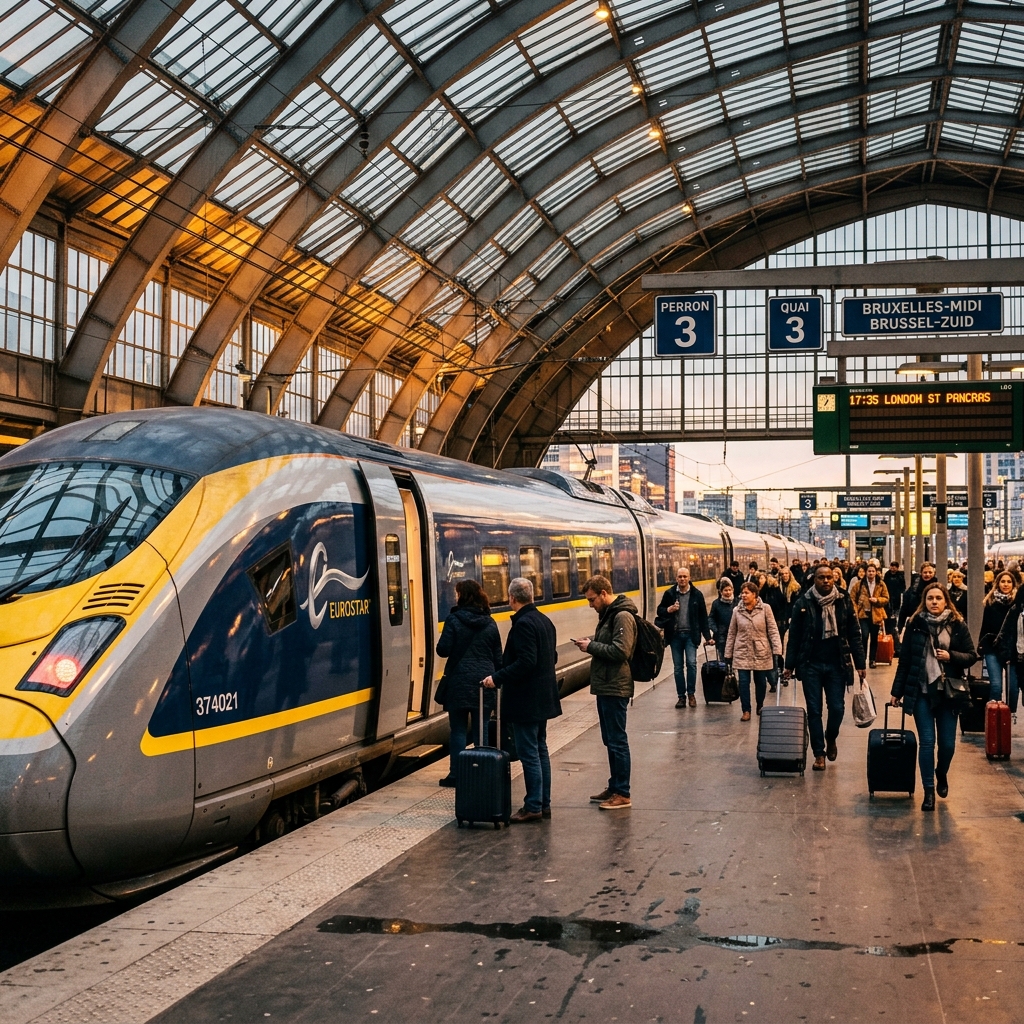
Brussels is the pivot of European rail travel. No city on the continent sits at the intersection of more international high-speed lines: London arrives by Eurostar in two hours, Paris by Thalys in 82 minutes, Amsterdam in 1h50, Cologne in under two hours by ICE. From Brussels, you can reach seven European capitals without leaving the train or entering an airport.
Most visitors pass through. The smarter move is to stop.
TL;DR: Brussels-Midi is Europe’s most connected station, London in 2h01, Paris in 1h22, Amsterdam in 1h50. Day trips to Bruges (55 min), Ghent (32 min), and Antwerp (38 min) are among the easiest in Europe. A 1-day Brussels rail pass (€8.90) covers unlimited IC travel within Belgium.
Brussels-Midi: Europe’s Most Connected Station
Brussels-Midi (Bruxelles-Midi / Brussel-Zuid) handles more high-speed international rail traffic than any other station on the continent, Eurostar, Thalys, ICE, and Intercity services converge here, connecting Belgium to six neighbouring countries. (SNCB/NMBS Annual Report, 2023). It is not the most beautiful station in Europe, but nothing else comes close for sheer connectivity.
International departures from Brussels-Midi:
- London St Pancras: 2h01 by Eurostar (multiple daily)
- Paris Gare du Nord: 1h22 by Eurostar/Thalys
- Amsterdam Centraal: 1h50 by Eurostar/Thalys
- Cologne Hbf: 1h47 by ICE
- Frankfurt: 3h10 by ICE
- Rotterdam: 1h15 by Thalys/IC
Getting from Brussels-Midi to the city centre: The station sits 2km southwest of the Grand Place. Metro lines 2 and 6 connect Midi to the Centre in about 10 minutes; tram lines 3 and 4 reach the centre in 15 minutes. Taxis queue outside the main hall. The walk along the improved Rue de France into the lower city takes roughly 30 minutes through uninspiring streets, the metro is the better choice.
What Does It Actually Cost? Main Route Fares at a Glance
Ticket prices across the Brussels rail network vary widely by flexibility and booking lead time. Advance fares on Eurostar can be less than a bus ticket; leave it to the last minute and you’ll pay four or five times more. The SNCB domestic fares are fixed regardless of how far ahead you book, a real benefit for spontaneous day-trippers.
| Route | Operator | Advance fare | Flexible fare | Journey time |
|---|---|---|---|---|
| Brussels–London | Eurostar | from €44 | €120–250 | 2h01 |
| Brussels–Paris | Eurostar | from €29 | €80–150 | 1h22 |
| Brussels–Amsterdam | Eurostar | from €29 | €80–130 | 1h50 |
| Bruges day trip | SNCB | €15.40 return | €15.40 | 55 min |
| Ghent day trip | SNCB | €11.80 return | €11.80 | 32 min |
| Antwerp day trip | SNCB | ~€13.60 return | ~€13.60 | 38 min |
SNCB domestic fares are flat, no dynamic pricing, no advance-booking requirement. A Bruges return costs the same whether you book a month out or walk up to the ticket machine that morning. This makes Belgian IC trains unusually forgiving for flexible travellers.
Eurostar: London to Brussels
The Eurostar from London St Pancras to Brussels-Midi takes 2 hours and 1 minute, centre-to-centre, faster than the equivalent flight once you factor in airport check-in, security, and transfers. Since 2023, Eurostar and Thalys have merged into a single company operating under the Eurostar brand, carrying over 18 million passengers annually across its network. (Eurostar Group Annual Report, 2023).
Booking: eurostar.com. Advance fares start around £39 one-way for non-flexible tickets. Standard Premier (wider seats, meal included) runs £120–180. Business Premier (fully flexible, lounge access) runs £200–300. Prices are typically quoted in sterling from the UK and euros from continental Europe.
At St Pancras: Arrive 60 minutes before departure minimum. The Eurostar terminal runs UK Border Force outbound controls, French border pre-clearance, and Belgian border pre-clearance, all before you board. Queues on Friday afternoons and Sunday evenings can run 30 minutes or more. The St Pancras concourse and the adjacent King’s Cross station have good food options if you arrive early. The Eurostar champagne bar on the upper level is the obvious place to wait if you have time to kill.
On board: Three classes. Standard seats are comfortable with a fold-down table and power sockets. There is no traditional buffet car; a trolley service runs. For a 2-hour journey this is adequate. Standard Premier includes a meal served at your seat, genuinely good quality for a train service.
Arriving at Brussels-Midi: Keep your passport handy; Belgian border control operates on arrival. Signage for metro, taxis, and street exits is clear enough. Pick up an SNCB domestic ticket from the machines in the main concourse if you’re continuing to Bruges or Ghent the same day.
Thalys/Eurostar: Paris and Amsterdam
Following the 2023 merger of Eurostar and Thalys, services operate under the unified Eurostar brand on these routes. The familiar red Thalys-liveried trains remain in service alongside the white Eurostar fleet, so don’t be surprised if your “Eurostar” to Paris is painted red.
Brussels to Paris (1h22)
Brussels-Midi to Paris Gare du Nord runs roughly 15–20 times daily. Trains reach 300km/h on the LGV Nord line north of Paris, making this one of the fastest point-to-point commercial rail connections in the world by city-centre-to-city-centre time. Advance fares from €29; flexible fares €80–150. Book at eurostar.com for cross-network combinations, a London–Brussels–Paris itinerary can be ticketed as a single booking.
Brussels to Amsterdam (1h50)
Brussels-Midi to Amsterdam Centraal runs via Antwerp and Rotterdam, cutting through the Randstad, the dense urban belt of Rotterdam, Delft, The Hague, and Amsterdam. The journey takes 1 hour 50 minutes. Advance fares from €29; book at eurostar.com or ns.nl.
Brussels to Cologne and Germany (1h47)
ICE trains operated by Deutsche Bahn connect Brussels-Midi to Cologne in 1 hour 47 minutes via Liège, climbing through the Vesdre valley before crossing the German border. From Cologne, onward ICE services reach Frankfurt (1h15 further), Munich, Berlin, and the rest of the Deutsche Bahn network. Book through bahn.de or Trainline. DB Sparpreis advance fares from €29.90 on many Brussels–German city routes.
The Belgian IC Network: Day Trips
Belgium’s domestic InterCity (IC) trains are operated by SNCB/NMBS and run on a clockface timetable, every 30 minutes on major corridors, hourly on secondary lines. The network covers the entire country efficiently, and the flat pricing means you can plan day trips without worrying about booking windows.
Bruges: What to See and When to Go
Bruges receives over 8 million visitors annually into a medieval centre designed for a fraction of that number, which makes timing everything. (Visit Bruges Tourism Statistics, 2023). The city before 9:30am and after 6pm is a different place from the midday crush of tour groups.
What to see in Bruges:
The Markt (Market Square) is the city’s centrepiece, a large cobbled square flanked by guild houses and dominated by the Belfry tower, which dates to the 13th century and offers 360-degree views over the city’s rooftops from its 83-metre height. The 366 steps are worth it. The carillon inside plays hourly; the bell tower’s mechanism is one of the most complete medieval examples in existence.
Canal boat trips run from five landing stages in the historic centre between 10am and 6pm (March–November). The 30-minute tours cover the Dijver canal system and pass under medieval stone bridges. They sell out quickly on summer weekends, book online or queue early.
De Halve Maan brewery (The Half Moon) on Walplein is the only remaining family-run brewery within the Bruges city walls. It still produces Brugse Zot and Straffe Hendrik on site. Guided tours run throughout the day; the tasting at the end is included. In 2016, the brewery installed a 3.2km underground pipeline beneath the city to deliver beer from the brewery to its bottling plant outside the walls, one of the more inventive pieces of Belgian infrastructure.
The Groeningemuseum holds the finest collection of Flemish Primitive paintings outside the major national museums, Jan van Eyck, Hans Memling, Gerard David. It opens at 9:30am. Going when it opens, before the coach groups, means you can stand in front of the van Eyck portraits undisturbed.
Day-trip timing that works: Take the first or second train from Brussels-Central (departures around 07:00–07:30). You’ll arrive in Bruges by 08:30, well ahead of the main tourist wave. Walk directly to the Markt for an early coffee, climb the Belfry when it opens at 9:30am, then the Groeningemuseum, then lunch, then the canal boat. Leave by 16:30–17:00 to beat the return crush. The IC back to Brussels runs every 30 minutes; last trains are well into the evening.
Avoid weekends in July and August if possible. Tuesday through Thursday the crowds are manageable. Weekends between June and August see the Markt and the towpath along the Dijver so packed that walking becomes slow. The canals are the same; the queue for boat tours runs 45 minutes or more by midday.
Ghent (32 minutes from Brussels)
Ghent is Brussels’s best day trip and one of the most underrated cities in northern Europe. It has approximately the same density of medieval architecture as Bruges, the Graslei and Korenlei canal-side quays, the Gravensteen (Castle of the Counts), the Cathedral of Saint Bavo with the Van Eyck Ghent Altarpiece, but a fraction of the tourist pressure and a large student population that keeps it genuinely alive.
The Ghent Altarpiece (Jan and Hubert van Eyck, completed 1432) was stolen by Napoleon, looted by the Nazis, negotiated through the Treaty of Versailles, and recently restored in a decade-long conservation project viewable through a glass wall in the cathedral. It is among the great paintings in European history, and it is in Ghent, largely unannounced.
Trains from Brussels-Central to Ghent-Sint-Pieters run every 15–20 minutes; the journey is 32 minutes and the return fare is €11.80. The historic centre is a 20-minute walk from the station, or take tram 1 directly.
Antwerp (38 minutes from Brussels)
Antwerp-Centraal station is the first reason to visit: a cathedral-like neo-baroque terminus opened in 1905, with a 75m dome, marble interiors, and four underground platforms added in 2007 without disturbing the original structure above. It is, without serious competition, the most beautiful railway station in Belgium and among the finest in the world.
Beyond the station: the Rubenshuis (Peter Paul Rubens’s home and studio), the Royal Museum of Fine Arts (with major Rubens, Bruegel, and Flemish masters collections), the Plantin-Moretus printing museum (a UNESCO site, with the world’s oldest printing press in its original location), and the diamond district that still handles approximately 80% of the world’s rough diamonds. (Antwerp World Diamond Centre, 2023).
The port, second largest in Europe by cargo volume, is visible from the waterfront promenade along the Schelde. The return fare from Brussels is approximately €13.60.
What to Do in Brussels
Brussels rewards at least two full days. The city has a slightly underdog quality, it’s not Paris, it doesn’t try to be, and that keeps it honest. The food is genuinely excellent. The beer culture is among the deepest in the world for a city this size.
The Grand Place: Victor Hugo called it the most beautiful square in Europe. The 17th-century guild houses that line it, rebuilt in six years after Louis XIV’s bombardment of 1695 demolished the city, are gilded, ornate, and collectively overwhelming. The Hôtel de Ville (Town Hall) anchors the south side. Visit at night when the facades are lit and the tourist coaches have gone.
Manneken Pis: The small bronze boy urinating into a fountain on the Rue de l’Étuve is among the most anticlimactic tourist sights in Europe, celebrated precisely because it is so absurdly modest for a city symbol. He is dressed in costumes by local organisations several hundred times per year; the collection of outfits is displayed in the Maison du Roi across the Grand Place.
The Atomium: Built for the 1958 World’s Fair, the Atomium is a 102m steel structure representing an iron crystal magnified 165 billion times. It should not work as an architectural gesture. It does work. The interior has a permanent exhibition on mid-century modernism and Expo 58; the upper sphere has a restaurant.
Museums: The Musée des Instruments de Musique occupies a gorgeous Art Nouveau building, the rooftop bar has Grand Place views and is worth the entrance fee alone. The Musée Magritte holds the world’s largest collection of René Magritte’s work. The Belgian Comic Strip Centre covers Tintin, the Smurfs, Lucky Luke, and the broader bande dessinée tradition that Belgium genuinely produced.
What to Eat in Brussels
Belgian food has an unfair reputation for being merely French food with better chips. In practice, Brussels is one of the most quietly serious eating cities in northern Europe. The local dishes are worth seeking out rather than eating around.
Moules-frites is the non-negotiable dish. Mussels cooked in white wine, shallots, and celery, served in the pot with a cone of frites alongside, the frites cooked twice in beef fat for a crust that holds under the steam. The mussel season runs roughly September through April. Most good brasseries on the Place Sainte-Géry and around the Ixelles area do a reliable version; the tourist-facing restaurants around the Grand Place are generally adequate but overpriced.
Carbonnade flamande is a Flemish beef stew braised slowly in Belgian dark ale, typically a Trappist or abbey beer, with mustard and thyme. It is darker and more mineral than a French daube; the beer gives it a faint bitter edge that fat and time soften. It is a winter dish, and most kitchens do it better in October than in July.
Waffles, and the distinction that matters: Brussels waffles are rectangular, light, and crispy, made with a yeasted batter and classically served plain, dusted with icing sugar. The versions sold with whipped cream, strawberries, and chocolate sauce on street carts are a tourist adaptation. A Liège waffle is different in every respect: denser, chewier, made with a brioche-style dough studded with pearl sugar that caramelises on the iron. Liège waffles are eaten warm, straight from the iron, without toppings. They don’t need any. Gaufres de Liège from a good street vendor, there are reliable carts near the Grand Sablon and in Ixelles, are among the best things you can eat in Belgium for under €3.
Chocolate: The concentration of serious chocolatiers along Rue au Beurre and around the Galeries Royales Saint-Hubert is genuine rather than decorative. Neuhaus (founded 1857, inventor of the praline), Pierre Marcolini, Wittamer, and Godiva all have addresses within a few minutes of the Grand Place. Marcolini’s single-origin bars are worth the price; Wittamer’s pastry counter is exceptional.
Frites from Maison Antoine: The friture on Place Jourdan in Etterbeek is frequently cited as the best frites in Brussels. It operates from a yellow kiosk, has no seating, and runs a queue on evenings and weekends. The frites are cooked in the traditional manner, twice fried in beef fat, served in a paper cone with sauce andalouse. Place Jourdan is a 15-minute tram ride from the Centre.
: In our experience, the Maison Antoine queue moves faster than it looks, expect 10–15 minutes on a weekday evening. The queue is part of the ritual.
Getting Around Brussels
Brussels has three main railway stations and a well-developed public transport network. Understanding which station serves which purpose saves significant time and avoids unnecessary taxi rides.
The three stations:
Brussels-Midi (Bruxelles-Midi / Brussel-Zuid) is the international hub. All Eurostar, Thalys, and ICE trains depart from and arrive at Midi. It is 2km southwest of the Grand Place. The station is functional rather than pleasant, large, busy, and prone to the kinds of petty crime that accumulate around major transport hubs in any city. Keep bags close.
Brussels-Central (Bruxelles-Central / Brussel-Centraal) is the most useful station for visitors. It sits directly below the historic centre, the Grand Place is a 10-minute uphill walk. All domestic IC trains stop here; it is the best departure point for Bruges, Ghent, and Antwerp day trips. It is smaller and easier to handle than Midi.
Brussels-Nord (Bruxelles-Nord / Brussel-Noord) serves the northern business district and some regional routes. Most visitors have no reason to use it unless their accommodation is in that area.
Metro, tram, and bus (STIB/MIVB): Brussels’s public transport network covers the city effectively. The STIB/MIVB 24-hour day pass costs approximately €8 and covers unlimited metro, tram, and bus travel from first validation. A single ticket bought in advance (from machines, the STIB app, or newsagents) costs €2.10; bought on board a tram it is €3. If you’re making three or more journeys in a day, the day pass is straightforwardly worth it.
Metro lines: Line 1 (east-west) and Line 5 (east-west, overlapping) are the most useful for visitors, running through the Centre and serving major museums. Lines 2 and 6 form a loop serving Midi, the Centre, and Nord. The network is not as extensive as Paris or London, trams fill the gaps in the outer neighbourhoods.
Walking within the centre: The historic centre around the Grand Place is compact and walkable. The lower town (around the Grand Place) and the upper town (Sablon, Palais Royal, European Quarter) are connected by a steep hill, there is a free museum elevator (the Magritte Museum end of the Rue Montagne-de-la-Cour) that avoids most of the climb.
Between Midi and Central on foot: The walk takes approximately 25–30 minutes via Boulevard du Midi and Rue de l’Hôpital. It is not a rewarding walk. The metro (line 2 or 6, one stop) takes 4 minutes.
: Visitors coming on Eurostar often miss Brussels-Central entirely, they arrive at Midi, take a taxi to their hotel near the Grand Place, and never realise that every domestic IC train also stops at Central. For day trips, it’s worth checking in to a hotel closer to Central than Midi, or at least knowing that Central is the right departure point.
Brussels as a Base for Wider Europe
Brussels’s greatest practical advantage is not what’s in the city, it is what the city makes reachable. No other European city gives you this range of day trips and regional connections from a single base: Bruges and Ghent by domestic IC train in under an hour, Paris and Amsterdam under two hours by high-speed rail, London two hours away on Eurostar.
The London to Paris train and London to Amsterdam train routes both pass through or connect via Brussels. This makes a Brussels stop a logical addition to either journey. The city works particularly well as a two-night break between London and Paris, or as the hub for a Benelux circuit, Amsterdam, Brussels, Bruges, and back, possible entirely without a car, using only IC and high-speed trains.
A useful sequence for a five-day rail trip: London → Brussels (Eurostar, day one) → Bruges day trip (day two) → Ghent day trip (day three) → Brussels to Amsterdam (Eurostar, day four, with a Rotterdam stop possible) → Amsterdam (day five). Every leg is a direct train. Total spend on rail: roughly €150–180 advance fares. No airports.
Related Reading: London to Paris by train, London to Amsterdam by train, How to book European trains