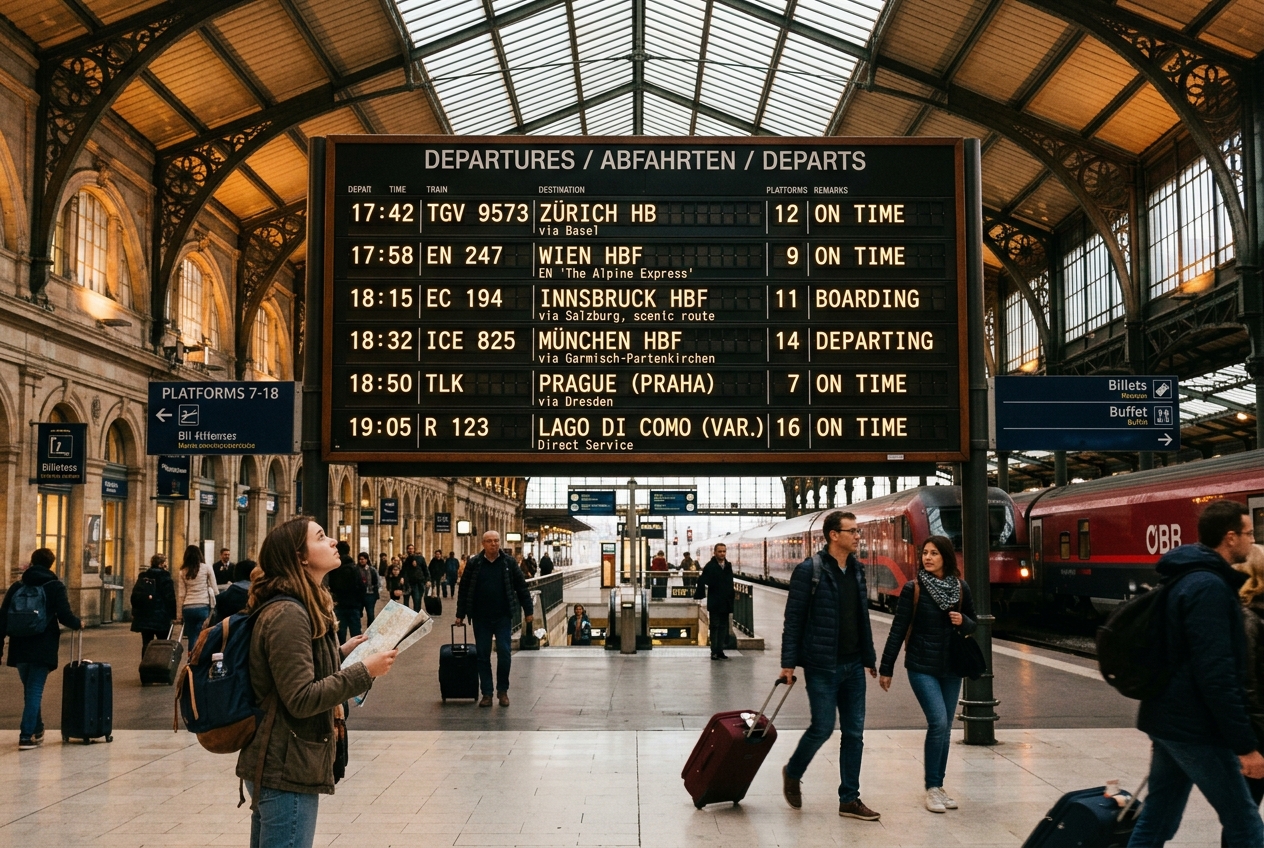
Three weeks on European trains is the trip that changes how you think about travel. Not because Europe is uniquely special — though it is — but because train travel forces a different pace. You watch the landscape change outside your window. You arrive in city centers, not airport suburbs. You meet the Swedish couple in the dining car and the Italian student in the corridor. And you never, once, remove your shoes for security.
This itinerary covers a logical arc through Western Europe over 21 days. It’s been tested twice — once in summer and once in early autumn — and refined to balance iconic cities with smaller places that make the journey between them feel like more than just transit.
It assumes a Eurail Global Pass or equivalent, though I’ll note where individual tickets might save money.
The Route at a Glance
Barcelona → Lyon → Swiss Alps → Lucerne → Munich → Vienna → Prague → Berlin → Amsterdam
Total train time: approximately 45-50 hours across all journeys. Average of 2-3 hours per train, with one overnight option.
Days 1-3: Barcelona, Spain
Start in Barcelona because the city rewards a few days more than a quick stop, and because the train connection north to France is one of Europe’s great rides.
Day 1: Walk the Gothic Quarter and La Rambla. Skip the tourist-trap restaurants on La Rambla itself — the side streets hide much better food at half the price. If you’ve booked ahead, visit the Sagrada Família interior (the light through the stained glass windows in the afternoon is worth the advance booking hassle).
Day 2: Park Güell in the morning (book timed entry), then Barceloneta beach and the El Born neighborhood. Eat pintxos (Basque-style tapas) in El Born — the small bars along Passeig del Born are excellent.
Day 3: Explore the Eixample neighborhood — Gaudí’s Casa Batlló and La Pedrera are here. Spend the afternoon at the Mercat de la Boqueria (go after 2pm when the crowds thin) and pack for tomorrow’s train.
Where to stay: The Gràcia or El Born neighborhoods offer the best combination of local atmosphere, good restaurants, and easy metro access.
Day 4: Barcelona to Lyon (Train Day)
The journey: Barcelona Sants → Lyon Part-Dieu, approximately 5 hours on the high-speed TGV through the south of France. Book a window seat on the left side for Mediterranean coastal views in the first hour.
Reservation required: Yes, €10-35 with Eurail Pass.
Arrive in Lyon by early afternoon. Lyon is France’s culinary capital and vastly underrated compared to Paris. The old town (Vieux Lyon) is a UNESCO World Heritage site with Renaissance architecture and hidden passageways called traboules.
Eat: A bouchon lyonnais — a traditional Lyonnaise restaurant serving hearty local food. Quenelles (fish dumplings in cream sauce) and salade lyonnaise are the essentials. Expect €15-22 for a full meal with wine at lunch.
Days 5-7: Swiss Alps
Day 5: Lyon to Interlaken via Bern
The journey: Lyon → Bern (3.5 hours), then Bern → Interlaken (1 hour). All covered by Eurail Pass, no reservations required on Swiss trains.
The approach to Switzerland through the Jura mountains is the first moment you’ll stare out the window and forget about your phone.
Day 6: Interlaken and Jungfrau Region
Take the train from Interlaken to Grindelwald or Lauterbrunnen. The Lauterbrunnen valley — 72 waterfalls cascading down sheer cliff walls — is one of the most dramatic landscapes in Europe. A gondola to Mürren (car-free village on the cliff edge) provides views that justify the entire trip.
The Jungfraujoch railway to “Top of Europe” (3,454 meters) is expensive (~CHF 200) but unforgettable if the weather is clear. Check the webcam before buying your ticket.
Day 7: Interlaken to Lucerne
The journey: Interlaken → Lucerne, 2 hours via the Golden Pass route. This is one of Switzerland’s designated scenic train routes — lakes, mountains, and alpine meadows the entire way. Free with Eurail Pass.
Lucerne is a compact, beautiful city on a lake with a medieval old town. The Chapel Bridge is the photo op, but the real Lucerne experience is simply walking along the waterfront as the Alps reflect in the lake.
Days 8-10: Munich, Germany
Day 8: Lucerne to Munich
The journey: Lucerne → Munich, approximately 4.5 hours with one change in Zurich. No reservation required.
Day 9-10: Munich
Munich is beer gardens, world-class museums, and a surprisingly relaxed atmosphere for a major city. The English Garden is one of Europe’s largest urban parks — bring a beer from a Biergarten and sit by the river where surfers ride the standing wave.
- Marienplatz and the Glockenspiel — touristy but fun at 11am or noon when the mechanical figures perform
- Deutsches Museum — the world’s largest science and technology museum, genuinely fascinating
- Viktualienmarkt — outdoor food market with Bavarian specialties and a beer garden in the center
- Nymphenburg Palace — a short tram ride from the center, with gardens that rival Versailles at a fraction of the crowd
Eat: A proper Bavarian meal at a traditional beer hall — Weisswurst (white sausage), Brezel (pretzel), and a Maß (liter of beer). Augustiner-Keller is the locals’ favorite over the more famous Hofbräuhaus.
Days 11-13: Vienna, Austria
Day 11: Munich to Vienna
The journey: Munich → Vienna Hauptbahnhof, approximately 4 hours on the direct Railjet. No reservation required but recommended in summer (€3 with Eurail Pass).
Days 12-13: Vienna
Vienna is imperial grandeur, incredible coffee culture, and the best classical music scene in the world. The Innere Stadt (inner city) is walkable, and the Ring road circles the old town with grand buildings at every turn.
- Schönbrunn Palace — the Habsburgs’ summer residence. Book the Grand Tour for the full 40-room experience
- Naschmarkt — Vienna’s best food market. The Kettenbrückengasse end has the best stalls
- Stephansdom Cathedral — climb the south tower for the best city view
- Evening at a Heuriger — a traditional Viennese wine tavern in the Grinzing or Neustift am Walde districts. Local wine, cold meats, and a garden setting
Coffee culture: Café Central and Café Sperl are the classics. Order a Melange (Viennese cappuccino) and a slice of Sachertorte and settle in — Viennese cafés are for sitting, not grabbing a cup to go.
Days 14-16: Prague, Czech Republic
Day 14: Vienna to Prague
The journey: Vienna → Prague, approximately 4 hours on the Railjet. No reservation required.
Days 15-16: Prague
Prague is stunning — the Charles Bridge, Prague Castle, and the astronomical clock are all genuinely impressive, not just tourist hype. The key to enjoying Prague is escaping the Old Town Square tourist trap and exploring neighborhoods like Vinohrady, Žižkov, and Letná.
- Prague Castle — the largest ancient castle complex in the world. Allow 3-4 hours for the full grounds including St. Vitus Cathedral
- Cross the Charles Bridge at sunrise (before 7am) to avoid the crowds and get the best photos
- Beer: Czech beer is the best in Europe and the cheapest. A half-litre of excellent local lager costs €1.50-2.50 in local pubs. Avoid the Old Town Square tourist pubs charging €5+
Days 17-18: Berlin, Germany
Day 17: Prague to Berlin
The journey: Prague → Berlin Hauptbahnhof, approximately 4.5 hours. No reservation required.
Day 18: Berlin
Berlin is raw, creative, and historically dense. Unlike most European capitals, it doesn’t try to be beautiful — it tries to be honest.
- East Side Gallery — the longest remaining stretch of the Berlin Wall, covered in murals
- Brandenburg Gate and the Holocaust Memorial — sobering and essential
- Kreuzberg neighborhood — Berlin’s multicultural heart, best street food, and nightlife
- Mauerpark flea market (Sundays) — the best flea market in Europe, with a karaoke amphitheater
Days 19-21: Amsterdam, Netherlands
Day 19: Berlin to Amsterdam
The journey: Berlin → Amsterdam Centraal, approximately 6.5 hours on the ICE. This is the longest single train ride on the itinerary. Book a window seat and enjoy the North German Plain — flat, yes, but the transition from Germany to the Netherlands is interesting.
Days 20-21: Amsterdam
Amsterdam is the perfect final stop — compact, canal-laced, and best explored by bicycle. Rent a bike and ride the canal ring. Visit the Rijksmuseum (Vermeer and Rembrandt) and the Anne Frank House (book online weeks ahead).
- Jordaan neighborhood — Amsterdam’s most charming area, with small galleries, brown cafés, and boutiques
- Vondelpark — Amsterdam’s Central Park equivalent. Perfect for a final-day picnic with Dutch cheese from the Albert Cuyp Market
- Departure: Schiphol Airport is a 20-minute train ride from Centraal Station — one last European train to end the trip
Budget Breakdown: What This Trip Actually Costs
| Category | Budget Traveler | Mid-Range |
|---|---|---|
| Eurail Pass (15-day flexi) | €450 | €450 |
| Reservations & extras | €80 | €120 |
| Accommodation (21 nights) | €840-1,050 | €1,470-2,100 |
| Food | €630-840 | €1,050-1,470 |
| Activities & entrance fees | €200-350 | €400-600 |
| Total | €2,200-2,770 | €3,490-4,740 |
Prices are per person. Accommodation assumes hostel dorms for budget and private hotel rooms for mid-range.
For detailed booking strategies and how to save money on each segment, see our complete guide to European train travel and budget train travel tips.