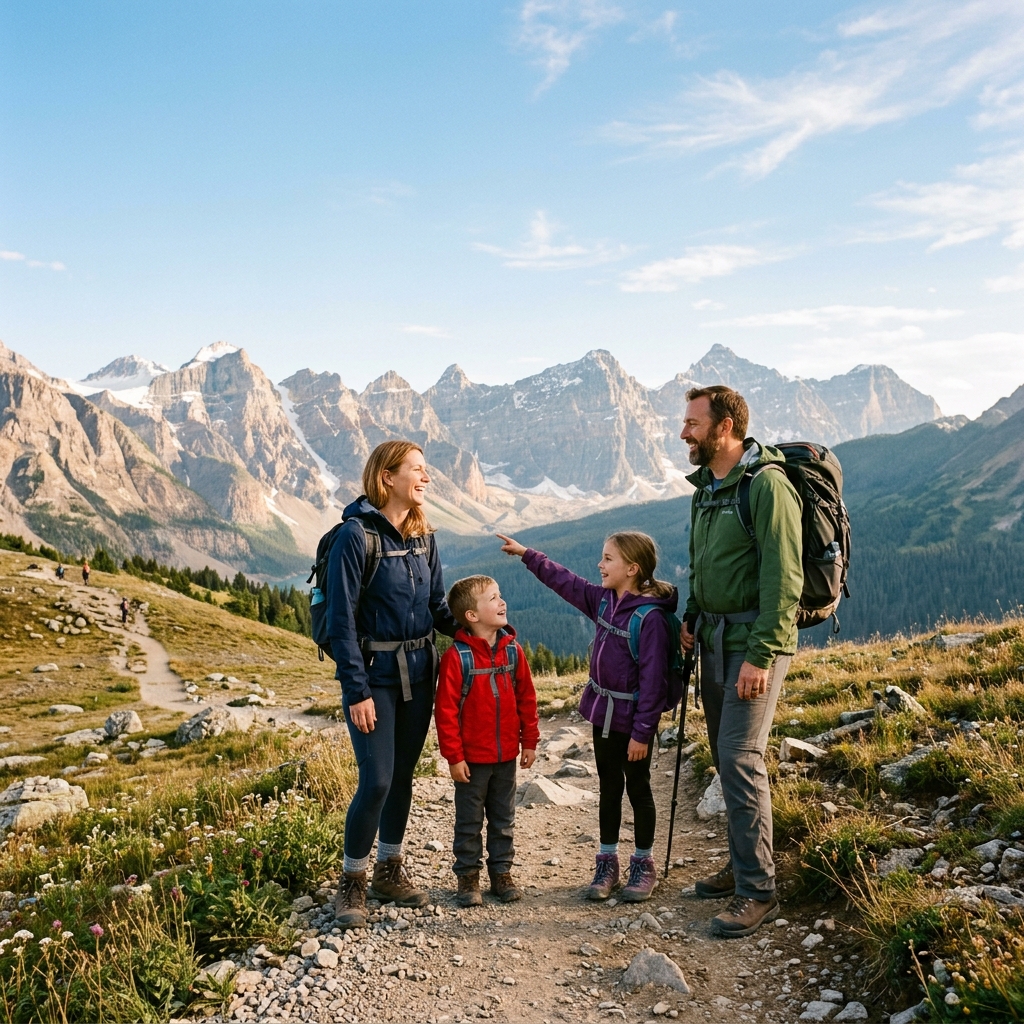
The family adventure vacation has a specific failure mode. One parent has spent months fantasizing about a multi-day trek through Patagonia. The other parent wants a pool and a book. The twelve-year-old wants WiFi. The seven-year-old wants to see animals. Everyone agrees to “compromise,” and the result is a trip that partially satisfies everyone and fully satisfies no one.
The solution is not compromise. It is architecture. A well-planned family adventure trip is designed so that each person gets the experiences they care about while sharing enough common ground that the trip builds collective memory rather than individual grievances.
Here is how to build one.
Step 1: Define “Adventure” for Your Family
Adventure travel exists on a spectrum. At one end is a week-long wilderness trek with camping and river crossings. At the other is a beach resort with a zip-line course and a guided nature walk. Both qualify as adventure for the right family.
Before choosing a destination, have an honest conversation — with yourself and with your family — about where you sit on this spectrum.
Key variables:
- Physical intensity. How far can your youngest family member walk in a day? How does the least-fit adult handle heat, altitude, or uneven terrain? The answer to these questions sets the ceiling for your trip.
- Comfort tolerance. Does everyone need a hotel room with a shower, or are some family members genuinely happy in a tent? Camping families and hotel families need different destinations.
- Risk comfort. Whitewater rafting, rock climbing, and mountain biking carry real physical risk. Some families thrive on this. Others need activities where the risk is managed to near-zero. Both are valid.
- Screen dependence. Be honest about how your children handle being disconnected. A twelve-year-old who has never spent a full day without a phone will struggle on a backcountry camping trip. Building screen-free tolerance before the trip is more effective than enforcing it during the trip.
Write down each family member’s honest capacity and preferences. The trip needs to work for the person with the lowest capacity while offering enough variety to engage the person with the highest.
Step 2: Choose the Right Destination Structure
Family adventure destinations fall into three structural categories, and the right one depends on your family’s profile.
Base Camp Model
You stay in one location and do day trips of varying intensity. This works best for families with young children (under 8) or wide fitness ranges.
Examples: A national park lodge with half-day and full-day hike options. A coastal town with snorkeling, kayaking, and boat trips. A mountain village with trails, bike paths, and cultural activities.
Why it works for families: No daily packing and moving. Younger kids can have a rest day while older kids and adults do a bigger adventure. Everyone returns to a familiar base each evening. Meals are predictable.
Best destinations for this model: Costa Rica (Arenal or Manuel Antonio as base), Yellowstone/Grand Teton, the Dolomites (using a valley town like Selva di Val Gardena), New Zealand’s South Island (Queenstown as base), and Norway’s Lofoten Islands.
Progressive Route Model
You move from place to place, experiencing different landscapes and activities along a route. This works for families with older children (10+) and moderate-to-high fitness.
Examples: A road trip through multiple national parks. An island-hopping itinerary. A point-to-point hiking route with hut accommodation.
Why it works for families: The changing scenery maintains engagement, especially for older kids. Each day brings a different environment. The sense of journey — going somewhere, covering ground — appeals to children who resist repetition.
Best destinations for this model: Iceland’s Ring Road (or sections of it), the Canadian Rockies (Banff to Jasper), Croatia’s coast by ferry, Utah’s national park circuit (Zion, Bryce, Capitol Reef, Arches, Canyonlands), and Peru (Cusco, Sacred Valley, Machu Picchu).
Guided Multi-Day Trip
An outfitter plans the itinerary, provides guides, handles meals and logistics, and manages activity levels. This works for families at any experience level and is especially valuable for first-time adventure travelers.
Why it works for families: Parents are relieved of all logistics. Guides adjust difficulty in real time based on the group’s energy. Other families on the trip provide peer groups for kids. Equipment is provided. Safety management is professional.
Reputable family adventure operators: REI Adventures, Backroads, Intrepid Travel (family trips), G Adventures (family journeys), and Austin Adventures all run family-specific itineraries with age-appropriate activity calibration. Prices range from $2,000 to $5,000 per person for 7 to 10 days, typically including accommodation, most meals, activities, and guide services. Flights are separate.
Step 3: Build the Daily Rhythm
The single biggest mistake in family adventure planning is scheduling every day at maximum intensity. Adults can sustain four consecutive full-day activities. Children cannot. The rhythm matters more than the peak experiences.
The 3-1-3 Pattern
Plan your week in a pattern: three activity days, one rest or low-key day, three more activity days. The rest day does not need to be inactive — it should be unstructured. A morning at a local market, an afternoon swim, an evening walk through town. No agenda, no transfer times, no “we need to be at the trailhead by 7 AM.”
This pattern prevents the cumulative fatigue that turns Day 5 of an adventure trip into a forced march accompanied by complaints.
Morning Adventures, Afternoon Freedom
For day-trip-based itineraries, front-load the demanding activity into the morning when energy and enthusiasm are highest. Schedule the guided hike, the kayak trip, or the bike ride for departure between 8 and 9 AM. Aim to finish by early afternoon.
Leave afternoons unscheduled. Some family members will want to rest. Others will want to explore the town, swim, or do a short secondary activity. This flexibility absorbs the natural variation in energy levels across ages without creating conflict.
Build in Reward Experiences
After a challenging hike or a long activity day, schedule something the kids will consider a reward. This does not need to be expensive or artificial — an ice cream stop, a swimming hole, a chance to play in a river, or dinner at a place they choose. The psychology of effort-then-reward is powerful for children and creates positive associations with the physical challenge.
Step 4: Handle the Logistics That Break Trips
Family adventure trips fail on logistics more often than on activity selection. These are the specific areas that require planning.
Gear and Packing
Adventure trips require functional gear. For children, the non-negotiable items are: properly fitted hiking shoes or boots (broken in before the trip, not purchased the day before), a daypack they can carry themselves, sun protection (hat, sunscreen, sunglasses), and rain gear regardless of forecast.
Do not buy premium adult gear for children who will outgrow it. Rent or buy budget versions and save the investment for items that affect safety (shoes) and comfort (sleeping bags, if camping).
Food and Snacking
Active children need to eat more frequently than adults. Carry snacks on every activity — trail mix, granola bars, dried fruit, cheese and crackers. Plan for a substantial breakfast before morning activities and ensure lunch is available at a predictable time.
For international destinations, identify foods your children will reliably eat before you go. Adventurous eaters are wonderful, but a hungry child on a mountainside is not the time to introduce unfamiliar cuisine. Have fallback options available.
Travel Between Activities
The time spent in vehicles between activities is dead time for children and a source of friction for parents. Minimize transfer times wherever possible. If a 90-minute drive is unavoidable, audiobooks and car games are more effective than screens for maintaining the outdoor-oriented atmosphere of the trip.
When planning a multi-destination route by train, the train itself becomes an activity rather than dead time — children engage with the scenery, movement, and novelty in ways they do not in a car.
Safety Planning
For adventure activities with children, verify these specifics before booking:
- What is the guide-to-participant ratio? For family activities with children under 12, look for ratios no higher than 1:6.
- What safety equipment is provided, and what do you need to bring?
- What is the operator’s cancellation policy for weather? A reputable operator will cancel unsafe activities without penalty.
- What is the nearest medical facility, and how long does it take to reach?
- Does the operator carry liability insurance?
Step 5: Manage Expectations Before the Trip
The most overlooked step in family adventure planning is the pre-trip conversation. Children who know what to expect — physically, logistically, and experientially — handle adventure travel dramatically better than children who are surprised by it.
Show, do not just tell. Watch YouTube videos of the trails you will hike, the rivers you will raft, the animals you might see. Let children visualize what they will experience.
Be honest about difficulty. “This hike is 8 kilometers and takes about 4 hours. The first hour is uphill and it will be hard. After that, it gets easier and the views are amazing.” Do not minimize the challenge or oversell the reward.
Give them agency. Let children choose one activity or one restaurant. Let them help plan one day. Ownership increases engagement. A child who chose the kayaking trip is invested in it in a way that a child who was informed about the kayaking trip is not.
Set the WiFi expectation. If connectivity will be limited or absent, say so weeks in advance, not when you arrive. “There’s no cell service at the campsite. We’ll have service in town on our rest day.” Children adjust to the constraint if given time to process it.
Destinations That Get Family Adventure Right
These five destinations consistently deliver strong family adventure experiences across a wide age range:
Costa Rica. Wildlife, volcanoes, beaches, and rainforest canopy experiences. Excellent safety record for adventure tourism. Family infrastructure is mature. Works for ages 4 and up.
New Zealand. Every type of outdoor activity in concentrated geography. The South Island can fill two weeks without repetition. Works for ages 6 and up.
Norway. Fjord kayaking, island hiking, fishing villages, and the midnight sun in summer. Safe, well-organized, and dramatically beautiful. Works for ages 5 and up.
Utah, USA. Five national parks within driving distance of each other, each with hikes calibrated to every fitness level. Works for ages 4 and up. The Junior Ranger program at each park gives children structured engagement.
The Dolomites, Italy. Lift-assisted hiking that makes high-altitude trails accessible to families. Mountain huts serve hot meals. The scenery is extraordinary. Works for ages 6 and up.
The Metric That Matters
A successful family adventure vacation is not measured by the number of activities completed, the difficulty of the trails hiked, or the Instagram-worthiness of the views. It is measured by whether your family talks about it afterward.
The moments that become family stories are rarely the summit views or the biggest rapids. They are the unexpected encounters: the fox on the trail, the rainstorm that forced everyone into a cave for lunch, the night the seven-year-old caught a fish for the first time and refused to eat it because they had named it.
Plan the framework. Leave room for the story to happen on its own.