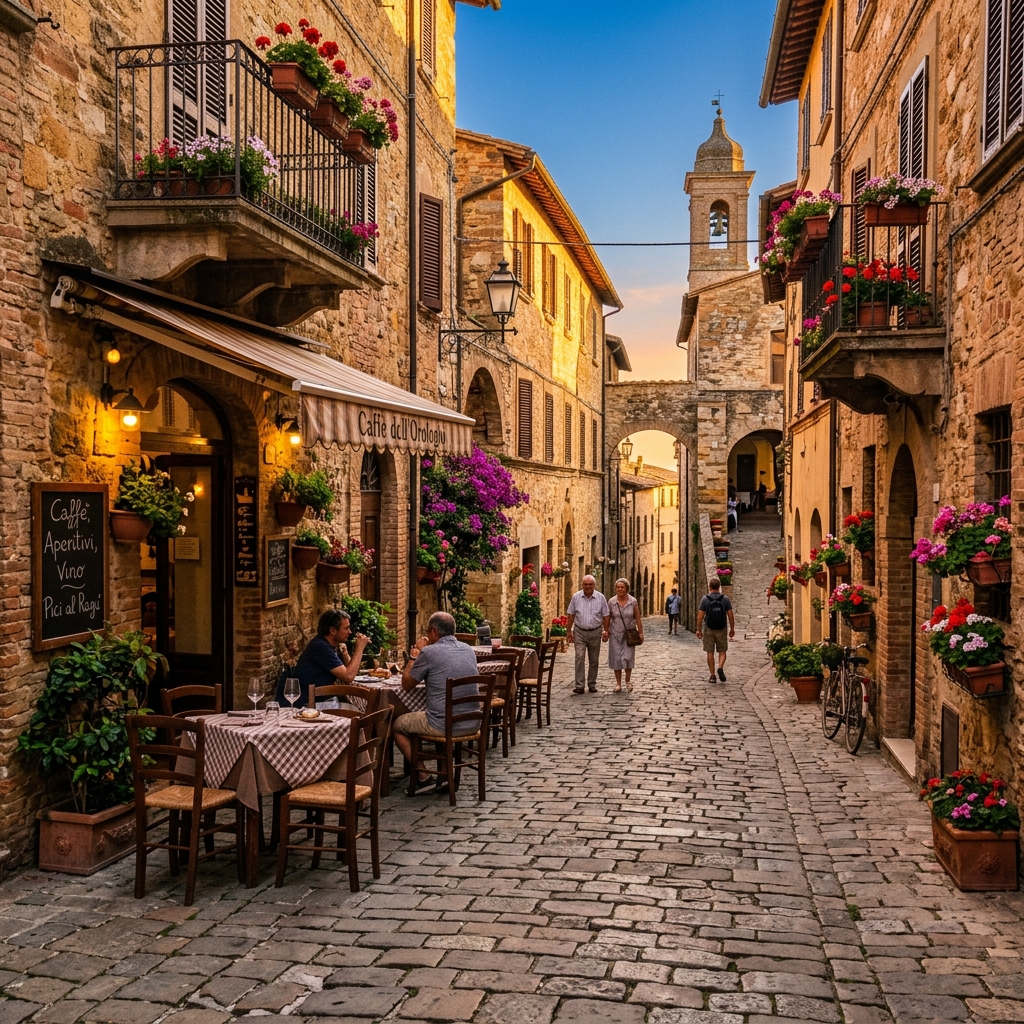
There is a version of Italy that most visitors never find. Not because it is hidden, it is not, but because seeing it requires slowing down to a speed that the standard itinerary does not allow.
Most first-time visitors to Italy try to see Rome, Florence, Venice, and the Amalfi Coast in ten days. This is understandable. These are genuinely extraordinary places, and the photographs are compelling. But ten days across four major destinations produces a specific kind of exhaustion and a specific kind of partial understanding, you have been to Italy in the same way you have been to an airport. You have passed through.
Italy is a country built for staying. The bar culture assumes you have time for a second coffee. The mercato closes at noon because everyone is cooking lunch. The passeggiata, the evening stroll, is not a tourist spectacle; it is how the town takes inventory of itself. These things are not accessible to the traveler on a schedule.
TL;DR: Slow travel in Italy means one base for a week or more rather than rushing between cities. The best slow travel bases are Bologna, Lecce, Palermo, and smaller hill towns in Umbria and Tuscany. Regional trains (not just the high-speed Frecce) connect everything at human speed. Markets, seasonal food, and learning two words of Italian will transform the experience. May, September, and October are the ideal months.
Why Italy Rewards Slowness More Than Almost Anywhere Else
Italy is a country with 20 distinct regions, each with its own cuisine, dialect, history, and character. The difference between Bolognese food culture and Neapolitan food culture is not cosmetic, it is as significant as the difference between French and Spanish cooking. The difference between Venice and Palermo is not merely aesthetic, it is historical, architectural, and social in ways that take time to absorb.
The traveler who spends three days in each of five cities will end the trip with a collection of surfaces. The traveler who spends twelve days in Bologna and three in Modena will end the trip with something approaching understanding.
There is also the practical argument. Moving every two or three nights is expensive, train tickets, accommodation check-ins and check-outs, orientation time in each new city. One week in a rented apartment in a single city costs less than four nights in each of three hotels, and you cook some meals at home, you stop eating every meal in a restaurant, and you discover the supermarket and the market and the bar on the corner where the espresso costs ninety cents and nobody looks at you like a tourist.
This is what slow travel is, at its core: long enough to stop being a visitor and to start being a temporary resident.
Choosing a Base: Beyond the Standard Circuit
The standard Italian circuit, Rome, Florence, Venice, is standard for good reason. These cities contain an extraordinary concentration of art, architecture, and historical significance. No one should feel embarrassed for visiting them.
But for slow travel, they are suboptimal bases. Rome and Florence are expensive, crowded, and optimized for tourism in ways that make it harder (not impossible, but harder) to find the local life that slow travel seeks. Venice is singular but small and increasingly unable to sustain long stays gracefully.
Here are the bases that reward a week or more.
Bologna: Italy’s Best-Kept City
Bologna is the city that Italians talk about when they talk about where they would actually like to live. It has a world-class university (founded in 1088, the oldest in the Western world), a covered portico network that allows you to walk almost anywhere in the historic center without getting wet, and a food culture that the rest of Italy acknowledges as the finest in the country.
The food is not subtle. Mortadella, tagliatelle al ragù (not “Bolognese”, that’s a Roman affectation), tortellini in brodo, crescentine fritte with local salumi. The Quadrilatero, the old market quarter, has been selling food in the same streets since the medieval period. The Mercato delle Erbe on Via Ugo Bassi is one of the finest covered food markets in Europe.
Bologna has fewer tourists than any comparably significant Italian city, partly because it lacks a single world-famous landmark like the Colosseum or the Uffizi. What it has instead is a city that functions for its inhabitants: good food, good universities, good culture, and the particular comfort of a place that does not need to perform for visitors.
A week in Bologna, cooking from the market, eating lunch at a trattoria in the Quadrilatero, taking the day train to Modena (30 minutes) or Ferrara (35 minutes), is as close to Italian daily life as most visitors will get.
For a deeper look at the food, see our guide to food tours in Bologna.
Lecce: The Baroque South
Lecce, in the heel of Italy’s boot, is the finest Baroque city in a country that has no shortage of Baroque architecture. Built from a local golden limestone called pietra leccese, a stone so soft and workable that it allowed sculptors to cover facades with extraordinary decorative detail, the historic center is genuinely overwhelming in its ornamental ambition.
But Lecce’s appeal for slow travel extends beyond architecture. Puglia’s food culture, orecchiette pasta, burrata (invented nearby in Andria), frisella bread, the fattoush-adjacent ciceri e tria, is distinct from northern Italian cuisine and underexplored by most visitors. The cost of living is lower than in the north. The climate is warmer. The beach is accessible.
The trulli country of Alberobello and the Valle d’Itria are day-trip distance. The coastal towns of Otranto and Gallipoli reward half-day excursions. Lecce functions as a genuine base rather than just a destination.
Palermo: The Most Interesting City in Italy
Palermo is not for everyone. It is noisy, somewhat chaotic, occasionally difficult to handle, and its streets have not been designed with the tourist in mind. This is precisely what makes it one of the most rewarding cities in Italy for the slow traveler.
Sicily’s capital contains layers of civilization, Greek, Roman, Arab, Norman, Spanish, that are visible in the architecture and, more surprisingly, in the food. The Ballarò and Capo markets are among the most vivid in the Mediterranean: street food vendors, piles of vegetables, fish fresh from the morning boats, and a physical energy that feels nothing like the polished tourism of northern Italy.
The arancine (rice balls, fried, in a hundred varieties), the sfincione (Palermo’s thick pizza), the pasta con le sarde, the caponata, Palermitan food is its own culinary tradition, Arab-influenced and distinctive. A week in Palermo spent eating at the markets and the small hole-in-the-wall restaurants that locals use is an education in food culture.
The city is also the gateway to the rest of Sicily: Agrigento’s Valle dei Templi, the mosaics of Piazza Armerina, the volcanic drama of Etna, and the baroque reconstruction of Noto after the 1693 earthquake are all reachable by regional train or bus.
Smaller Hill Towns: Umbria and Tuscany
For travelers who want quietness and rural Italian life rather than urban culture, Umbria offers the best concentration of small, livable hill towns in the country.
Orvieto sits on a volcanic tufa plateau above the Umbrian plain, reachable in 90 minutes from Rome by regional train. The cathedral is one of the great Gothic buildings in Italy; the town around it has genuine local restaurants and markets and a pace of life that Rome does not.
Spoleto is less visited than Orvieto, slightly larger, and has a remarkable Roman amphitheater, a medieval aqueduct bridge, and an outstanding festival (the Festival dei Due Mondi, each June-July). Off-season, it is a quiet, beautiful, genuinely Italian city.
Montalcino in Tuscany is wine-country slow travel: a medieval hill town surrounded by Brunello vineyards, with a wine bar in the fortress where you can taste estate wines by the glass, and a handful of restaurants serving local Sienese cuisine. Small enough to know in a day, good enough to stay a week.
Regional Trains: The Slow Traveler’s Network
Italy’s high-speed train network, the Frecce services operated by Trenitalia, and the Italo trains, is impressive. Rome to Milan in under 3 hours; Florence to Venice in 2 hours; Rome to Naples in 70 minutes. These are genuinely fast trains, and for long distances between major cities, they make sense.
But for slow travel, the regional train network is often more useful, and more interesting.
Regional trains stop in places the high-speed lines bypass. The Regionale service from Bologna through the Apennines to Florence, for example, takes nearly an hour longer than the high-speed route, and travels through mountain scenery that the Freccia misses entirely. The regional train along the Adriatic coast from Bologna to Lecce connects small resort towns and fishing ports that do not appear on the high-speed network.
Regional train tickets are inexpensive, often €10–25 for journeys of 1–2 hours, and do not require advance booking. You can buy at the station, at a ticket machine, or on the Trenitalia app. For the slow traveler who decides at breakfast to spend the afternoon in a town 40 minutes away, this flexibility is more valuable than the speed of the high-speed network.
Key regional routes for slow travelers:
- Bologna → Ferrara (35 min, through the Po plain, UNESCO-listed Renaissance city)
- Bologna → Modena (30 min, Balsamic vinegar, Ferrari Museum, extraordinary food)
- Rome → Orvieto (90 min, Umbrian gateway, much cheaper than the direct tourist route)
- Naples → Agropoli / Cilento coast (1–2 hours, south of Amalfi, without the crowds)
- Palermo → Agrigento (2 hours, Valle dei Templi, Greek temples above the sea)
- Palermo → Catania via Enna (3 hours through the Sicilian interior, rarely traveled, spectacular)
See our full guide to traveling Italy by train for the complete picture.
Markets, Food, and the Rhythm of Italian Days
Slow travel in Italy is, in large part, food travel, not in the sense of restaurant-hopping, but in the sense of participating in Italian food culture as it actually operates.
The morning bar ritual. Italians do not have coffee at home and then leave for work. They stop at the bar on the way. The coffee is short, standing, at the counter, and costs less than €1.50 in most of Italy (more in tourist centers, a reliable indicator of whether you’re in the right bar). Ordering a cappuccino after 11am marks you as a tourist; a caffè is correct at any hour. Order at the cassa first in some bars (pay first, take your receipt to the barista), or directly at the bar in others, watch what other customers do.
The mercato comunale. Most Italian cities of any size have a covered municipal market, the Mercato Centrale in Florence, the Mercato di Testaccio in Rome, the Mercato delle Erbe in Bologna, the Vucciria and Ballarò in Palermo. These markets sell local produce, cheese, salumi, fresh pasta, and prepared food. For the slow traveler with kitchen access, the market is where lunch happens: a wedge of Parmigiano, a piece of mortadella sliced to order, a bread roll, some tomatoes. Cost: €5. Quality: exceptional.
The Sunday lunch. Sunday in Italy means a long lunch, typically 1–3pm or later, that is the anchor of family and social life. If you have made any local acquaintance at all, the invitation to Sunday lunch is the highest form of Italian hospitality. Even without an invitation, watching the restaurants fill on Sunday, families of three generations, dressed properly, not in a hurry, is to see Italian culture operating at its most characteristic.
Aperitivo. In northern Italy especially (Milan, Bologna, Turin), the hour before dinner, roughly 6–8pm, is aperitivo: a drink (Aperol spritz, Negroni, Campari soda) accompanied by free snacks. In some cities (Milan most famously, but also Bologna and Turin), the snacks constitute a light meal, small plates of vegetables, salumi, cheese, pasta. Aperitivo hour at a local bar is the best value in Italian urban food culture.
Seasonal Rhythms: When to Go and What You’ll Find
May–early June: Ideal. Wildflowers, green hills, markets full of spring vegetables (asparagus, artichokes, fava beans), manageable temperatures everywhere including the south. Not yet peak season; accommodation prices are moderate.
July–August: Peak summer. Major cities are crowded and hot. The Amalfi Coast is a parking lot. However: this is when the Italian interior comes alive. Mountain villages, hill towns, and the Dolomites are at their best. If you’re slow-traveling in an interior town (Orvieto, Spoleto, Montalcino), summer is perfectly viable.
September–October: Harvest season, and arguably the finest month for slow travel in food terms. Grape harvest (vendemmia) throughout the wine regions. Olive harvest begins in October in Tuscany and Umbria, many farms allow visitors to participate or purchase just-pressed oil. Chestnut festivals across the Apennines. Markets are at their most abundant. Temperatures are manageable.
November–March: Quiet, cheap, and cold. Many coastal and rural businesses close or reduce hours. But the city culture continues uninterrupted, Bologna, Palermo, and Rome in winter are fully functional and far less crowded than in summer. Truffle season (October–December in Umbria, November–January in Alba) makes this period exceptional for food-focused slow travel.
Two Words of Italian and Why They Matter
You do not need to speak Italian to slow travel in Italy. English is understood at any level of tourism-facing business. But the attempt matters in a way that it does not in most of northern Europe.
Italians notice whether you try. “Buongiorno” (good morning/good day, used until mid-afternoon) and “Grazie” (thank you) are the minimum. “Un caffè, per favore” (a coffee, please) and “Il conto, per favore” (the bill, please) take you further. None of this requires Italian fluency. What it signals is respect, an acknowledgment that you are a guest in someone else’s country rather than a consumer of a service.
In smaller towns and in the south, where English is less universal, the attempt is even more appreciated. It opens conversations. It gets you better tables. It is the easiest practical improvement you can make to a slow travel experience in Italy.
Practical Logistics
Accommodation: A rented apartment (via Airbnb, Booking.com, or local agencies) is preferable to a hotel for slow travel of more than 4–5 days. Kitchen access allows market shopping and cooking, dramatically reducing food costs and improving food quality. Look for apartments in the historic center, not on the main tourist squares, but nearby.
SIM card: An Italian or European SIM card with data (TIM, WindTre, or Vodafone Italy) is much cheaper than roaming and allows use of Google Maps, Trenitalia app, and local restaurant apps offline.
Timing: Arrive at restaurants at Italian lunch hours (12:30–2pm) and dinner hours (7:30–9:30pm). Arriving at 6pm or 11pm will encounter either closed doors or tourist-trap establishments that open for non-Italian schedules.
Related Reading
- Italy by Train: The Complete Guide, how to handle the full Italian rail network, from Frecce to regional trains
- What Is Slow Travel?, the philosophy and practice of traveling at human speed
- Food Tour Bologna: The Best Food Experiences in Italy’s Culinary Capital, a deep dive into Bologna’s market culture, restaurants, and food traditions