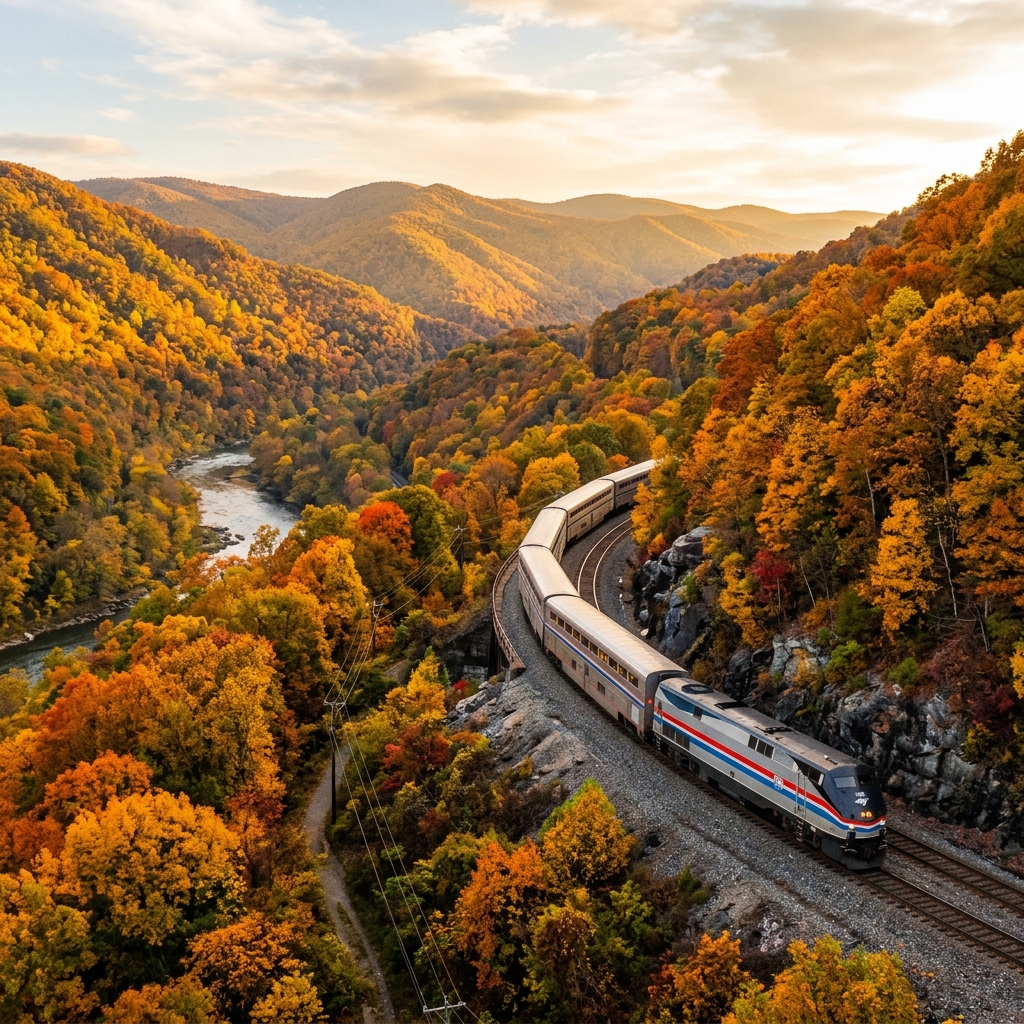
The Cardinal is Amtrak’s hidden spectacular. It runs only three days a week, departs at an awkward time, and is perpetually overshadowed by the more famous Coast Starlight and California Zephyr. Most people have never heard of it. This is unfortunate, because the Cardinal passes through what may be the finest mountain scenery of any train journey in the eastern United States.
The route connects New York and Chicago via Washington D.C., the Shenandoah Valley, and West Virginia’s New River Gorge, a canyon so deep and forested that it was only designated a national park in 2020. Passenger trains have been running through it since the 19th century. Most Americans have no idea it exists.
If you have ever wondered what lies between the two great American coasts, not the flyover plains, but the older, wilder country of the Appalachians, the Cardinal is how you find out.
TL;DR: The Cardinal runs New York–Washington–Chicago three times weekly (not daily), taking approximately 19.5 hours. Coach from ~$50–$130; Viewliner Roomette (private sleeper with meals) from ~$150–$300 Saver. The New River Gorge in West Virginia is the scenic peak, some of the most dramatic field accessible by any eastern US train. Not suited for rigid schedules; ideal for travelers who value the route over speed.
The Route: New York to Chicago via the Appalachians
The Cardinal covers approximately 1,377 miles between New York Penn Station and Chicago Union Station. Unlike most Amtrak long-distance trains, it does not take the most direct path. Instead, it dips south through Washington and Virginia before cutting west through the mountains of West Virginia, a routing that adds distance but provides some of the most compelling field on the eastern seaboard.
New York to Washington: The Northeast Corridor
The Cardinal departs New York Penn Station and runs south along the Northeast Corridor, Amtrak’s busiest and most familiar route, through New Jersey, Delaware, and Maryland. This section is efficient rather than scenic; the Cardinal shares tracks here with commuter rail and other Amtrak services.
Philadelphia is the first major stop (about 1h 15min from New York). The train continues south through Wilmington and Baltimore before arriving at Washington D.C. Union Station, roughly 3.5 hours from New York. Union Station is worth a look in itself, a 1907 Beaux-Arts temple of marble and vaulted ceilings, recently renovated, and one of the finest public buildings in the capital.
Washington is the Cardinal’s final northeastern stop. Westbound trains leave the Northeast Corridor here and turn toward the mountains.
Washington to Charlottesville: Piedmont Foothills
From Washington, the Cardinal heads west and southwest through the Virginia Piedmont, horse country, gentle ridges, and small towns that feel historically deep in a way the Northeast Corridor cities do not. Manassas, site of two Civil War battles, passes early. The Blue Ridge Mountains become visible to the west as the train moves through the Piedmont.
Charlottesville, Virginia (roughly 6 hours from New York) is the most attractive stop on this eastern section. The city is walkable, with the University of Virginia campus and Thomas Jefferson’s Monticello nearby. If you have flexibility in your schedule, Charlottesville rewards an overnight stop, though the Cardinal’s three-day frequency means you’ll need to plan carefully around available departure days.
Charlottesville to the New River Gorge: The Mountain Crossing
This is where the journey transforms.
West of Charlottesville, the Cardinal climbs into the Allegheny Mountains through a series of tunnels and cuts. The field becomes increasingly abrupt, narrow valleys, wooded ridgelines, and the particular density of Appalachian forest that has no equivalent in other American mountain ranges. These are old mountains, worn down and rounded, but still serious terrain.
Clifton Forge and Covington in Virginia mark the deepest mountain section before the train crosses into West Virginia. The tracks here follow river valleys, threading through gaps in the ridges that 19th-century engineers chose for their gradient advantages and that now provide a visual corridor through otherwise impenetrable forest.
The New River Gorge: The Cardinal’s Defining Moment
Between Hinton and Montgomery, West Virginia, the Cardinal descends into the New River Gorge, and this is why people ride this train.
The New River is, geologically speaking, one of the oldest rivers in North America, older than the mountains it carved through, which is why it cut its gorge so deeply rather than being redirected by the rising terrain. The canyon is nearly 1,400 feet deep in places, with forested walls rising on both sides of the tracks. The river appears and disappears alongside the train. The light, filtered through the canopy overhead, has a green quality that is not found anywhere else.
There are no roads through the central gorge accessible from the valley floor. The only way to see this field at river level is by kayak or by train. The Cardinal passes through it in roughly an hour. Be in the Sightseer Lounge for this.
The New River Gorge National Park, designated in 2020, making it one of the newest national parks, surrounds this section. The park’s visitor centers are accessible from the town of Fayetteville (a short drive from the Thurmond station, which the Cardinal passes). Thurmond itself is a near-ghost town that was once a booming coal railroad town; the Cardinal passes through it without stopping.
Pro tip: Westbound passengers typically pass through the gorge in late afternoon, with good light. Eastbound passengers cross in the morning. Both are excellent, but the late afternoon light in the gorge, with the sun beginning to angle through the canopy, is particularly fine.
Charleston to Cincinnati: West Virginia Coal Country
After the gorge, the train follows the Kanawha River to Charleston, West Virginia, the state capital and the largest city on the route. The field west of Charleston becomes less dramatic as West Virginia transitions to the flatter country of the Ohio Valley.
Cincinnati follows, across the river from Covington, Kentucky, and is the last major stop before Chicago. The train typically arrives in the early morning hours, which means most passengers experience this stretch overnight.
Cincinnati to Chicago: Final Approach
Indiana and Illinois roll past in the hours before Chicago. The train arrives at Chicago Union Station in the late morning, a perfectly timed arrival that allows a full afternoon in the city if you have time before continuing by train (the Empire Builder, California Zephyr, and other long-distance routes all depart from Chicago Union Station).
The Three-Day-Per-Week Schedule: What This Means
The Cardinal’s most significant practical quirk is its frequency. Unlike the daily Empire Builder or Coast Starlight, the Cardinal runs only three times per week in each direction, roughly Wednesday, Friday, and Sunday westbound; Tuesday, Thursday, and Saturday eastbound.
This means:
- You cannot be flexible about the day of travel. Your departure day is determined by the schedule, not your preference.
- A missed connection can strand you for two days if you cannot catch the next Cardinal. Always book forward connections with at least a full-day buffer.
- It cannot function as a commuter option. The Cardinal is a journey train, not a practical transport tool between New York and Chicago.
Check current days of operation on Amtrak.com, the schedule has varied and the specific operating days should be confirmed when booking.
Accommodation Classes
Coach
The Cardinal uses Viewliner equipment, Amtrak’s single-level long-distance cars, rather than the Superliner double-deck cars used on western trains. Coach seats are reserved, reclining, and reasonably comfortable for the journey’s duration.
For a ~19-hour journey, coach is viable if you can sleep upright. The window seats on the left (south) side of the train offer the better gorge views westbound.
Cost: $50–$130 one-way.
Viewliner Roomette
The Viewliner roomette is a private cabin with two facing seats (day) converting to upper and lower berths (night), a large window, reading lights, and power outlets. Unlike the Superliner roomettes on western trains, the Viewliner roomette has its own toilet (behind a panel at the foot of the lower berth), a significant advantage for overnight travel.
All meals in the dining car are included for sleeping car passengers.
Given the journey is under 20 hours, many travelers use the roomette primarily for privacy and the meal inclusion rather than actually converting it to sleeping configuration. This is a perfectly reasonable approach.
Cost: $150–$300 Saver; $350–$500 standard. Per room, two travelers sharing halve the effective cost.
Viewliner Bedroom
A larger private room with two separate berths, an enclosed toilet and sink, and more storage. Shower access is at the end of the sleeping car. Meals included.
Cost: $400–$700+ per room.
Dining Car
The Cardinal has a full dining car with table seating. Sleeping car passengers have all meals included. Coach passengers pay à la carte.
The dining car is the social center of the train, strangers are seated together, conversations happen over breakfast and dinner that would not happen in any other context. For a solo traveler, the Cardinal’s dining car can be one of the more unexpectedly sociable experiences in American travel.
Connections: Chicago and New York
In Chicago: Chicago Union Station is one of Amtrak’s main hubs. The Cardinal connects there with the Empire Builder (to Seattle/Portland), the California Zephyr (to San Francisco), the Lake Shore Limited (to New York via Cleveland), and numerous other services. A morning arrival on the Cardinal leaves time for connections departing in the afternoon or evening.
In New York: New York Penn Station connects to the entire Northeast Corridor network, Boston, Washington, and points south and north. It also connects to the Lake Shore Limited, which provides an alternative (and daily) New York–Chicago route via Albany and Cleveland, though through very different terrain.
Cardinal vs. Driving: New York to Chicago
| Factor | Cardinal | Driving via I-80 |
|---|---|---|
| Time | ~19.5 hours | ~12–13 hours |
| Scenery | New River Gorge, Appalachians | Pennsylvania/Ohio highway |
| Flexibility | 3 days/week | Any time |
| Cost | $50–$130 coach | $80–$120 gas + tolls |
| Fatigue | You rest while moving | 12+ hours at the wheel |
For pure speed, driving or flying wins. For the quality of the journey and the scenery seen, the Cardinal is not comparable, it simply accesses different country that driving ignores entirely.
Practical Tips
Book early, especially for sleepers. The Cardinal’s three-day frequency means sleeper inventory fills up faster than on daily trains, there are fewer departures to spread demand across.
Sit on the left (south) side westbound for the best New River Gorge views. Reserve your seat early in the booking process if you have a seat preference.
Use the Sightseer Lounge. The upper-deck lounge car is the best viewing platform on the train and the social hub. Go there before the gorge section begins.
Allow connection buffer in Chicago. Cardinal delays are not uncommon. If you’re catching a connecting train out of Chicago, leave at least a full afternoon between your Cardinal arrival and your next departure.
Consider splitting the journey. The Cardinal’s routing through Charlottesville and Charleston means a stopover in either city is feasible, and both reward a night or two.
Related Reading
- Amtrak Coast Starlight: Los Angeles to Seattle, the Pacific coast counterpart, Amtrak’s western scenic crown
- Best Scenic Train Routes in the USA, all of Amtrak’s great field journeys compared
- California Zephyr: Chicago to San Francisco, the western connection from Chicago Union Station
We evaluate destinations and travel services independently. To learn more about our editorial standards, read our Editorial Policy.