In 2010, Noma was named the best restaurant in the world. What followed changed Copenhagen permanently. Chefs flew from Tokyo and New York to eat in a converted warehouse on a Christianshavn canal. René Redzepi’s kitchen trained a generation who went out and opened their own restaurants, each working variations on the same philosophy: use what grows here, respect the seasons, find beauty in restraint.
Noma closed as a restaurant in January 2024. But Copenhagen’s food culture now runs too deep to depend on any single address. The city has the best smørrebrød tradition in the world, one of Europe’s finest food markets, a bakery scene that has quietly become a global benchmark, and a neighbourhood food culture in Nørrebro that has nothing to do with tourist itineraries.
The Smørrebrød Tradition
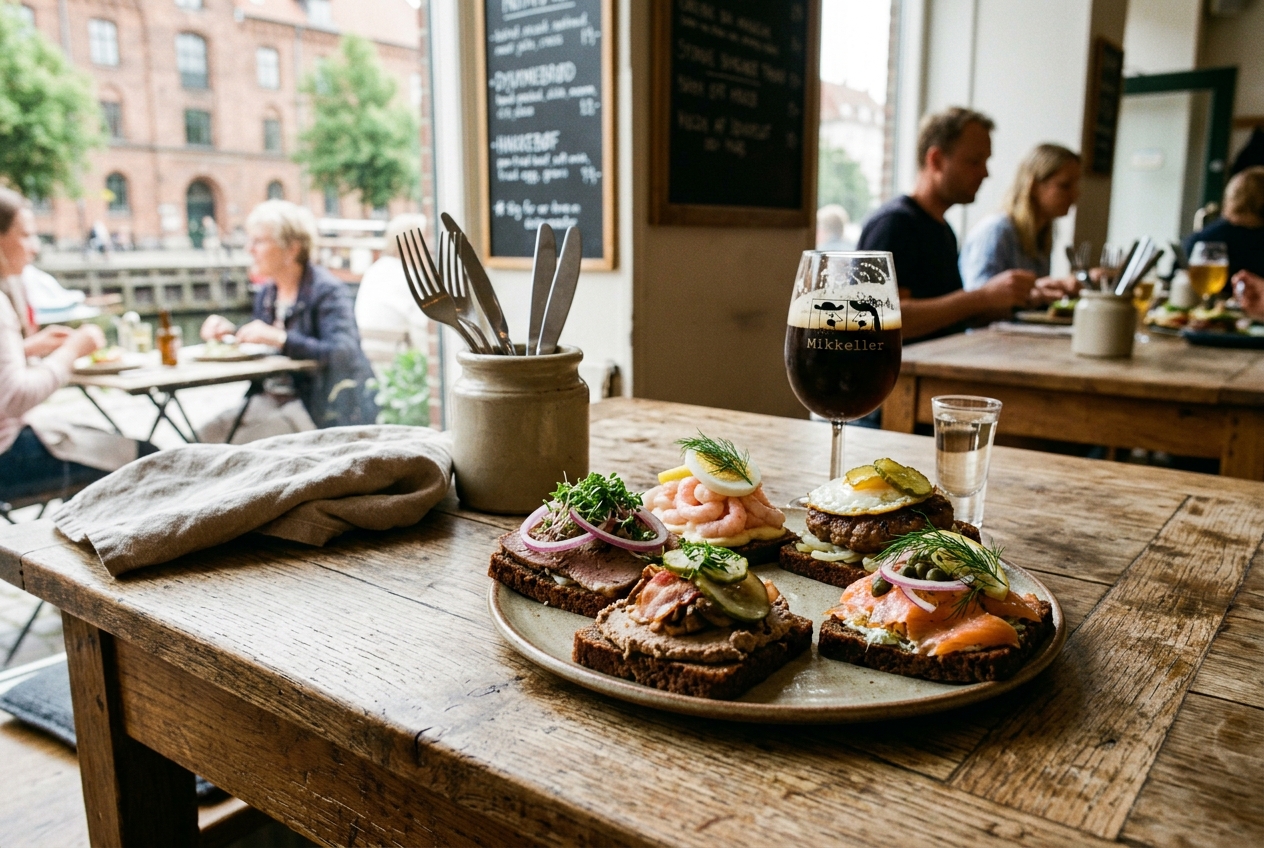
Smørrebrød is the foundation of Danish food culture — and the most direct way into it. The open-faced sandwich on dense rye bread (rugbrød) is not a light lunch option. It is a complete meal, structured by rules developed over centuries: specific toppings go on specific bread types, specific garnishes accompany specific proteins, and the combinations are not arbitrary.
The canonical toppings: pickled herring with onion and capers on rye; liver pâté (leverpostej) with crispy bacon and pickled beetroot on rye; roast beef with remoulade, fried onions, and grated horseradish on rye; the stjerneskud (“shooting star”) — plaice, shrimp, asparagus, and caviar on white bread, which is the most extravagant traditional option and the one to order at a special lunch.
Where to Eat Smørrebrød
Schønnemann (Hauser Plads 16): The old master. Open since 1877, lunch only, always full of politicians, journalists, and regulars who have been coming for decades. The menu has not modernised — this is the tradition itself, unchanged and entirely self-confident. The herring selection is exceptional. Book ahead at restaurantschonnemann.dk; without a booking you will wait at the bar, which is not entirely unpleasant.
Aamanns 1921 (Niels Hemmingsens Gade 19–21): The modernised version, in a spectacular renovated building near Strøget. Chef Adam Aamann treats smørrebrød as a living tradition — the structural rules observed but the toppings updated with whatever is in season. Slightly more expensive than Schønnemann; slightly more likely to have a table if you call the same day.
Told og Snaps (Toldbodgade 2): Near Nyhavn, which is tourist territory, but Told og Snaps itself is entirely genuine — a classic smørrebrød restaurant with excellent herring, good aquavit selection, and a menu that hits every traditional benchmark. Better for a solo lunch at the bar than a group dinner.
New Nordic on a Budget
The tasting menu at Geranium (3 Michelin stars, eighth floor of the national football stadium) is DKK 3,500 per person — around €470 — and has been fully booked months ahead since Noma closed. This is not a realistic option for most visits, and it is also not the only way to experience what New Nordic cuisine means in practice.
Høst (Nørre Farimagsgade 41): A designed, atmospheric restaurant in a converted merchant’s courtyard that serves a version of New Nordic at accessible prices — two courses at lunch for around DKK 295 (€40), three for DKK 395. The cooking applies seasonal and local thinking to simpler preparations: root vegetable dishes, fermented elements, well-sourced fish. It is not Geranium, but it is genuinely good food at a fraction of the price, in a room that would cost twice as much in London.
Amass (Refshalevej 153): Matt Orlando’s restaurant on the post-industrial island of Refshaleøen applies the New Nordic philosophy with a zero-waste framework — stocks made from vegetable trimmings, bread from yesterday’s dough, desserts built from elements that would otherwise be discarded. The lunch menu is around DKK 400 per person, significantly cheaper than dinner (DKK 900+). Take the harbour bus from Nyhavn; the 20-minute ride is part of the experience.
Relæ (closed as a restaurant but its alumni run several good places): Christian Puglisi closed Relæ in 2021 but its influence spreads through much of the mid-range restaurant scene. His pizzeria Bæst (Guldbergsgade 29 in Nørrebro) makes the best pizza in Scandinavia from house-cured charcuterie and organic dairy — DKK 165–220 per pizza.
Torvehallerne: The Best Single Stop
Torvehallerne, at Israels Plads near Nørreport station, is Copenhagen’s covered food market. Two glass pavilions, around 60 stalls, open Tuesday to Sunday. It opened in 2011 and has become the best single place to understand the city’s food culture in one stop.
Coffee Collective has a counter at Torvehallerne and is among Scandinavia’s most respected specialty coffee roasters — the Kenyan and Ethiopian single origins are consistently excellent. A filter coffee costs DKK 55; an espresso slightly less. Take it standing at the high counter facing the market floor.
Grød (porridge): The concept sounds unpromising. The execution is not. Grød — Danish for porridge — has a counter at Torvehallerne serving hot grain bowls built from oats, spelt, and rye, topped with roasted vegetables, poached eggs, seasonal fruit, and nut butters. A bowl costs DKK 75–95. It is warming, filling, and the kind of thing that sounds like a food trend and turns out to be genuinely delicious.
The fish stall on the northern end sells smoked salmon, gravlax, pickled herring, and smoked eel of exceptional quality — buy a portion and eat it with rye bread from the bakery counter next door.
The prepared food counters at lunchtime offer plates at DKK 100–150, which is significantly cheaper than any sit-down restaurant nearby. Thursday and Friday lunches are the busiest; arrive before noon or after 1.30pm to avoid the worst of the queues.
Nørrebro: Where Locals Eat
Nørrebro is Copenhagen’s most diverse neighbourhood — a mixed community of Danish families, immigrants from the Middle East, Africa, and Southeast Asia, students, and the young professionals who have been moving in as rents rise in the inner city. It is also, increasingly, where the most interesting food in Copenhagen is happening outside the fine-dining circuit.
Jægersborggade is the street to walk: a pedestrianised lane of coffee shops, natural wine bars, ceramics studios, and small restaurants that has quietly become one of the best eating streets in Northern Europe. Relæ’s legacy (the restaurant was here before it closed) lingers. The bakeries are excellent — look for the queue.
Kebabs and shawarma: Nørrebro has the best kebabs in Scandinavia, which is a claim that sounds modest and is not. The Turkish and Lebanese grills along Nørrebrogade and the side streets around Blågårds Plads produce döner and shawarma of a quality that stands comparison with Istanbul or Beirut. A portion costs DKK 65–90. This is not a consolation option — it is one of the best things you can eat in the city.
Bæst (Guldbergsgade 29): Christian Puglisi’s pizza and charcuterie restaurant. The pigs are raised on the farm Puglisi co-owns outside Copenhagen; the mozzarella is made in-house from organic Danish milk; the dough ferments for 48 hours. The result is the best pizza in Scandinavia without qualification. Book ahead on weekends.
Getting to Copenhagen by Train
Copenhagen’s international train connections are improving — slowly, but improving.
From Hamburg: The current route takes 5 hours 30 minutes via Puttgarden, where passengers board a ferry across the Fehmarn Belt to Rødby in Denmark before continuing by train. It is an inconvenient connection and the source of complaints from frequent travellers. The Fehmarn Belt fixed link — a tunnel between Germany and Denmark — is under construction and projected to open around 2029, which will cut the Hamburg–Copenhagen journey to around 2 hours 40 minutes. Book on DB.de or Trainline; tickets from €35.
From Stockholm: SJ high-speed trains run the 5-hour journey from Stockholm Central to Copenhagen via the Øresund Bridge. Book 90 days ahead and tickets start from SEK 149 (€15); standard advance prices are SEK 300–600 (€27–54). The Øresund crossing — a combined rail-road bridge and tunnel connecting Sweden and Denmark — is one of Europe’s great engineering achievements, and the moment the train emerges from the tunnel on the Danish side with the sea on both sides is worth experiencing.
From Oslo: The Göteborg route takes 7 hours 30 minutes total — train to Göteborg (3 hours 45 minutes from Oslo S), then onward to Copenhagen (3 hours). Direct booking via Vy (Norwegian railways) or SJ.
From Paris: No direct rail connection. Fly or take the overnight train to Hamburg and connect. The Hamburg connection, despite its imperfections, is manageable for travellers with luggage — the ferry crossing is pleasant enough and takes about 45 minutes.
Within Copenhagen: The metro is excellent — punctual, frequent (every 2–4 minutes at peak), and running 24 hours. A single journey costs DKK 26 (€3.50). The Rejsekort contactless card is the most convenient option for multiple journeys; alternatively, buy a 24-hour card for DKK 80.
When to Go
June to August is the classic window. The days are long — 17 hours of daylight in June — outdoor seating opens everywhere, and the harbour baths (free swimming in the inner harbour, a remarkable civic amenity) are open. The Copenhagen Cooking and Food Festival runs in August with special menus and events at restaurants across the city.
December is the other answer. Copenhagen’s Christmas markets are genuinely atmospheric rather than purely commercial — the one at Tivoli is the most famous, but the market on Kongens Nytorv and the smaller ones in Nørrebro are better. Hygge — the Danish concept of warm, candlelit conviviality — was invented for this season and makes total sense here in a way it does not in most other places. The city’s restaurants are full; the smørrebrød lunch takes on extra weight eaten in a candlelit room as the dark comes in by 3pm.
April and May are shoulder season: quieter, cheaper, the gardens beginning to open, and the restaurant scene fully active. One of the underrated times to visit.
The Danish Bakery
A note on bread and pastry, because it would be negligent to omit it. Copenhagen’s bakeries have quietly become some of the best in the world. The influence of New Nordic thinking — local grains, long fermentation, respect for process — has transformed what was already a strong tradition.
Hart Bageri (Gammel Kongevej 109 in Frederiksberg): Richard Hart (formerly of Tartine in San Francisco) opened this bakery in 2018 and it immediately became a pilgrimage destination. The sourdoughs use Danish heritage wheat; the pastries combine French technique with Danish ingredients. Queue before 10am or the shelves are bare.
Andersen Bakery (multiple locations): The most accessible of the high-quality chains. The cardamom buns and cinnamon snails (kanelsnegle) are benchmarks for the form.
A local note: Danes eat pastry in the morning, not at any other time. Walking into a bakery at 3pm and finding the display half-empty is normal. Go in the morning.
For more on reaching Copenhagen and the wider Scandinavian rail network, see our guides to Oslo by train, Germany by train, and Copenhagen by train.