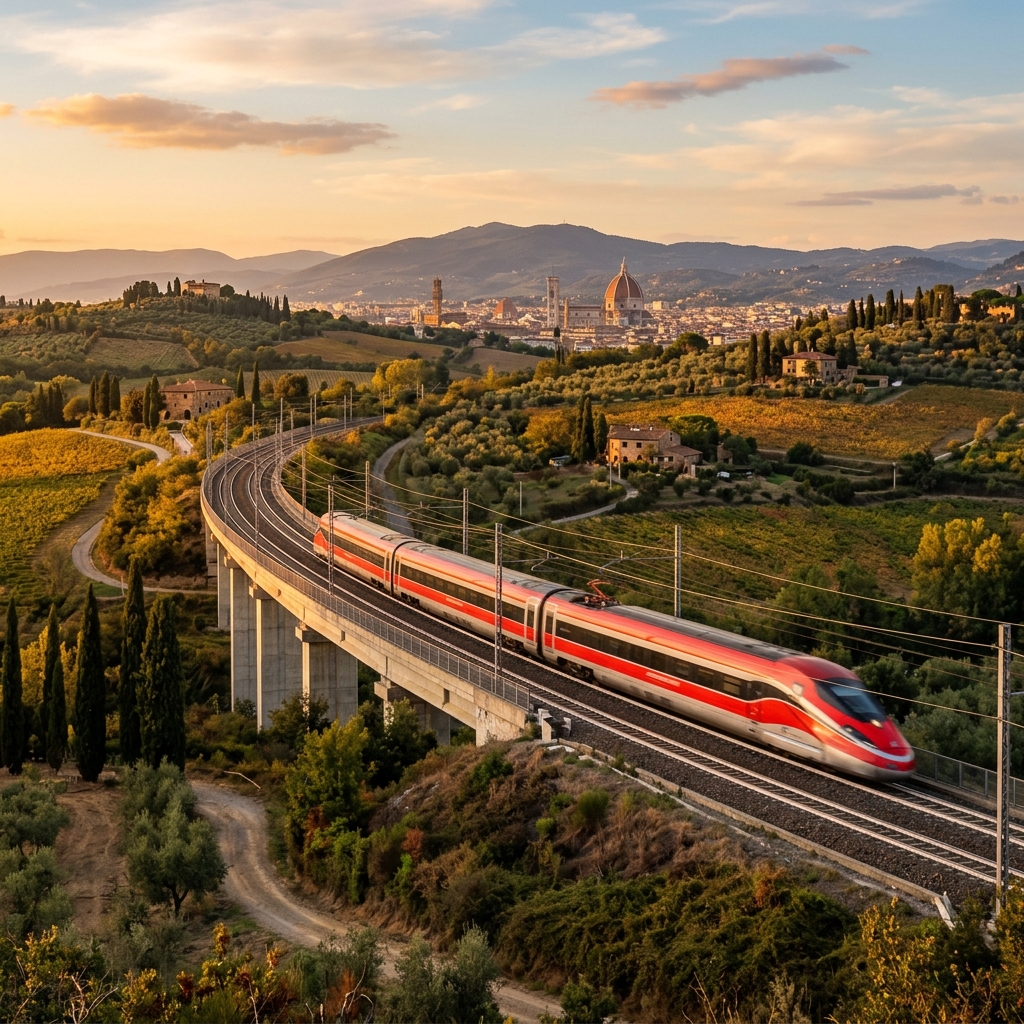
Milan and Florence are two cities that agree on very little, not on food, not on football, not on what counts as good taste. But they share a railway. And on that railway, the two cities are connected by one of the fastest, most frequent, and most competitively priced corridors in Italian high-speed rail.
The journey takes under two hours on the Frecciarossa. It costs, if you plan ahead, less than a glass of Barolo in a Milanese bar. The train departs from the grandest station in Italy, Milano Centrale, a cathedral of fascist architecture and excellent espresso, and arrives at Firenze Santa Maria Novella, a ten-minute walk from the Duomo.
This guide covers everything: journey times, pricing, which operator to choose, what the journey is actually like, and how to get the most out of Florence on arrival.
TL;DR: The Milan to Florence train takes 1 hour 45 minutes on the fastest Frecciarossa services, with 20+ daily departures from Milano Centrale. Tickets start from around €9–19 booked in advance, rising to €40–80 for flexible fares. Both Frecciarossa (Trenitalia) and Italo serve the route. Book via Trenitalia or for the best fares.
How Long Does the Milan to Florence Train Take?
The fastest Milan to Florence trains complete the 294km journey in 1 hour 45 minutes, the Frecciarossa high-speed services that run at up to 300 km/h. That’s a remarkable compression of distance: two cities that once required a full day’s carriage ride now sit under two hours apart. Italo’s fastest services take approximately 1 hour 50 minutes to 2 hours, competitive with Frecciarossa and often cheaper on certain dates.
InterCity trains are slower, typically 2 hours 40 minutes to 3 hours on this route, and significantly less comfortable. Regional trains aren’t a practical choice here: they take 3+ hours with changes, and the price difference rarely justifies the time cost.
| Service | Journey Time | Direct? | Departures/day |
|---|---|---|---|
| Frecciarossa (high-speed) | 1h 45m–1h 55m | Yes | 20+ |
| Italo EVO / AV | 1h 50m–2h 05m | Yes | 6–10 |
| InterCity | 2h 40m–3h | Yes (some) | Limited |
| Regionale | 3h+ | Usually no | Several |
Trains depart from Milano Centrale, Milan’s main station, and arrive at Firenze Santa Maria Novella, Florence’s central station, a 10-minute walk from the Duomo. Both stations sit at the heart of their respective cities, with no transfers or shuttle buses required.
The other Milan station: Milano Porta Garibaldi also serves some Frecciarossa departures, particularly those continuing north toward Como or Switzerland. It’s smaller and more convenient if you’re staying in Milan’s Isola or Porta Nuova districts. Check the departure station carefully when booking, they’re 25 minutes apart by metro.
continuing south to Rome → rome-to-florence-train guide
How Much Does the Milan to Florence Train Cost?
The Milan to Florence route uses dynamic pricing: fares are lowest when the booking window opens (four months ahead), and climb steadily as seats fill. According to Trenitalia’s published fare tiers, advance Super Economy tickets start from as low as €9–19, while flexible first-class fares reach €60–80 on peak travel dates (Trenitalia, 2026). That’s a remarkable price range for 294km of high-speed rail.
Frecciarossa (Trenitalia) fare tiers:
- Super Economy, from ~€9–19, non-refundable and non-exchangeable
- Economy, from ~€20–30, limited changes permitted
- Business, from ~€35–50, more flexibility included
- Executive, from ~€55–75, lounge access at major stations
Italo fare tiers:
- Low, from ~€12–20, non-refundable
- Economy / Flex, from ~€25–45
- Prima (first class), from ~€55–70
The cheapest fares are genuinely excellent value for a sub-two-hour journey on a premium high-speed train. They’re released in limited quantities, sell out first on busy travel dates, and don’t come back once they’re gone.
Frecciarossa vs Italo, Which Operator Should You Book?
Italy’s high-speed rail market is one of the few in Europe with genuine head-to-head competition, and it benefits passengers directly. Italo entered the market in 2012, breaking Trenitalia’s monopoly and forcing both operators to lower prices and improve service (European Commission transport report, 2023). For the Milan to Florence route, both are a good choice, here’s how to decide.
Frecciarossa (Trenitalia) is the dominant operator: 20+ daily departures, spreading across the full day from around 5:30 a.m. to 10 p.m. The frequency is the main practical advantage, if you miss your train or plans shift, the next departure is rarely more than an hour away. Wi-Fi is available at every seat (quality is variable but usable), power sockets are standard, and the onboard Bistrot café serves proper espresso and decent sandwiches. Eurail passes are valid on Frecciarossa with a seat reservation fee (around €10–13 for standard class).
Italo runs 6–10 daily services on this route. Slightly fewer options, but the trains are comfortable, the pricing is sometimes marginally cheaper than Frecciarossa on the same date, and the Italo Più loyalty programme rewards frequent travellers. One important note: Eurail passes are not valid on Italo, which is a private operator outside the Interrail/Eurail network.
| Frecciarossa | Italo | InterCity | |
|---|---|---|---|
| Journey time | ~1h 45m | ~1h 55m | ~2h 45m |
| Price from | ~€9 | ~€12 | ~€8 |
| Frequency | 20+ daily | 6–10 daily | Limited |
| Comfort | Excellent | Excellent | Basic |
| Direct? | Yes | Yes | Usually yes |
| Eurail valid? | Yes (reservation req.) | No | Yes |
| Onboard café | Yes | Yes | Limited |
The practical answer: check both operators for your specific travel date and book whichever offers the better advance fare. The 10-minute difference in journey time is immaterial. The only reasons to prefer Frecciarossa are pass validity or a need for maximum flexibility on departure time.
What Is the Journey Actually Like?

The route south from Milan runs through the Po Valley, a wide, flat agricultural plain that forms the economic heart of northern Italy. It’s not the most dramatic field in Europe. Paddy fields, irrigation canals, and industrial towns pass in the window for the first 40 minutes or so. Then, somewhere around Bologna, the terrain begins to change.
Through the Apennines
The Apennine mountain range separates northern Italy from the peninsula, and the high-speed line doesn’t go around it, it goes through. The route passes through a series of long tunnels bored through the mountains south of Bologna, emerging periodically into narrow valleys before the landscape opens again into the rolling hills of Tuscany. It’s not the Swiss Alps, but it has its own quality: a geological shift that marks the boundary between the industrial north and the Renaissance south.
The tunnels are long enough that first-time travellers sometimes wonder where the scenery went. It comes back. Give it a few minutes.
Arrival at Firenze Santa Maria Novella
The train pulls into Firenze Santa Maria Novella, Florence’s main central station, built in the 1930s and still one of the better-looking Modernist stations in Italy. Step outside and you’re immediately confronted with the Basilica of Santa Maria Novella directly opposite the station entrance, its Alberti façade spanning the piazza. The Duomo is a 10-minute walk east. Ponte Vecchio is 15 minutes on foot south.
There are no transfers, no airport buses, no taxis needed for the historic centre. Florence’s compactness is one of its great gifts: the city is small enough to cover on foot, and the station puts you at the edge of it immediately.
On arrival: The first 10 minutes of walking from Santa Maria Novella station through the streets toward the Duomo, past medieval palazzi, narrow lanes, sudden glimpses of terracotta domes, does something that no photograph quite manages. The city’s scale is human. It fits. Don’t take a taxi from the station; walk, even with your luggage.
Milan to Florence Train Booking Strategy
When to Book for the Best Prices
Trenitalia and Italo both release their cheapest fares when the booking window opens, approximately 4 months (120 days) before travel. Those Super Economy fares, starting from €9 on Frecciarossa, are available in limited quantities, first-come first-served (Trenitalia fare conditions, 2026). For summer travel (June to August), book the day the window opens. For shoulder season travel in spring or autumn, 3–4 weeks ahead is typically adequate.
The worst time to book is the week before travel. Flexible fares dominate the remaining inventory, and a last-minute standard ticket will cost €40–65 for the same seat that sold for €12 four months ago.
Where to Book
- Trenitalia.com, official site, best for Frecciarossa; no booking fees; English language available
- Italotreno.it, official Italo site; check separately as Italo fares don’t always appear on aggregators
- ****, shows both operators side by side; useful if you’re building a multi-leg European itinerary; small booking fee applies
- Eurail app, if you’re travelling on a pass, full Eurail pass guide; remember Italo is not valid
Seat Selection Tips
Both Frecciarossa and Italo allow seat selection at booking at no extra charge. Window seats give you the best view of the Apennine tunnels and the Tuscan hills on the approach to Florence. There’s no particular side advantage on this route (unlike the Venice lagoon crossing), just pick a window and you’ll be satisfied.
What to Do in Florence After You Arrive

Florence is a city that resists being hurried. It’s compact enough to cover a great deal in a single day, but dense enough with things worth looking at that a weekend barely scratches the surface. Here’s what matters most.
The Uffizi Gallery
Book tickets in advance, this is non-negotiable in summer, and strongly advisable the rest of the year. The queue without a booking can run 90 minutes. Inside: Botticelli’s Birth of Venus and Primavera, Leonardo’s Annunciation, Michelangelo’s Doni Tondo, Caravaggio’s Bacchus. Plan a minimum of three hours. The building itself, a U-shaped Vasari design with the Arno visible at the end of the corridor, is part of the experience.
Brunelleschi’s Dome
The dome of Florence Cathedral is the achievement that inaugurated the Renaissance, literally the first large dome built in Europe since the Pantheon. A separate ticket covers the climb (463 steps, no lift). Book online to skip the ground-level queue. The view from the top is the best urban panorama in Italy: the Arno, the terracotta roofscape, the hills of Fiesole in the distance.
The Campanile view vs the dome view: Most visitors climb the Dome and skip the Campanile (Giotto’s bell tower, same piazza). The Campanile is worth doing instead of, not in addition to, the dome, it’s shorter, the queues are far smaller, and crucially it includes the dome itself in the panoramic view, which the dome climb obviously cannot. For a single iconic shot of Florence, the Campanile delivers it.
The Oltrarno Neighbourhood
The neighbourhood south of the Arno, the Oltrarno, is where Florence stops performing for tourists and starts being itself. The Piazza Santo Spirito has a morning market, good aperitivo bars, and the Brunelleschi-designed basilica of Santo Spirito (free entry, often empty). The Boboli Gardens behind Palazzo Pitti are formal, extensive, and excellent for an afternoon when the city’s stone streets feel relentless in summer heat.
Eating in Florence
Florence has strong views about food. The bistecca alla fiorentina, a T-bone steak from Chianina cattle, minimum 600g, served rare or it doesn’t count, is the signature dish and worth planning a meal around. Street food runs to lampredotto (tripe) sandwiches from market stalls, a Florentine tradition that dates back centuries. For the full market experience, the Mercato di Sant’Ambrogio, east of the centre, is less touristic than the Mercato Centrale and more genuinely local.
After Florence, the logical next leg is east to Venice. The Florence to Venice Frecciarossa takes just over two hours and includes that extraordinary lagoon crossing. Florence to Venice by train
Journey Time Visualised
Related Reading
- Venice to Rome by Train: Times, Prices & Booking Tips, Venice to Rome by train takes 3h 45m on the Frecciarossa.
- Italo Train Review: Is Italy’s Private High-Speed Rail Worth It?, Italo trains hit 300 km/h on Italy’s main corridors.
- Italy by Train: The Essential Guide to Italian Rail Travel, Italy by train: 1,467 km of high-speed track, fares from €9, and two competing operators.
Frequently Asked Questions
Is there a direct train from Milan to Florence?
Yes, both Frecciarossa and Italo run direct (non-stop, or one brief stop at Bologna) services between Milano Centrale and Firenze Santa Maria Novella. Journey time is 1 hour 45 minutes to 2 hours on high-speed services, with 20+ Frecciarossa departures daily. InterCity trains are also direct on some services but take around 2 hours 45 minutes. Regional trains typically require a change and take 3+ hours.
Which Milan station serves the Florence train?
Most Milan to Florence trains depart from Milano Centrale, Milan’s main station, served by metro lines M2 (green) and M3 (yellow) and all major bus routes. Some Frecciarossa services also call at Milano Porta Garibaldi, the smaller northern station useful for the Isola and Porta Nuova districts. Check your specific booking: Centrale is the default for this route, but it’s worth confirming before you travel.
Can I use a Eurail pass on the Milan to Florence train?
Yes, on Frecciarossa and InterCity trains, but a seat reservation is required on top of the pass, costing approximately €10–13 for Frecciarossa standard class (Eurail.com, 2026). Eurail passes are not valid on Italo, which operates outside the Eurail network. For a single Milan–Florence journey, a point-to-point advance ticket is often cheaper than the reservation fee alone. See our full Eurail pass cost breakdown for a detailed comparison.
How early should I book the Milan to Florence train?
For summer travel (June–August), book when the window opens 4 months ahead, Super Economy fares from €9 sell out quickly on popular dates. For spring and autumn travel, 3–4 weeks out is typically adequate. Avoid booking within a week of travel unless you’re comfortable paying the highest flexible fares (€40–70+). Both Trenitalia and Italo use dynamic pricing: the earlier you book, the lower the price.
How far is Florence train station from the city centre?
Firenze Santa Maria Novella station sits directly at the edge of the historic centre. The Duomo is a 10-minute walk east along Via de’ Panzani and Via dei Cerretani. Ponte Vecchio is approximately 15 minutes on foot south. The station is named for the Basilica di Santa Maria Novella directly opposite, you’ll see its Alberti façade as you exit. For most central sights, walking is faster than any taxi or bus.
The Logic of the Italian Rail Triangle
Milan, Florence, and Rome form the core of Italian high-speed rail, a triangle that Italian trains cover faster, more frequently, and more cheaply than almost any equivalent road or air connection. Milan to Florence in 1h 45m. Florence to Rome in 1h 30m. Milan to Rome in 3h.
That’s the whole of northern and central Italy, connected by trains that run every 30 to 60 minutes, starting from €9. No airline can match the city-centre to city-centre convenience. No motorway can match the speed, the comfort, or the view of the Apennines from a Frecciarossa window seat.
Book early, travel light, and let the train do the thinking.
Find your tickets via Trenitalia, Italo, or for a side-by-side comparison.
And when you arrive: , where you stay in Florence shapes the experience significantly. The Oltrarno is the neighbourhood worth choosing.