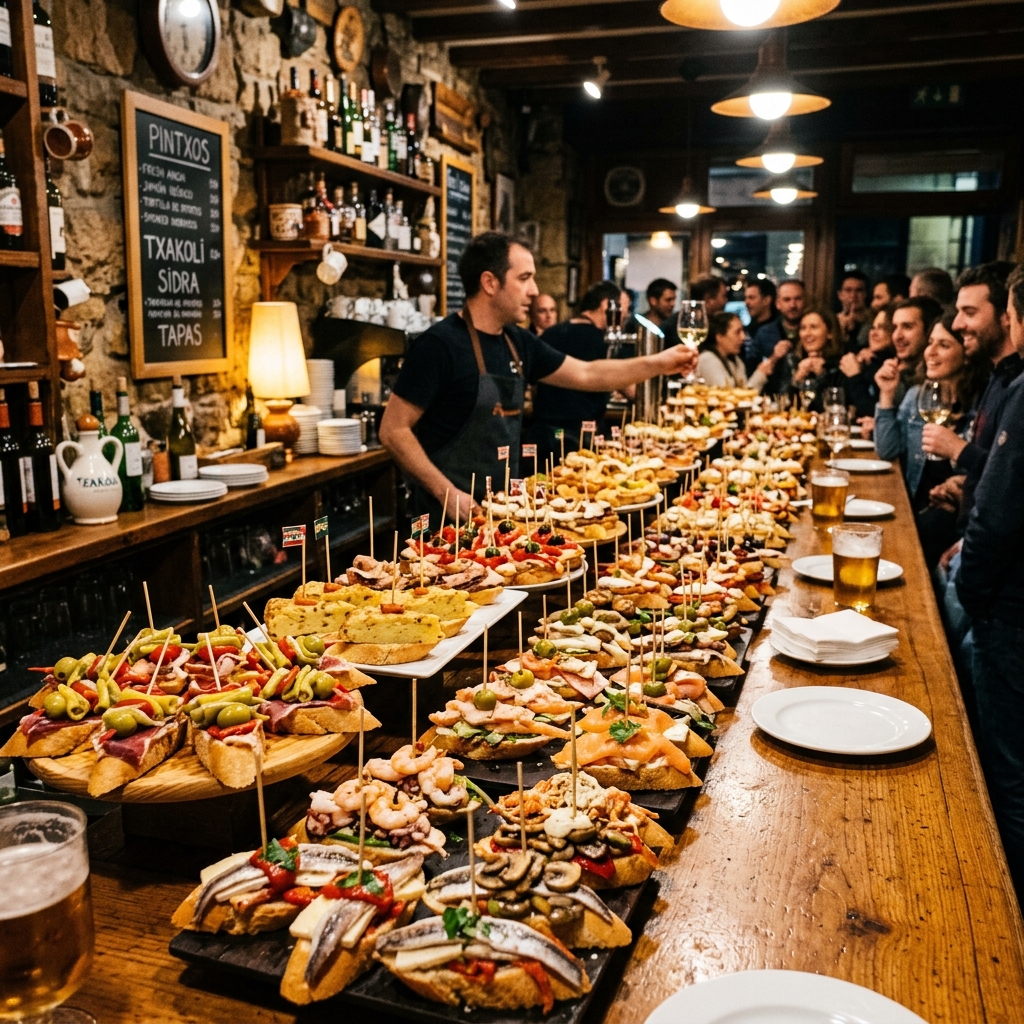
There is a bar in San Sebastián’s Old Town called Bar Nestor. It serves two things: a tortilla de patata (potato omelette) and a T-bone steak. The tortilla is made once daily in a single enormous pan, cut into portions at 1pm and 8pm precisely, and sold out within minutes. People queue 20 minutes before it is cut. The tortilla has been described by chefs with three Michelin stars as the finest version of the dish they have ever eaten.
This is San Sebastián. A city of 180,000 people on the Bay of Biscay in the Basque Country, where the sea is cold and green, the mountains come down almost to the beach, and the concentration of culinary excellence — from the €2 bar counter to the €265 tasting menu — is unlike anywhere else on earth.
Why San Sebastián Is Different
The statistics are well-known: San Sebastián has more Michelin stars per capita than any other city in the world, including Tokyo, Kyoto, and Paris. Within 20 kilometres of the city centre, you have Arzak, Akelare, Martín Berasategui, Mugaritz, Zuberoa — a density of three-starred restaurants that would be extraordinary in a city of three million, let alone one of 180,000.
The reason is structural. The Basque Country has a centuries-old tradition of txokos — private members’ cooking societies, historically all-male, where groups of friends meet to cook competitive multi-course meals for each other. These are not gentlemen’s clubs with chefs on staff. The members do the cooking themselves. The txokos created a culture in which cooking skill was a form of masculinity and social status, and in which the standard of amateur cooking was driven systematically upward. The professional restaurant culture grew from that root.
But the argument for San Sebastián as the world’s greatest eating city rests less on the tasting menus than on the pintxos bars. The three-starred restaurants are extraordinary. The Old Town at 8pm on a Thursday, with €2 pintxos on every bar counter and glasses of txakoli being poured from shoulder height, is more extraordinary.
The Pintxos Crawl: The Parte Vieja Circuit
The Parte Vieja (Old Town) is a compact grid of streets between the bay and the river, about 600 metres square. It contains more bars per square metre than anywhere in Spain. On a Friday evening, the pavement crowd is so thick on the main streets — Calle Fermín Calbetón, Calle 31 de Agosto — that movement becomes sideways shuffling.
The ritual is precise: enter a bar, survey the counter (pintxos are displayed on the bar top, not listed on a menu), order 2 or 3 pieces that look freshest, ask for a txakoli or a zurito (small beer), eat standing at the counter, pay, leave, and walk 50 metres to the next bar. Repeat for 2 hours.
The Essential Bars
Bar Nestor (Calle Pescadería 11): The tortilla. Reserve your portion by calling the morning you want it — the number is on the door — and pick it up at 1pm or 8pm. The T-bone steak, salted only and grilled over charcoal, is also exceptional. This is not a bar to visit for variety; it is a bar to visit for a lesson in the perfection of simplicity.
La Cuchara de San Telmo (Calle 31 de Agosto 28): No pintxos on the counter here — everything is cooked to order from a short menu on a blackboard, which means you order and wait two minutes rather than point and eat immediately. Worth it. The foie gras with apple, the braised pig’s cheek, and the seasonal vegetables cooked in the wood oven have made this the most recommended bar in the Old Town for the past decade.
Bar Txepetxa (Calle Pescadería 5): The anchovy bar. Everything here is built on the anchovies of the Bay of Biscay, which are among the finest in the world. The counter is covered with pintxos topped with different anchovy preparations — with smoked salmon, with sea urchin roe, with gilda (olive and pickled pepper), with truffle oil. One of the great expressions of a single ingredient.
Atari Gastroteka (Calle Mayor 18): More polished and slightly more expensive than the traditional bars, with excellent mushroom pintxos, house-cured jamón, and a txakoli list that goes beyond the house pour. Good for a meal when you want to sit rather than stand.
A Fuego Negro (Calle 31 de Agosto 31): The modernist option. Black-clad staff, avant-garde pintxos, excellent cocktails. The KKK pintxo (kokotxa — salt cod cheek — with pil-pil sauce) is a Basque classic presented with care. Younger crowd, later hours, slightly higher prices.
Pintxos Etiquette
The pintxos on the bar are usually the base of the offer. The better pieces — anything cooked to order or prepared fresh behind the counter — are on blackboards or announced verbally. Ask what is good. The staff will tell you.
Pay when you order or when you leave, depending on the bar. In the busiest places, paying as you go is easier. Keep your toothpicks (each pintxo is typically speared with one) if the bar counts them to calculate your bill — some do.
The crowds peak between 8pm and 10pm. If you want to eat without fighting for counter space, go at 7pm when the bars open. If you want the full sensory experience of the Parte Vieja in full swing, go at 9pm and embrace it.
The Michelin Restaurants
Arzak
Juan Mari Arzak opened his restaurant in 1974 in his grandmother’s house in the Alto de Miracruz neighbourhood, east of the city. His daughter Elena joined him in the kitchen in the 1990s. Together they have held three Michelin stars since 1989 — a continuous 35-year record that reflects not just consistent quality but genuine evolution.
The cuisine is Basque at its foundation — salt cod, baby squid, red peppers of Gernika — but continuously reimagined with techniques and ingredients that reflect the Arzaks’ relentless experimentation. The tasting menu costs approximately €265 per person, plus wine. Book 2 to 3 months ahead by email ([email protected]). Closed Sunday and Monday.
Mugaritz
Mugaritz sits in the Rentería valley, 9km from San Sebastián by taxi (around €15). Andoni Aduriz opened it in 1998 after working under Ferran Adrià at El Bulli, and it has held two Michelin stars for over 15 years. Where Arzak cooks in dialogue with tradition, Mugaritz pursues a more uncomfortable aesthetic — dishes that challenge, disorient, and occasionally provoke. Not all diners love it. Most leave thinking about it for weeks.
The tasting menu is approximately €230 per person. The restaurant opens each year in April and closes in late November for the kitchen team’s research period. Book at mugaritz.com.
Akelare
Pedro Subijana’s restaurant sits on a cliff at Mount Igueldo, above the western beach of San Sebastián, with views over the Atlantic that are among the most spectacular of any dining room in the world. Three Michelin stars since 2006. The cuisine draws on Basque fishing traditions — txangurro (spider crab), kokotxas (cod cheek), grilled fish — in two tasting menu formats: Aranori (focused on the sea) and Bekarki (more land-oriented). Around €220 per person. Book at akelarre.net.
One Rung Down: Excellent and More Accessible
Kokotxa (Calle del Campanario 11, in the Old Town) holds one Michelin star and offers a lunch menu on weekdays for around €60 — extraordinary value for the quality level.
Alameda in nearby Hondarribia (30 minutes by local bus) is a three-generation family restaurant with one star, serving traditional Basque food at prices roughly half those of the three-starred kitchens. The kokotxa al pil-pil and the salt-baked fish are benchmarks for the style.
Txakoli: The Wine of the Basque Country
Txakoli is the wine of San Sebastián and it is almost impossible to drink anywhere else, which is part of why it tastes so good in context. The local appellation, Getariako Txakolina, covers the hillsides west of the city near the fishing village of Getaria. The wine is made from Hondarrabi Zuri — a grape that produces something very dry, high in acidity, lightly fizzy, and around 11% alcohol.
It is not a subtle wine. It is a direct wine — refreshing, slightly saline from the maritime air, completely uninterested in complexity. With a plate of anchovies or a counter of pintxos, it is close to ideal.
The pour is the ritual. The waiter holds the bottle at arm’s length above the glass — sometimes at chest height, sometimes at full reach above the head — and pours a thin stream that falls 50cm or more, picking up bubbles and aeration as it falls. You get a small glass with a significant head of fizz. Drink it before the bubbles die.
Most bars in the Parte Vieja pour a house txakoli from a local producer. To explore the range, visit the area around Getaria on a day trip — 25 minutes by bus from San Sebastián, a beautiful fishing village with a remarkable church.
Getting There by Train
From Madrid: Renfe AVE connects Madrid Chamartín to San Sebastián (Donostia) in 5 hours 30 minutes. Tickets start from €30 booked well in advance on Renfe.com. There are typically 6–8 services per day.
From Paris: The fastest route is TGV Inoui or Ouigo from Paris Montparnasse to Hendaye (the French border town), then the Cercanías C-2 train for 20 minutes across to San Sebastián Amara station, with a bus connection to the city centre. The TGV takes about 5 hours from Paris to Hendaye; total journey city-to-city is around 5 hours 30 to 6 hours. Tickets on SNCF’s website or via Trainline. A direct Ouigo low-cost service from Paris to Hendaye runs on certain days, with tickets from €15 on ouigo.com.
From Bilbao: The EuskoTren Euskotren line connects Bilbao with San Sebastián in 2 hours 30 minutes, with a scenic route through the Basque coast. Alternatively, ALSA buses run the motorway in 1 hour 15 minutes for around €8.
From Barcelona: RENFE Media Distancia or the Intercity takes around 5 hours 30 minutes via Zaragoza. Buses (ALSA, BlaBlaBus) cover the same route in 5–6 hours and are often cheaper.
When to Go
September is the consensus best month. The summer crowds have thinned, the sea is at its warmest (18–20°C), the festivals are excellent (the San Sebastián Film Festival runs in September), and the pintxos bars are full without being crushed. The Parte Vieja in September at 9pm — warm air, crowds out but not overwhelming, the bars lit up — is as good as a European city gets.
May and June are excellent for the food specifically. The spring anchovy catch (costera de primavera) produces the best anchovies of the year, and the spring menus at the fine-dining restaurants reflect what is in season. Quieter than summer, with prices reflecting it.
January and February are cold (5–10°C), wet, and very quiet. The pintxos bars are open; the Michelin restaurants are all serving. If you can tolerate grey weather, this is when the city belongs to locals and the queues outside Bar Nestor are manageable.
Day Trips
Bilbao (1 hour 15 minutes by bus, or 2 hours 30 minutes by scenic Euskotren): The Guggenheim Bilbao still stops visitors cold nearly 30 years after it opened. Frank Gehry’s titanium-clad building is one of the finest works of architecture completed in the 20th century. The Casco Viejo (old quarter) has its own pintxos culture, less refined than San Sebastián’s but with personality.
Biarritz (45 minutes by train from Hendaye, or 1 hour from San Sebastián by bus): The French Basque resort is 40 kilometres away and culturally in a different world — art deco villas, a working harbour, excellent surfing beaches, and the Basque Coast’s own food culture. The covered market in Bayonne (30 minutes from Biarritz) has the best jambon de Bayonne in the world.
Getaria (25 minutes by bus): A fishing village wedged between two bays, with a Gothic church built directly over the main road (traffic passes under the nave). Famous for txakoli wine and for the extraordinary whole fish grilled on outdoor charcoal grills — the turbot here, salted, grilled, and served with a white wine and garlic sauce, is one of the meals of a lifetime.
For more on reaching San Sebastián and the wider Iberian rail network, see our guides to Spain by train, Madrid to Seville by train, and our round-up of Europe’s best food cities.