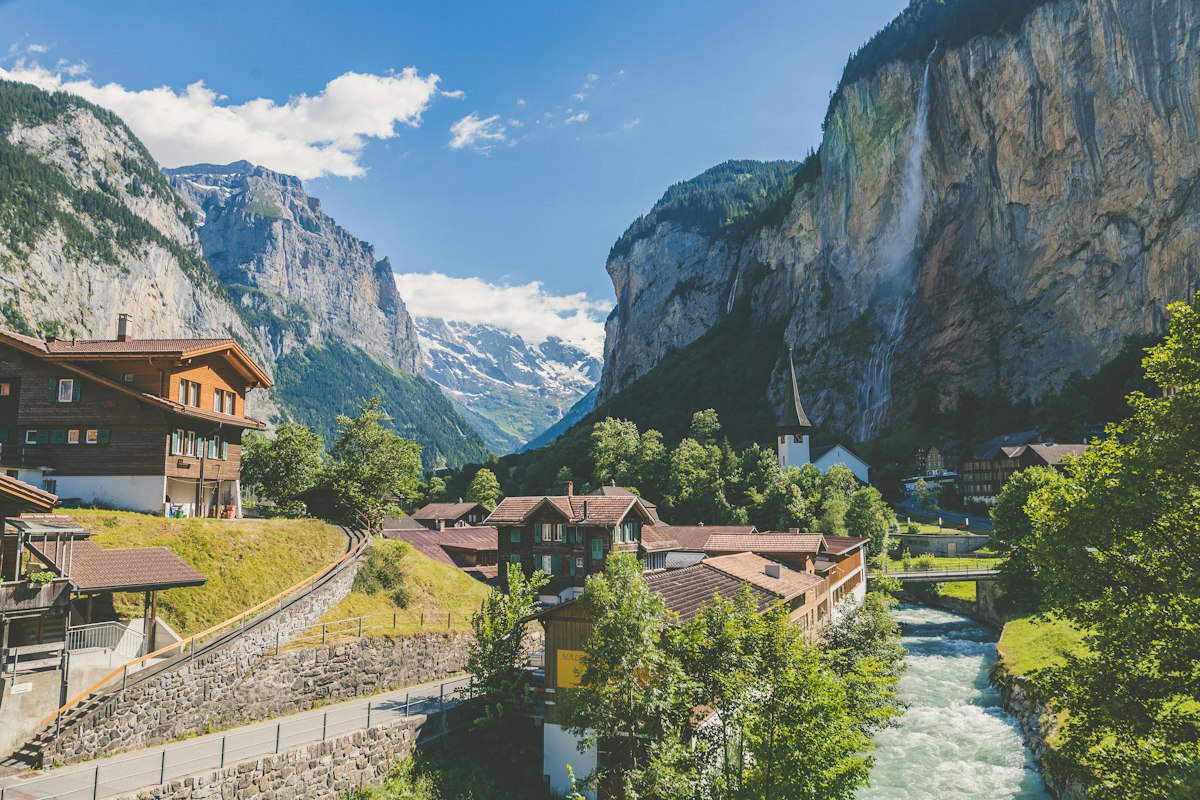
The Glacier Express gets a lot of attention. It deserves some of it, the eight-hour journey from Zermatt to St. Moritz through the heart of the Swiss Alps is genuinely spectacular, and we’ve written about it in detail in our Glacier Express guide. But the attention it receives creates a distortion. It makes people think Switzerland has one great train journey, when in fact it has dozens.
The Swiss rail network covers 5,700 kilometres of track through a field that is, by any reasonable standard, absurd. Mountains that shouldn’t be possible. Valleys carved by glaciers that are still visible above the treeline. Villages clinging to slopes at angles that make you question gravity. And all of it is served by trains that run on time with a reliability that borders on philosophical.
The routes in this guide are not premium tourist products. They’re regular scheduled services, the trains that Swiss people actually take to get from one place to another. They don’t have panoramic cars or three-course meals. They do have windows, and what’s outside those windows is extraordinary.
TL;DR: Switzerland’s regular train network passes through scenery that rivals, and sometimes exceeds, the famous panoramic trains. The Lötschberg, Gotthard, Brünig, and Simplon routes all offer world-class Alpine views on standard tickets with no reservation required. A Swiss Half Fare Card (185 CHF/month) halves all fares.
Why Regular Swiss Trains Are the Real Secret
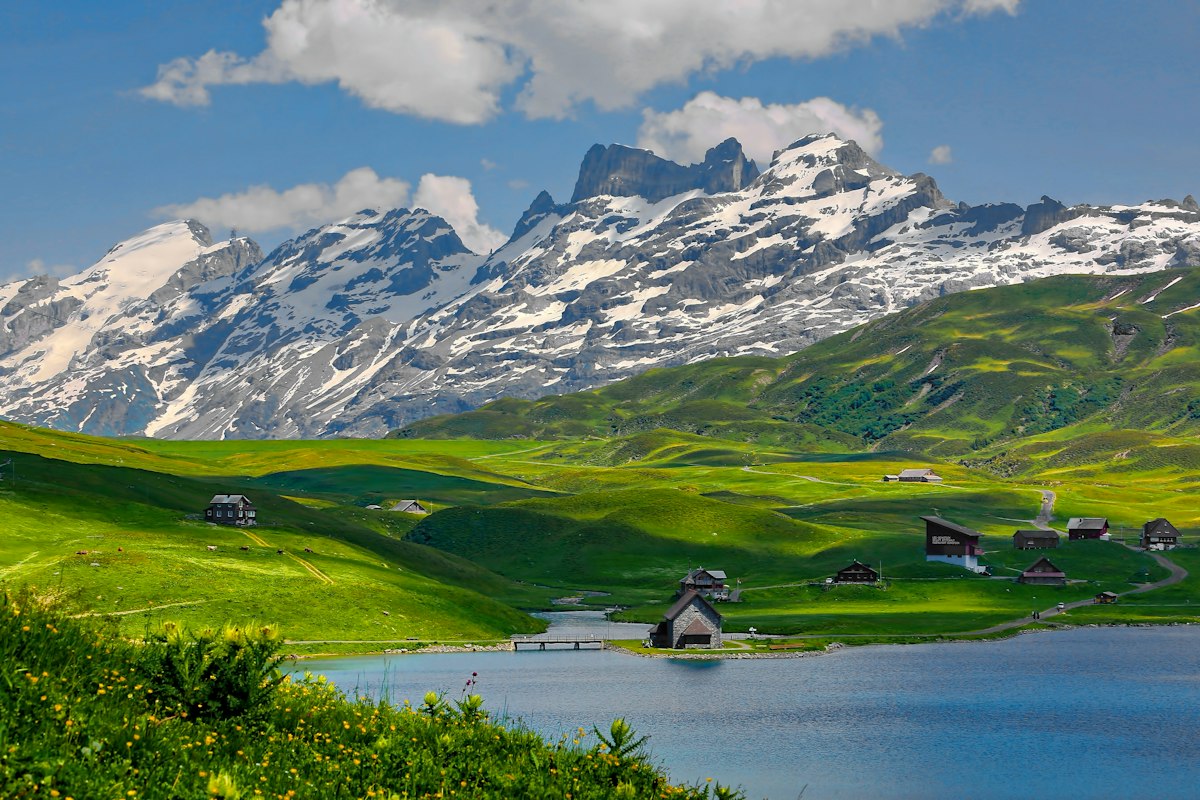
The premium panoramic trains, Glacier Express, Bernina Express, GoldenPass Express, are excellent, but they come with caveats. They require advance reservations. They charge supplements of 30-50 CHF on top of the base fare. They run limited schedules. And they’re full of tourists taking photographs of each other taking photographs.
Regular Swiss trains, by contrast, run every hour or half-hour on most routes. They cost the standard fare. They require no reservation. The carriages are modern, clean, and have large windows. And the scenery outside is the same scenery, the mountains don’t change depending on whether you’ve paid a supplement.
The Swiss Federal Railways (SBB) network was built through some of the most challenging terrain on earth. Every line is a feat of engineering. That means every line has tunnels, viaducts, switchbacks, and valley crossings that produce views you didn’t expect and didn’t pay extra for.
Our Switzerland by train guide covers the overall planning. This piece focuses on specific routes that deserve attention.
1. The Lötschberg Mountain Route: Brig to Spiez
Duration: 1 hour 15 minutes | Distance: 60 km | Scenic rating: Exceptional
This is the route the Glacier Express used to take before the Lötschberg Base Tunnel was built in 2007. The old mountain line still runs, and it’s better than the tunnel because you can actually see things.
The train climbs from the Rhône Valley floor at Brig through a series of spiralling tunnels that gain altitude in loops, you can see the track you were on five minutes ago, 200 metres below. It emerges onto the southern face of the Bernese Oberland with views across to the Aletsch Glacier, the largest glacier in the Alps. Then it crosses the Lötschberg summit and descends to Spiez on Lake Thun.
Sixty kilometres. Seventy-five minutes. No supplement required. This is, mile for mile, among the most scenic train rides in Europe.
How to ride it: Take any RegioExpress service from Brig marked for Spiez via the Lötschberg mountain route (not the base tunnel). Runs roughly every hour. Second-class fare about 32 CHF, or 16 CHF with a Half Fare Card.
2. The Gotthard Panorama Route: Luzern to Lugano via Göschenen
Duration: 3 hours 30 minutes | Distance: 140 km | Scenic rating: Exceptional
The old Gotthard line, the one that existed before the 57-km base tunnel opened in 2016, is still operating and it’s magnificent. The train climbs from Luzern along the shore of Lake Uri, ascends through the famous spiral tunnels above Wassen (where you see the same church three times at different altitudes), crosses the Gotthard summit, and descends into Italian-speaking Ticino.
You cross a climatic and cultural border on this route. You board in German-speaking central Switzerland, surrounded by green meadows and fog. You alight in Lugano, where the light is Mediterranean, the language is Italian, and the palm trees are real.
The spiral tunnels at Wassen are an engineering landmark. The train loops through the mountain three times, gaining altitude with each pass. Watch the church steeple in the valley below, it appears on the left, then below, then on the right.
How to ride it: Take the Gotthard Panorama Express from Luzern (includes a boat segment on Lake Luzern) or simply ride the regular IR train via Göschenen. The standard train costs about 55 CHF to Lugano; half with the card.
3. The Brünig Line: Luzern to Interlaken
Duration: 2 hours | Distance: 75 km | Scenic rating: Very good
The Brünig line is the only metre-gauge route in the SBB network, which means it was built to climb grades that standard-gauge trains can’t manage. It uses a rack-and-pinion system on the steepest sections, you can hear the cog engage as the train tilts upward.
From Luzern, the train follows Lake Sarnen, climbs over the Brünig Pass at 1,008 metres, and descends into the Hasli Valley before arriving in Interlaken with the Eiger, Mönch, and Jungfrau visible ahead. The Hasli Valley descent is the highlight, the train moves through a narrow valley with waterfalls on both sides and the Aare River below.
This is a practical route as well as a scenic one. It connects two of Switzerland’s most visited towns, and it does so through field that looks like the cover of every Switzerland tourism brochure ever printed.
How to ride it: Direct RegioExpress services run every hour. Fare about 33 CHF second class. No reservation needed.
4. The Simplon Route: Brig to Domodossola
Duration: 35 minutes | Distance: 40 km | Scenic rating: Good to very good
The Simplon Tunnel is 19.8 km long, it was the longest tunnel in the world when it opened in 1906 and remained so for nearly a century. The tunnel itself is dark, obviously, but the approaches on both sides are dramatic. The Swiss side climbs through the upper Rhône Valley; the Italian side descends through the wild Diveria gorge into the town of Domodossola, where you’re suddenly in Italy and the architecture, language, and light have all changed.
This is a short ride, 35 minutes, but it makes an excellent day trip. Domodossola has a Saturday market that’s been running since the 15th century, and the town is genuinely charming. Take the train over, have lunch, take the train back.
How to ride it: RegioExpress from Brig. Runs every hour. Cross-border fare approximately 18 CHF second class.
5. The Centovalli Railway: Domodossola to Locarno
Duration: 2 hours | Distance: 52 km | Scenic rating: Exceptional
The “Valley of a Hundred Valleys”, the Centovalli, is a narrow-gauge railway that runs from Domodossola in Italy to Locarno on Lake Maggiore in Switzerland. It crosses 83 bridges and passes through 34 tunnels through a field of chestnut forests, waterfalls, and villages that look like they were placed there specifically for the purposes of being beautiful.
This is a genuinely lesser-known route. It doesn’t appear in most guidebooks and it’s not marketed as a tourist train, despite being operated by FART (the Ferrovie Autolinee Regionali Ticinesi, the name is funnier in English than in Italian). The scenery is subtropical in places, almost jungle-like in the deeper valleys, which is not what you expect from Switzerland.
How to ride it: Combine with the Simplon route for a circular trip from Brig: Brig to Domodossola (35 min), Centovalli to Locarno (2 hours), then train or bus back to Brig via the Furka or Nufenen pass. A spectacular day out.
6. The Rhône Valley Line: Geneva to Brig
Duration: 2 hours 15 minutes | Distance: 170 km | Scenic rating: Good
The main line from Geneva through the Rhône Valley to Brig runs through the heart of the Valais, Switzerland’s sunniest canton and one of its most distinctive. Vineyards cover the south-facing slopes on terraces that date back centuries. The Rhône River flows alongside the track. The northern wall of the valley rises to peaks that are permanently snow-covered.
This route is a main line, not a tourist attraction, which means it’s fast, frequent, and cheap. It’s also the gateway to several of the other routes in this guide, the Lötschberg, the Simplon, and the Glacier Express all depart from Brig at the eastern end.
The section between Sion and Brig is particularly good. The valley narrows, the mountains close in, and the vineyards give way to rock faces. The town of Leuk, visible from the train, is perched on a cliff above the valley floor in a way that seems structurally inadvisable.
How to ride it: IC trains run every 30 minutes. Geneva to Brig is about 45 CHF second class.
7. The Bernese Oberland: Spiez to Zweisimmen
Duration: 45 minutes | Distance: 35 km | Scenic rating: Very good
The short line from Spiez to Zweisimmen runs through the Simmental, a wide, green valley with traditional wooden chalets, flower-filled meadows, and a backdrop of peaks that includes the Niesen and the Stockhorn. It’s quintessentially Swiss in a way that photographs can’t quite capture because the scale is wrong, the mountains are bigger than they look, and the valleys are deeper.
This line connects with the MOB (Montreux-Oberland Bernois) railway at Zweisimmen, which means you can continue to Montreux and Lake Geneva. The combined Spiez-Zweisimmen-Montreux journey is essentially the route of the old GoldenPass and it’s beautiful throughout.
How to ride it: RegioExpress from Spiez. Fare about 18 CHF. Connects with the GoldenPass Express to Montreux (reservation required for the Express; the standard MOB trains are reservation-free).
8. The Lake Geneva Shore: Lausanne to Montreux
Duration: 25 minutes | Distance: 30 km | Scenic rating: Very good
This is perhaps the shortest entry on the list, but it’s worth including because the scenery-per-minute ratio is extraordinary. The train from Lausanne to Montreux runs along the northern shore of Lake Geneva through the Lavaux vineyards, a UNESCO World Heritage Site. The vineyard terraces, which date to the 11th century, descend to the lake shore in steps. The French Alps are visible across the water. On a clear day, Mont Blanc appears.
Twenty-five minutes. No reservation. Regular IR trains every 15-30 minutes. The fare is about 12 CHF.
Sit on the left side heading toward Montreux. The lake views are on that side, and they’re among the best views from any commuter train anywhere in the world.
Planning a Swiss Scenic Train Trip
The Swiss Half Fare Card (185 CHF for one month) halves all fares on trains, buses, and boats throughout Switzerland. If you’re taking more than a few of these routes, it pays for itself quickly. Our Switzerland by train guide covers all pass options in detail.
Combine routes for day trips. Several of these routes connect naturally: Brig to Domodossola to Locarno (Simplon + Centovalli), Geneva to Brig to Spiez (Rhône Valley + Lötschberg), Luzern to Lugano (Gotthard). Plan circular routes that bring you back to your base by evening.
Sit upstairs on double-decker trains. Many Swiss regional trains are double-deckers. The upper deck offers higher vantage points and panoramic views through larger windows. It’s free, just walk upstairs.
Check the weather before choosing routes. Alpine scenery is best on clear days. The SBB app shows webcams at many mountain stations. If the forecast is cloudy, save the high routes for another day and do a lake-shore route instead.
Don’t overlook the buses and boats. Switzerland’s PostBus network covers mountain passes that trains can’t reach, and lake steamers connect towns on Lakes Luzern, Thun, Brienz, and Geneva. All are covered by Swiss rail passes. The boat across Lake Luzern to Flüelen, where you connect with the Gotthard line, is itself a highlight.
The Bottom Line
The Glacier Express and Bernina Express are excellent, we’ve written about both. But Switzerland’s real secret is that the ordinary trains are extraordinary. The network was built through impossible terrain by engineers who didn’t know the meaning of the word impossible, and the result is that every route has tunnels, bridges, switchbacks, and valley crossings that would be a headline attraction in any other country.
Buy a Half Fare Card. Pick a base, Brig, Luzern, and Interlaken all work well. Take a different train each day. You’ll come home with the settled knowledge that Switzerland’s best scenery is not reserved for tourists who pay a supplement. It’s available to everyone who buys a standard ticket and looks out the window.