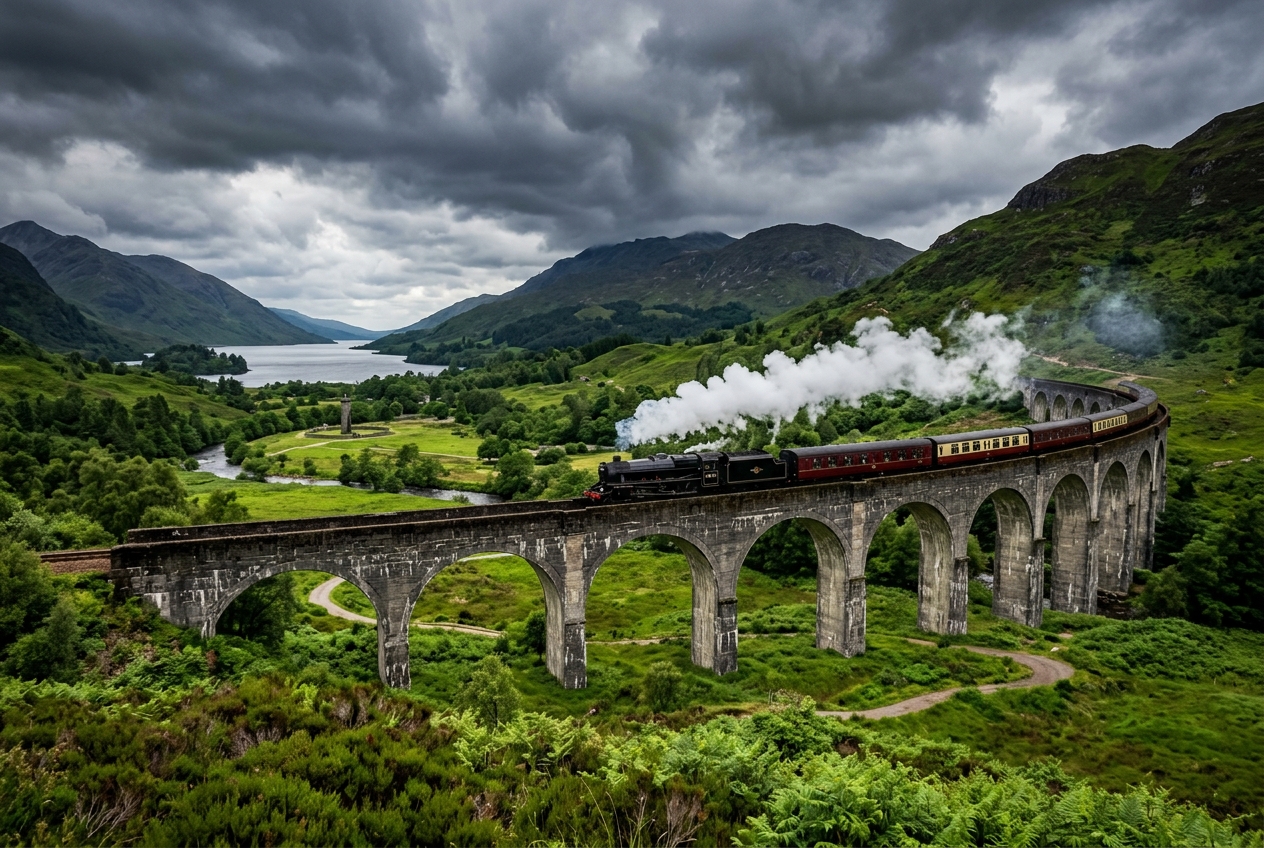
The simplest summary: two train lines that run into the Scottish Highlands from Inverness represent some of the finest rail travel in the world, and most visitors to Scotland never take either of them.
The Kyle of Lochalsh line heads west to the sea. The Far North Line heads north to the top of Britain. Together they cover terrain so dramatic, so empty, and so particular to this corner of Europe that no other form of travel, certainly no road, shows it to the same effect.
Getting to Inverness: The Gateway to the Highlands
Every Highland train journey begins or passes through Inverness, the capital of the Highlands and the hub from which both scenic lines depart.
From Edinburgh: Direct ScotRail trains run from Edinburgh Waverley to Inverness via Perth and Aviemore, taking approximately 3.5 hours. The route crosses the Cairngorms plateau and follows the valley of the River Spey, already dramatic, and with good reason to pay attention to the right-hand window through Aviemore. Trains run roughly every 1–2 hours.
From Glasgow: ScotRail services from Glasgow Queen Street to Inverness take around 3 hours 15 minutes, also via Perth.
From London: The Caledonian Sleeper is the correct answer (see below). Flying to Inverness from London takes under 2 hours on the flight itself, but the sleeper eliminates a hotel night and wakes you in the Highlands, a different proposition entirely.
Inverness itself: Give it at least an afternoon. The Victorian Market (1870, covered arcades, still fully functioning), the castle promontory over the River Ness, and the independent food shops along Academy Street are all worth your time. Base yourself here for 2–3 nights to day-trip on both scenic lines.
The Kyle of Lochalsh Line: Inverness to the Sea
The 82-mile Kyle line leaves Inverness heading southwest, crosses the Black Isle on a causeway across the Beauly Firth, and then turns northwest into terrain that begins to feel genuinely remote within the first hour.
The Journey
Inverness to Dingwall (30 minutes): The line skirts the Beauly Firth, wide, tidal, ringed by hills, before reaching the market town of Dingwall. On a clear morning, Ben Wyvis (1046m) dominates the skyline to the north.
Dingwall to Garve (50 minutes): The line climbs into the Highland interior. The landscape opens: heather moor, the odd isolated farmhouse, the river Blackwater running alongside. This is already a different Britain.
Garve to Achnasheen (1 hour): The valley narrows. Loch Luichart and Loch Gowan appear; the mountains begin to close in. Achnasheen, a single platform with a hotel, is the watershed point, where westward-flowing rivers drain to the Atlantic rather than the North Sea.
Achnasheen to Strathcarron (30 minutes): The descent to the west. The Torridon mountains appear to the north, ancient Torridonian sandstone, some of the oldest rock in the world (approximately 750 million years old). The scale changes. These are not the tamed hills of the southern Highlands; they are buttresses.
Strathcarron to Kyle of Lochalsh (40 minutes): The final section crosses Stromeferry, skirts the shore of Loch Carron, and runs the last miles along the sea. Kyle of Lochalsh station sits at the water’s edge, looking across to Skye and the Cuillin ridge beyond. In clear weather, the Cuillins, jagged volcanic peaks, entirely different in character from the surrounding sandstone and gneiss, are visible from the platform.
Practical Details
The journey takes approximately 2h30m. There are typically 3–4 trains per day in each direction. Book via ScotRail’s website or the Trainline; the Kyle line is popular with tourists in summer and sells out. Seats on the left side of the train (travelling west) give you the best views across Loch Carron and towards Skye in the final stretch.
A good option is to travel one direction by train and return by the Citylink bus via the inland road (A890/A835), which adds the Bealach na Bà, one of Britain’s most dramatic mountain roads, to the experience. The bus journey takes around 2h45m.
Connections from Kyle of Lochalsh
Kyle of Lochalsh sits at the Skye Bridge crossing. Walk across (15 minutes on foot) or take the Citylink bus to reach Kyleakin and Broadford on Skye. Portree is a further hour by bus. The Skye Ferry at Glenelg (seasonal) offers an atmospheric alternative crossing from the south.
The Far North Line: Inverness to Thurso and Wick
If the Kyle line is spectacular, dramatic mountain landscapes, sea lochs, Atlantic views, the Far North Line is something different: an exercise in remoteness. It runs 168 miles (270km) from Inverness to Thurso and Wick, reaching the northernmost railway station on mainland Britain. The journey takes approximately 4 hours to Thurso.
The Route
Inverness to Tain (1 hour): The line runs north along the Black Isle, crosses the Cromarty Firth (with views of the old oil-rig construction yards), and passes through the royal burgh of Dornoch Firth. Tain is the oldest royal burgh in Scotland, with a fine medieval collegiate church.
Tain to Golspie (1 hour): The line follows the east coast through Sutherland, one of the most sparsely populated places in Europe. The statistics are striking: Sutherland is larger than Luxembourg, with a population of under 15,000. The field is wide, moorland and sea in alternation, with the occasional ruined broch or stone-walled croft.
Golspie to Helmsdale (45 minutes): Pass through Brora (a small town with a whisky distillery and a beach), cross the Helmsdale River, and descend into the small fishing port of Helmsdale. Timespan heritage centre in Helmsdale is worth a stop if you have time, it covers the Highland Clearances with unusual intelligence and without sentimentality.
Helmsdale to Forsinard (45 minutes): The line turns inland and climbs into the Flow Country, 400,000 hectares of blanket bog, the largest in the world, a UNESCO World Heritage Site since 2024. Forsinard station has an RSPB visitor centre (check hours before travelling). The Flow Country does not look like what most people expect of a World Heritage Site: it is flat, brown, and seemingly featureless. In reality it is an ecosystem of extraordinary complexity and climate significance, storing more carbon than all British and Irish forests combined.
Forsinard to Thurso and Wick (1 hour): The line splits at Georgemas Junction, the northern junction of any railway in Britain. One branch heads west to Thurso (Castle of Mey, the late Queen Mother’s home, is 8 miles east); the other heads east to Wick. Both termini are coastal towns with character.
Thurso
Thurso is the most northerly town on mainland Britain and the access point for the Orkney ferry from Scrabster harbour (2 miles west). The crossing to Stromness takes 90 minutes on the Northlink ferry. Orkney is an entirely logical extension of a Far North Line journey, offering standing stones (Skara Brae, the Ring of Brodgar), Norse history, and extraordinary birdwatching.
The Caledonian Sleeper: London to the Highlands
The Caledonian Sleeper remains one of the genuinely pleasurable long-distance train experiences available in Britain. It solves a real problem: the distance from London to the Highlands (approximately 580 miles to Inverness) is too far to drive, too expensive to justify by air, and too long for a daytime train. The sleeper turns the journey itself into an event.
What to Expect
Trains depart London Euston at 21:15 (Inverness service) and arrive in Inverness at approximately 08:42 the following morning. The Fort William service follows the West Highland Line from Glasgow, reaching Fort William at 09:59, giving a view of the Highland moorland at dawn that is, on a clear morning, genuinely moving.
Caledonian Rooms are private en-suite cabins with a fold-down bed, lockable door, power outlets, and access to a shared shower at the end of the carriage (for the non-en-suite rooms). The cabin is small but well-designed. Breakfast is served in the club car or brought to your room, a full Scottish breakfast on request.
Seats in the Caledonian Club Car are available at lower prices for budget travellers. The lounge car serves drinks and light food.
Booking
Book directly at sleeper.scot (the Caledonian Sleeper website). Cabins sell out months ahead in summer, book 8–12 weeks in advance for July and August travel. Prices range from approximately £60 (Caledonian Club Car seat) to £200 (private Caledonian Room single) depending on date and booking window. Return journeys from Highland stations back to London are available on the same route.
Passes vs Point-to-Point
BritRail Scotland Rover: Covers all ScotRail services across Scotland for 3, 4, or 8 days within a set period. Useful if you plan to combine the Kyle Line, Far North Line, West Highland Line, and connections between Edinburgh/Glasgow and Inverness. Check the current BritRail website for pricing, typically £80–140 for a 4-day consecutive pass.
Point-to-point: If you’re making 2–3 specific journeys and booking 6–8 weeks ahead, Advance fares on individual tickets often beat the pass. The Inverness–Kyle round trip costs approximately £20–28 on Advance; Inverness–Thurso is around £25–35. Buy through ScotRail or Trainline.
The Caledonian Sleeper is not covered by most BritRail passes and must be booked separately.
Best Itinerary: Five Days in the Scottish Highlands by Rail
Day 1: Arrive Inverness via Caledonian Sleeper from London. Explore Inverness, Victorian Market, castle walk, dinner.
Day 2: Day trip on the Kyle of Lochalsh line. Depart Inverness at 08:46, arrive Kyle of Lochalsh 11:28. Walk to Skye Bridge, lunch in Kyle, return afternoon train. Consider spending the night in Kyle to allow an early morning Skye trip.
Day 3: (Optional Skye day, or) day trip to Culloden Battlefield (7 miles from Inverness) and Loch Ness. Return Inverness.
Day 4: Far North Line to Thurso. Depart Inverness 07:37, arrive Thurso 11:47. Explore the town, lunch, afternoon ferry view from Scrabster, return evening train or stay overnight.
Day 5: Return to Edinburgh or Glasgow for onward connections. The Inverness–Edinburgh route through the Cairngorms is one of the finer daytime rail journeys in Britain.
Connections and Onward Travel
The Kyle of Lochalsh line connects naturally with the London to Edinburgh train as the first leg of a Highland journey. For context on how the Kyle and Far North lines fit into the broader field of European scenic rail, see our guide to the most scenic train routes in Europe.
Related Reading: London to Edinburgh by train, The most scenic train routes in Europe, Night trains in Europe