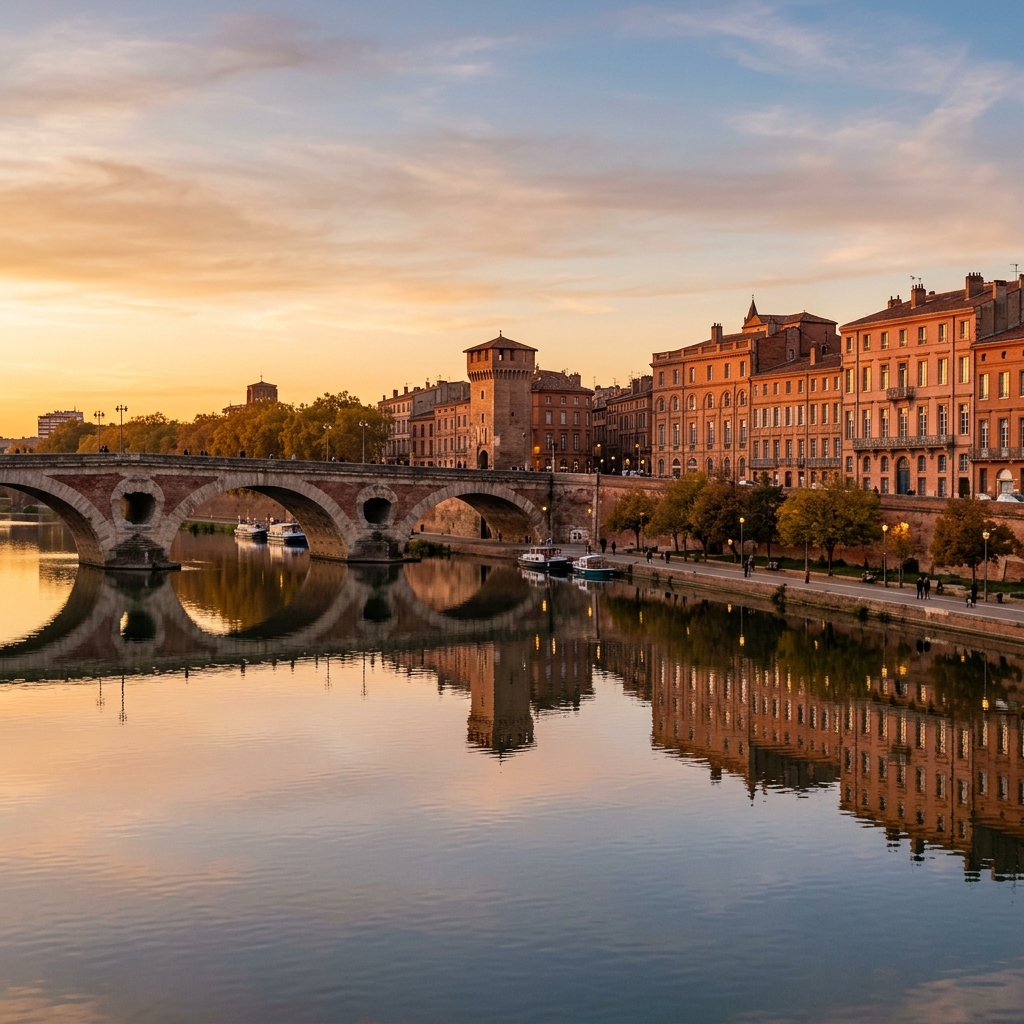
Toulouse sits where France tilts toward Spain and the Atlantic gives way to the Mediterranean. It is not a city that features prominently on most European rail itineraries, which is precisely why it should feature on yours.
The French call it La Ville Rose, the Pink City, for the terracotta brick used in virtually every building, quarried from the alluvial plain of the Garonne and fired to a warm reddish-pink that changes colour through the day. At dusk the city turns almost bronze. In morning light after rain it glows.
Getting to Toulouse by Train
From Paris (TGV, 4h15)
Paris Montparnasse to Toulouse Matabiau is one of SNCF’s busier TGV routes, with around 10 direct departures per day. Journey time is 4 hours 10 to 4 hours 30 minutes depending on the service (some call at Bordeaux; faster direct trains take the Landes route).
Booking advice: The cheapest Advance (non-exchangeable) fares, Ouigo tickets starting from €10–15, standard SNCF fares from €25–35, are available 6–8 weeks ahead and sell quickly for weekend services. Book on the SNCF Connect app, Ouigo.com, or Trainline. Flexible TGV fares (fully changeable) cost €80–140. There is no meaningful advantage to going via Bordeaux unless you plan to stop.
The journey itself passes through the Loire Valley south of Paris, the Landes pine forest of Gascony (vast, flat, and strangely beautiful in its monotony), and descends into Toulouse through the Lauragais hills. The first sight of the brick city from the train is a genuinely good arrival.
From Barcelona (3–4 hours via Narbonne)
Toulouse and Barcelona are separated by the eastern Pyrenees, which trains skirt rather than cross. The standard route: TGV or Renfe AVE to Narbonne (1h10–1h40 from Toulouse), then onward to Barcelona Sants (1h30–2h from Narbonne, depending on the service).
Total journey time is 3–4 hours with the connection at Narbonne. This is less convenient than a direct route, but the Narbonne change is straightforward, Narbonne is a small, unhurried station with clear connections. Book cross-border combinations through Rail Europe, Trainline, or the Renfe website for the Spanish leg.
Narbonne itself deserves an hour if you have a long connection: the unfinished Gothic cathedral (construction halted in 1340 when funds ran out, leaving the nave never built, the choir stands alone, cathedral-height, surrounded by medieval streets) is one of the stranger architectural experiences in southern France.
From Bordeaux (2h10)
Regional TGV services connect Bordeaux-Saint-Jean to Toulouse Matabiau in approximately 2 hours 10 minutes. This is part of the southwest France wine country corridor, use it to connect a Bordeaux wine base with a Toulouse stay. Fares are €25–60.
From Lyon (4h30)
Lyon Part-Dieu to Toulouse requires a change, typically at Marseille or Nîmes, and takes 4–5 hours. The scenic alternative is the Cévennes route through the Massif Central, slower but with extraordinary fields.
Toulouse Matabiau Station
Toulouse’s main station is Matabiau, on the northeast side of the historic centre. It is not the most elegant of French stations, a functional 19th-century building expanded several times, but it is compact and well-connected.
Metro: Line A connects the station directly to the city centre (Capitole, Esquirol) in 5 minutes. A day pass costs approximately €4.50. The metro is the correct way to cross the city.
Luggage storage: Available at the station (€5–8 per item per day). Useful for day-trip departures when you’ve already checked out of your accommodation.
Car hire: All major companies have desks at Matabiau. Essential if you plan to drive into the Pyrenees, where rail access is limited.
What to See in Toulouse
Toulouse rewards the visitor who gives it more than a day.
The Capitole: The city hall and opera house on the central square is Toulouse’s architectural statement, a vast pink-brick and white stone façade from 1750, its interior frescoed with scenes from the city’s history. The square itself is large and animated; the Saturday market around the square and the neighbouring streets is the best time to see Toulouse as a lived city.
Les Jacobins: A Dominican church begun in 1229, with a fan-vaulted ceiling that is one of the most beautiful Gothic spaces in France, a single central column at the east end explodes into 22 ribs that spread across the apse like a palm tree. This is the church where the relics of Thomas Aquinas are kept.
Basilique Saint-Sernin: The largest Romanesque church in Europe, built in pink brick on the pilgrimage road to Santiago de Compostela. The octagonal bell tower visible from across the city rises in five stages from the 11th century. The crypt holds relics of 128 saints, accumulated over centuries of pilgrimage.
The Garonne: The river is wide and fast-moving through Toulouse, still Alpine in character even this far downstream. Walk the riverside quays in the evening, when the light turns the brick to amber.
Food: Toulouse’s culinary identity is cassoulet and duck. Cassoulet, white beans slow-cooked with duck confit, Toulouse sausage, and pork, is the regional obsession; the finest version in the city is at Chez Emile on the Place Saint-Georges. The Toulouse sausage (saucisse de Toulouse) is also excellent grilled at any boucherie. The covered market at Victor Hugo is the city’s finest food hall, on the upper floor of a 1970s building, butchers, cheesemongers, and the best rotisserie duck.
Day Trips by Train from Toulouse
Carcassonne (50 minutes, €15–20 return)
The walled city of Carcassonne is one of the great medieval set pieces in Europe. La Cité, the upper fortified town on the hill, enclosed by double walls with 52 towers, was extensively restored in the 19th century by Viollet-le-Duc (who was criticized at the time for romanticizing the restoration; the pointed rooflines he specified were not historically accurate). The result, criticism aside, is spectacular.
Trains from Toulouse run approximately hourly. The station is at the base of the hill; walk or take a shuttle up to the Porte Narbonnaise. Go early: tour groups arrive from 10am. The lower town (Bastide Saint-Louis) is an underrated 13th-century grid of streets with better restaurants and fewer crowds than La Cité.
The Canal du Midi runs directly past Carcassonne, the towpath west from the Écluse de l’Évêque toward the Minervois is excellent for an afternoon walk or cycle.
Albi (1 hour, €18–25 return)
Albi sits on the Tarn river and contains two extraordinary things in close proximity: the Toulouse-Lautrec Museum (housed in the Palais de la Berbie, the medieval archbishop’s palace, with the world’s largest permanent collection of Toulouse-Lautrec’s work) and the Cathédrale Sainte-Cécile.
The cathedral is the largest brick building in the world and one of the most imposing Gothic structures in France, built in the late 13th and 14th centuries as a deliberate statement of Catholic authority after the Cathar heresy. Its fortress-like exterior, no flying buttresses, just sheer pink-brick walls, prepares you very poorly for the interior, which is entirely painted in a riot of late Gothic polychrome.
The Ariège Valley and the Pyrenees (Foix: 1 hour, Ax-les-Thermes: 2 hours)
The train south from Toulouse into the Ariège valley is one of the most beautiful regional lines in southwest France. The valley narrows as it climbs toward the Spanish border; the castle of Foix, three medieval towers on a volcanic rock above the town, is visible from the train.
Foix itself is an excellent base for the Ariège. Niaux Cave (by reservation only) contains some of the finest Palaeolithic cave paintings in Europe, less visited than Lascaux, with bison and horses drawn 13,000 years ago on the cave walls.
Ax-les-Thermes is a thermal spa town at 720m altitude, surrounded by ski resorts and walking country. The train continues to Latour-de-Carol on the Spanish border, connecting with the Catalan narrow-gauge line down to Barcelona.
The Canal du Midi: Toulouse to Carcassonne
The Canal du Midi, built 1666–1681, a UNESCO World Heritage Site since 1996, begins in Toulouse at the Port de l’Embouchure where it joins the Canal de Brienne, and runs 360km to the Mediterranean at Sète. It is shaded for much of its length by centuries-old plane trees (many now diseased and being replaced) and passes through a sequence of locks, aqueducts, and lock-keeper cottages.
The classic approach from Toulouse: hire a bicycle at the Toulouse city bike stations (Vélô Toulouse), follow the towpath southeast toward Castanet-Tolosan and beyond, and return by TER regional train from the nearest station. The 95km towpath between Toulouse and Carcassonne is almost entirely flat; serious cyclists do it in a day.
Boat hire is also possible from Toulouse, Castelnaudary, and Carcassonne, typical rental runs €700–1200 per week for a six-berth narrowboat. No experience required; operators give a 30-minute lesson.
Toulouse as a Slow Travel Base
The city rewards a stay of three nights or more. On the first day, walk the historic centre in concentric circles outward from the Capitole. On the second, take a day trip to Carcassonne or Albi. On the third, explore Saint-Cyprien across the river, eat well at the Victor Hugo market, and spend the afternoon on the banks of the Garonne.
The rhythm of Toulouse is southern French: long lunches, late dinners (no serious restaurant takes bookings before 19:30), afternoons when the streets quiet down. The university population, Toulouse has the second-largest student population in France after Paris, keeps the bars and cafés running.
For the connection westward to the Pyrenees by train and beyond, our Paris to Barcelona train guide covers the cross-Pyrenean connections in full.
Related Reading: Paris to Barcelona by train, Most scenic train routes in Europe, Europe rail pass guide