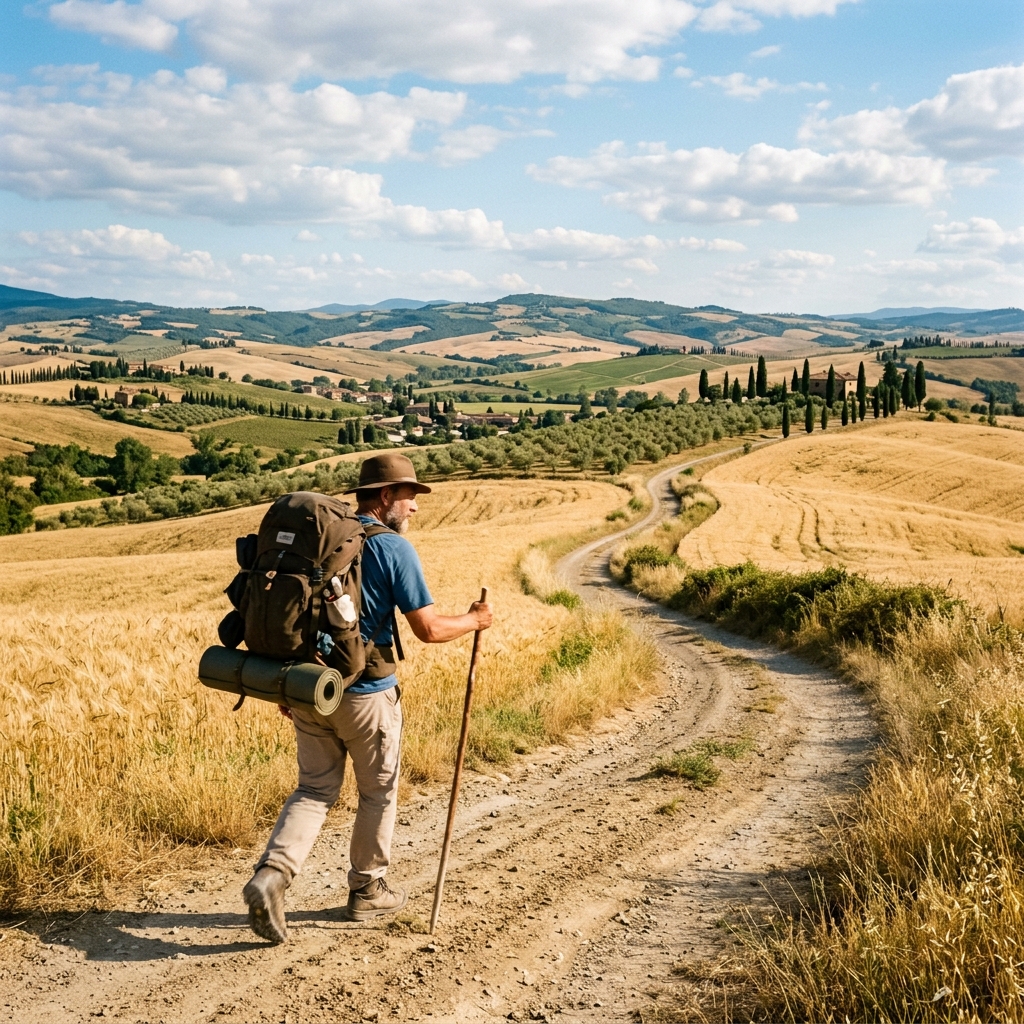
The road to Rome is older than Rome itself. Long before Airbnb and TripAdvisor, pilgrims followed the Via Francigena, the Way that Comes from France, from the fog of Canterbury Cathedral south through the Alps, down the length of Italy, and into the eternal city. Archbishop Sigeric of Canterbury walked it in 990 AD and left behind a list of 79 overnight stops. That list still largely holds.
Two thousand years of feet have worn this path into the field. The Via Francigena is not as famous as the Camino de Santiago, and that is precisely why you should walk it.
What Is the Via Francigena
The official Via Francigena runs 2,000km from Canterbury Cathedral in England to the Basilica di San Pietro in Rome. It passes through four countries, England, France, Switzerland, and Italy, and crosses the Great St Bernard Pass at 2,473 metres. It has been a UNESCO-recognised cultural route since 2004 and is gradually gaining the signage, infrastructure, and pilgrim community that the Camino has enjoyed for decades.
The route divides naturally into four sections:
- Canterbury to Calais (160km): the English section, ending at the Channel
- Calais to Great St Bernard Pass (800km): through Reims, Lausanne, and the Jura
- Great St Bernard Pass to Lucca (750km): descent through the Aosta Valley, the Po Plain, and the Ligurian hills
- Lucca to Rome (400km): the Tuscany and Lazio section, and the reason most people come
For most walkers, the answer is simple: fly or take the train to Lausanne, walk the Swiss section and the Italian section, and arrive in Rome. Or skip straight to Lucca and walk the final 400km. The route accommodates both.
Getting There by Train
One of the Via Francigena’s great logistical advantages over the Camino is that trains run close to the route at both ends and at every major staging point in between.
To Lausanne (for the Swiss/Alpine section): Paris to Lausanne takes 3 hours 30 minutes by TGV, with tickets from €29 booked in advance on Trainline or the SNCF app. From Geneva, it is 45 minutes and trains run every 30 minutes. Lausanne is also served by Eurostar connections from London via Paris.
To Lucca (for the Tuscany section): From Florence, Lucca is 1 hour 30 minutes by regional train, with trains every hour and tickets from €9 on Trenitalia. From Pisa Centrale, it is just 30 minutes and trains run every 20 minutes, a useful fact if you fly into Pisa. The walk begins at the remarkably intact Renaissance walls surrounding the city.
To Viterbo (for the Lazio/final section): Viterbo is served by two regional lines from Rome. The Orte–Viterbo line takes about 2 hours from Roma Termini via Orte, with tickets around €7. This makes the final 92km from Viterbo to Rome an entirely self-contained walk that can be done in 5 to 6 days.
From Rome: Roma Termini connects onward to everywhere. High-speed trains to Florence take 1 hour 30 minutes from €19, to Milan 3 hours from €29, and to Naples 1 hour 10 minutes from €19.
The Tuscany Section in Detail: Lucca to Siena
If you have one week and have never walked the Via Francigena, start here. The 170km from Lucca to Siena passes through fields that feel almost aggressively beautiful, vine-terraced hillsides, cypress avenues, medieval towers rising from flat plains, and the extraordinary empty light of the Crete Senesi.
Lucca itself deserves a day before you begin. Walk the 4km loop of the city walls (the only Renaissance walls in Europe complete enough to walk on top of), explore the Piazza dell’Anfiteatro, and eat a buccellato, the local sweet bread, from Pasticceria Taddeucci on Piazza San Michele. Get your credential stamped at the Duomo di San Martino.
Lucca to Altopascio (16km): An easy opening day through flat agricultural land. Altopascio was historically famous for its hospital for pilgrims, the Order of the Tau operated one of the medieval world’s largest hospices here. The campanile still rings the bell that guided lost pilgrims through the marshes.
Altopascio to San Miniato (29km): The first real hills. San Miniato sits on three hills above the Arno valley and is known for its white truffles (harvest season October–November). The Rocca di Federico II offers views over the valley that explain immediately why the medieval road chose this ridge.
San Miniato to Gambassi Terme (25km): Rolling Tuscan countryside at its most characteristic. The Via Francigena here follows white gravel roads (strade bianche) between olive groves and vineyards.
Gambassi Terme to San Gimignano (13km): The towers of San Gimignano appear on the horizon two hours before you arrive, which is one of the great approach experiences of the route. Fourteen medieval towers remain of the original 72, each built by a competing merchant family as a display of wealth and power. Stay the night, eat ribollita (bread and bean soup), and leave early before the day-trippers arrive.
San Gimignano to Siena (38km, two days): The approach to Siena via Colle di Val d’Elsa and Monteriggioni (a perfectly circular walled village) is among the route’s finest stretches. Monteriggioni’s walls are referenced in Dante’s Inferno, he compared the giants in the ninth circle to the towers rising above them.
Siena is a full stop. The Piazza del Campo, the fan-shaped medieval square where the Palio horse race is run twice a year, is one of Europe’s greatest public spaces. The Duomo’s marble striped facade and the detailed floor mosaics inside are worth at least half a day. Get your credential stamped at the Santa Maria della Scala museum (formerly a medieval pilgrim hospital). Eat pici cacio e pepe, the thick hand-rolled pasta of Siena, at a trattoria off the Campo.
The Crete Senesi and Radicofani
Between Siena and Viterbo lies the most otherworldly field on the Italian route. The Crete Senesi, literally “Sienese clays”, are rolling badlands of pale grey clay hills, eroded into rippling forms that look like a painter’s study for a background in a Flemish masterpiece. There are almost no trees. The roads are empty. The light in early morning turns the hills silver.
San Quirico d’Orcia has a Romanesque collegiate church of exceptional quality and a town garden, the Horti Leonini, that has barely changed since the 16th century.
Bagno Vignoni is barely a village, a handful of houses around a large Renaissance piazza that contains, instead of the usual statue, a thermal pool. The Romans bathed here. Lorenzo de’ Medici brought his court here for the mineral waters. Today you can bathe in the pools at the Posta Marcucci hotel (day passes available, around €20) or in the free area at the bottom of the valley. It is completely unlike anywhere else.
Radicofani is a fortress village at 896 metres, the highest point on the Italian section of the route south of the Alps. The climb is genuine, about 600 metres of ascent from Bagno Vignoni, but the views from the keep over the Val d’Orcia and, on a clear day, Monte Amiata and the sea, justify everything.
Accommodation Along the Route
The Via Francigena has three accommodation tiers:
Ospizi (pilgrim hostels): Run by parishes, municipalities, or confraternities, these charge €15–25 per night for a bed in a shared dormitory. Some include a simple dinner of pasta and bread. Quality varies enormously, some are beautiful restored medieval buildings; others are church halls with camp beds. You need a valid credential to access most of them. The AEVF (Associazione Europea delle Vie Francigene) app has an up-to-date list.
Agriturismos: Farm stays are the heart of the Tuscan accommodation experience. Expect a private room, a large breakfast of local cheeses, salumi, and eggs, and often a dinner of remarkable quality using the farm’s own produce. Prices run €40–70 per room for B&B. Book ahead in the Crete Senesi, options are thin in some stretches. Agriturismo Podere Salicotto near Buonconvento is a well-regarded option.
Hotels and B&Bs: In the larger towns, Lucca, San Gimignano, Siena, Montalcino, the full range is available, from two-star pensiones at €50 a night to four-star hotels at €180. Siena fills up fast in summer; book well in advance.
Wild camping: Permitted in most of Tuscany on land that is not fenced, cultivated, or within 150 metres of an inhabited building, but technically requires landowner permission. In practice, pilgrims wild camp in olive groves and field margins without problem, particularly south of Siena. Lazio has stricter rules, accommodation is close enough together that it rarely becomes necessary.
The Credential and the Testimonium
The pilgrim passport (credenziale) is a folded card you carry throughout the journey and get stamped at churches, town halls, cafes, and tourist offices along the route. It proves you are a genuine pilgrim rather than a tourist, which matters for accessing the ospizi.
You can obtain a credential before departure from various organisations, including the British Pilgrimage Trust (in the UK), or at the cathedral in Canterbury, Lausanne, or Lucca at the start of your walk. Cost is typically €3–5.
On arrival in Rome, you present your credential at the Opera Romana Pellegrinaggi office (Piazza Pio XII, near the colonnade of St Peter’s Square). If you have walked the final 100km to Rome and can demonstrate it with stamps, you receive the Testimonium, a Latin certificate printed on parchment that certifies you have completed the pilgrimage. The office is open Monday to Saturday, 9am to 12pm and 3pm to 6pm.
When to Go
April and May are the finest months on the Italian route. The hills are green, the wildflowers are in the verges, the ospizi are not yet full, and the temperatures in Tuscany sit comfortably between 15°C and 22°C. The Great St Bernard Pass, if you are doing the Alpine section, does not reliably clear of snow until late May or June.
September and October are the second-best window. The harvest is underway, vines heavy with grapes, the Crete Senesi in late golden light, truffle season beginning in San Miniato. Temperatures are similar to spring.
June to August in inland Tuscany is hot. Genuinely, deeply hot. The Crete Senesi in August offers no shade and temperatures above 35°C. It can be done, but it requires very early starts (5am), midday rest, and a high tolerance for suffering. Most experienced Via Francigena pilgrims avoid the Tuscan summer.
The Modular Approach
The great advantage of the Via Francigena over the Camino is that it can be walked in pieces, out of sequence, over years. The route’s proximity to train lines makes this easy.
A practical multi-trip plan might look like this: a first trip of 8 days walking from Lucca to Siena in May; a second trip of 7 days from Siena to Viterbo in October (including Bagno Vignoni and Radicofani); and a final trip of 6 days from Viterbo to Rome the following spring. Three holidays. The complete Tuscany and Lazio experience.
The pilgrimage is not diminished by pausing. The credential accumulates stamps across years. The Testimonium waits at the end whenever you arrive.
For further reading on travelling slowly through Italy, see our guides to Rome for slow travellers, Italy by train, and our comparison with the Camino de Santiago.