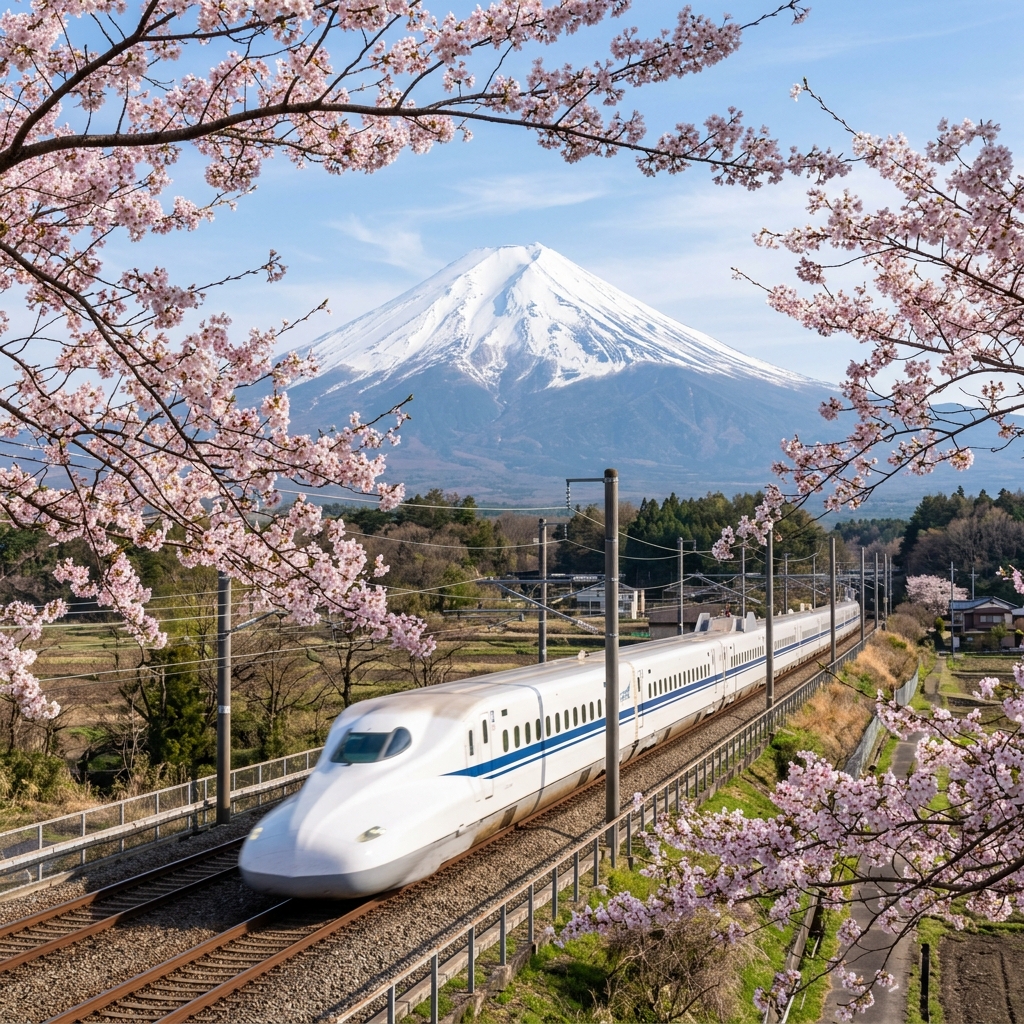
Japan’s Shinkansen network covers 3,041 km of high-speed track and runs on-time to within 36 seconds on average, one of the most precise rail systems ever built (JR Group Annual Report, 2024). For visitors, the Japan Rail Pass promises a single ticket to unlock all of it. The reality is more nuanced, and after October 2023’s price hike of roughly 70%, the maths look very different from what most travel blogs still claim.
This guide does the actual arithmetic. You’ll see exactly which itineraries make the JR Pass a clear win, which ones don’t, and when a cheaper regional pass beats the national one by a significant margin.
TL;DR: The JR Pass 7-day ordinary (¥50,000 / ~$330) is worth it only for intensive multi-city itineraries after the October 2023 price increase. A simple Tokyo–Kyoto–Osaka–Tokyo loop costs ~¥42,310 without a pass, meaning you need extra trips to break even. The Nozomi Shinkansen (the fastest service) is excluded from the pass entirely (JR Group, 2024).
What Is the Japan Rail Pass?
The Japan Rail Pass, universally called the JR Pass, is a flat-rate ticket valid on nearly all trains, buses, and ferries operated by the six Japan Railways Group companies (JR Group, 2024). Launched in 1981, it was designed to encourage foreign tourists to explore beyond Tokyo and Osaka. Today it remains the single most comprehensive rail pass available for Japan, covering Shinkansen bullet trains, limited express trains, local JR lines, some JR buses, and even the JR ferry to Miyajima Island.
The pass is sold in three durations, 7, 14, and 21 days, and in two classes: ordinary (standard) and Green (first class). Activation is flexible: you choose your start date at any JR ticket office after you arrive. That flexibility is one of the pass’s genuine advantages over point-to-point tickets.
One thing most guides skip: the JR Pass is not a Japan pass. It covers JR-operated infrastructure only. Private railways, the Hankyu line in Osaka, the Kintetsu network, most subway systems, are entirely separate. In a country where private railways often run the most convenient urban routes, that distinction matters enormously for practical day-to-day navigation.
How Much Does the Japan Rail Pass Cost?
After October 2023’s price revision, the first major increase in the pass’s history, the ordinary 7-day pass costs ¥50,000 (approximately $330 USD), up from ¥29,650 before the change (JR Group, 2023). That’s a 69% increase. The Green (first class) versions add roughly 30–40% on top. All prices below are as of March 2026.
Green class on the Shinkansen means a wider seat, more legroom, and a quieter carriage. It does not mean a separate premium lounge or meal service, the experience upgrade is real but modest. For most travelers, ordinary class is entirely comfortable on even the longest Shinkansen journey.
Children aged 6–11 pay half the adult ordinary price. Under-6s travel free. There are no senior or youth discounts on the national pass itself, though some regional passes offer age-based pricing.
Is the Japan Rail Pass Worth It?
After the October 2023 price increase, many travel blogs still publish pre-hike “worth it” calculations. The honest answer is that the JR Pass is now worth it only for genuinely intensive itineraries, the simple Tokyo–Kyoto–Osaka circuit that used to justify the pass no longer does. Here’s why, with real numbers.
A standard 7-day pass costs ¥50,000. Consider a common tourist loop:
- Tokyo → Kyoto (Hikari Shinkansen): ¥13,610
- Kyoto → Hiroshima (Hikari/Sakura): ¥11,090
- Hiroshima → Osaka: ¥3,740
- Osaka → Tokyo (Hikari): ¥13,870
- Total without pass: ¥42,310
That’s ¥7,690 short of the pass price. The basic four-city circuit does not pay off. You need those extra trips.
Add a Tokyo–Nikko return (¥5,560 by JR limited express) and a couple of Osaka-day-trip legs, and the pass crosses the break-even point. Add Kyushu, Hokkaido, or multiple-city hopping across two weeks, and the pass becomes a clear financial win. The rule of thumb now: plan at least 6–8 long-distance JR journeys within the pass window before buying.
What Does the JR Pass Cover?
The JR Pass covers an impressive breadth of services across Japan’s six regional JR operators (JR Group, 2024). That breadth is what distinguishes it from the regional alternatives.
Shinkansen: All Shinkansen lines are included except Nozomi and Mizuho services on the Tokaido and Sanyo lines (more on that below). The Tohoku, Hokkaido, Joetsu, Hokuriku, Kyushu, and Nagasaki Shinkansen lines are fully covered.
JR local and express trains: All JR-operated limited express, rapid, and local trains across the country. This includes the Narita Express (NEX) from Tokyo’s airport, a ¥3,070 saving on arrival alone.
JR buses: Selected long-distance JR highway buses. Particularly useful for routes like Kyoto–Shirakawa-go where no train exists.
JR ferry: The Miyajima Ferry from Miyajimaguchi to Miyajima Island, home of the floating torii gate. Worth including on any Hiroshima day trip.
Seat reservations: Free of charge at any JR ticket office or Green Window (Midori-no-madoguchi). This is a crucial difference from the Eurail Pass, where reservations cost extra on most fast trains. With the JR Pass, you reserve at no cost. Do it for all Shinkansen journeys, reserved car travel is smoother and more predictable.
Europe’s most scenic train routes for comparison
What Is NOT Covered by the JR Pass?
This is the section that most blog posts bury in a footnote. The exclusions are significant enough to affect your planning if you don’t know them upfront.
Nozomi and Mizuho on the Tokaido/Sanyo Shinkansen. These are the fastest services between Tokyo and Osaka/Hiroshima/Fukuoka. The Nozomi makes the Tokyo–Osaka run in about 2 hours 25 minutes; the Hikari (pass-eligible) takes around 3 hours 10–15 minutes. That’s a real difference, but 45 minutes slower is not a dealbreaker on a scenic Shinkansen journey. The Nozomi trap catches many travelers who book without checking and then find they can’t use their pass.
Private railways. Tokyo’s Tokyu, Seibu, Odakyu and Keio lines; Osaka’s Hankyu and Kintetsu networks; Kyoto’s Eizan line; the Nishitetsu line in Fukuoka. None of these are JR. In cities, you’ll use IC cards (Suica, ICOCA) for these, budget for that separately.
Tokyo subway. Entirely separate from JR. The Tokyo Metro and Toei Subway systems are not covered. A 24-hour Tokyo Metro pass costs ¥800, good value if you’re moving around the city on a single day.
The Shinkansen to Nikko. Nikko is served by the Tobu Nikko line (private) from Asakusa, not JR. You can reach Nikko by JR via Utsunomiya and then bus, but it’s slower. Check the routing if Nikko is on your itinerary.
Non-JR accommodation buses and most airport express services outside Tokyo. Kansai Airport’s Haruka Express to Kyoto and Osaka is JR-operated and pass-eligible. Haneda connections to central Tokyo are not JR.
How to Buy the Japan Rail Pass
Until recently, the JR Pass had to be purchased entirely outside Japan. That changed in 2023: you can now buy the pass inside Japan, but at a significantly higher price (Japan Tourism Agency, 2023). The domestic price for the 7-day ordinary pass is ¥60,000, ¥10,000 more than the overseas purchase price. Buy it before you leave home.
Where to buy overseas: The pass is sold through authorised distributors in most countries, JTB, Klook, and the official JR Pass website are the main channels. Prices are identical across authorised sellers; the difference is delivery method and customer service quality.
How it works: You purchase a voucher (or increasingly, a digital code) before departing. On arrival in Japan, exchange it for the physical pass at any major JR station, Tokyo, Narita Airport, Haneda Airport, Kyoto, Osaka, and dozens more. Bring your passport; the pass is valid only for foreign visitors on a tourist visa.
Exchange desks at airports are open from early morning. Exchanging at Narita or Haneda on arrival is efficient and sets you up immediately for the Narita Express or Haruka to your hotel.
How to Use the Japan Rail Pass
Activating and using the pass correctly makes a real difference to how smoothly your trip runs. The process is straightforward but has a few non-obvious steps.
Activation. When you exchange your voucher, staff will ask you to choose a start date. You don’t have to activate it the day you exchange it, you can exchange on arrival and start the clock the following morning if you’re spending your first day near Tokyo without needing long-distance trains. Choose your activation date strategically to maximise covered travel days.
Ticket gates. The JR Pass is not an IC card, it cannot be tapped. At Shinkansen stations, look for the staffed gate (manned wicket) rather than the automatic turnstiles. Show your pass to the attendant. On local JR lines with automatic gates, most now have a slot for pass inspection, or a staffed gate nearby.
Seat reservations. Shinkansen trains have both reserved and unreserved cars. The JR Pass allows unlimited free reservations, use them. Walk to any JR Green Window (Midori-no-madoguchi) or use the newer ticket machines that accept pass reservations. Book popular routes (Tokyo–Kyoto, especially in Golden Week or autumn foliage season) a day or two ahead.
Unreserved cars. If you board without a reservation, use the unreserved (jiyūseki) cars and sit in any open seat. During peak travel periods, these fill up and you may have to stand for part of the journey.

What Are the Best Shinkansen Routes to Use Your Pass On?
Some routes offer outstanding value because the standard walk-up fare is expensive relative to the pass’s daily cost. Japan Tourism Agency data shows Shinkansen ridership hit 351 million passengers in fiscal 2023, up 17% year-on-year as domestic travel rebounded fully (Japan Tourism Agency, 2024).
Tokyo → Kyoto / Osaka (Hikari): ¥13,610 / ¥13,870. The cornerstone of most JR Pass itineraries. At 3h15m, the Hikari is comfortable and scenic, Mount Fuji is visible on clear days from the right-hand side heading west.
Tokyo → Hiroshima (Hikari): ¥18,040 one way. A single return trip covers 72% of the 7-day pass cost on its own.
Osaka → Hakata/Fukuoka (Sakura or Hikari): ¥15,110. Unlocks Kyushu from a Kansai base.
Tokyo → Sendai (Tohoku Shinkansen, Hayabusa): ¥11,410. The Hayabusa is fully pass-eligible, and it’s the fastest Shinkansen in Japan at 320 km/h.
Shin-Hakodate-Hokuto → Sapporo when Hokkaido Shinkansen extension opens (targeted 2031): Not yet operational, but the current Hokkaido Shinkansen (Tokyo–Shin-Hakodate-Hokuto) is pass-eligible and reaches Hokkaido in under 4 hours.
Tokyo → Nikko via JR: Use the JR Tohoku line to Utsunomiya (Shinkansen or limited express) then bus. Pass-eligible throughout JR sections and worth doing to avoid the ¥2,780 one-way Tobu private fare.
JR Pass vs Regional Passes, When Is a Local Pass Better?
The Kansai scenario is where the national JR Pass most frequently loses to a regional alternative. Consider a traveler spending 5 days in Kyoto, Osaka, Nara, Hiroshima, and Himeji without touching Tokyo:
- Kansai Wide Area Pass (5 days): ¥13,500
- Covers: Shinkansen Kyoto–Hiroshima (Nozomi excluded, same as JR Pass), Haruka Airport Express, JR lines throughout Kansai
- Versus 7-day JR Pass: ¥50,000
For a Kansai-only trip, the regional pass is a ¥36,500 saving. That’s not a marginal difference, it’s enough to fund several nights of accommodation. The Kansai Wide Area Pass even allows Shinkansen travel within the region at the same Nozomi exclusion as the national pass.
Other regional passes worth considering:
JR East Pass (Tohoku): Covers the entire JR East network including the Tohoku and Hokkaido Shinkansen. 5 consecutive days from ¥20,000, strong value for Tokyo + Tohoku itineraries.
Sanyo–San’in Area Pass: ¥23,000 for 7 days, covering western Honshu and the San’in coast. Good for Hiroshima, Izumo, and the Kinosaki onsen circuit.
Kyushu Rail Pass: All-Kyushu 7-day pass from ¥21,000, covering all Kyushu Shinkansen and limited expresses. Well-designed for a dedicated Kyushu loop.
The principle: match the pass geography to your itinerary geography. Regional passes almost always win when your journey stays within one area. The national JR Pass earns its price when you’re genuinely crossing from one end of Japan to the other.
Tips for Getting the Most from Your JR Pass
A few practical points that make a real difference in day-to-day use.
Map your itinerary before purchasing. List every JR journey you plan, look up the standard fare on Hyperdia or the JR fare calculator, and total them up. If the total is below ¥50,000 (7-day) or ¥80,000 (14-day), buy a regional pass or point-to-point tickets instead. This step alone can save hundreds of dollars.
Use the Narita Express immediately. The NEX from Narita Airport to central Tokyo costs ¥3,070 one way, use your pass on day one and bank that saving before you’ve even left the airport. The Haruka Express from Kansai Airport to Kyoto/Osaka (¥3,600) is equally valuable.
Reserve Shinkansen seats in advance at quieter times. The Green Window queues at major stations can be 20–30 minutes long during peak periods. Use JR’s English-language station kiosks or the SmartEx app (for Tokaido Shinkansen reservations) to avoid queues. Reservations are free with the pass.
Activate the pass the day before your first long-distance trip. If you arrive in Tokyo and spend your first two days sightseeing locally before heading to Kyoto, don’t activate until the morning you leave for Kyoto. You’ll recover 1–2 days of pass validity.
Combine with an IC card. Load a Suica or ICOCA with ¥3,000–5,000 for subways, private trains, buses, and convenience store payments. The JR Pass handles your long-distance travel; IC handles city movement. These two tools together give you near-complete transport coverage.
Check the JR route vs private route for each city. In Kyoto, the JR Sagano Line to Arashiyama is pass-eligible; the Hankyu route is not. In Osaka, JR Loop Line is covered; subway and Hankyu are not. Knowing these distinctions before each day’s plans saves both money and confusion.
Related Reading
- Japan by Train: The Ultimate Rail Travel Guide, Everything you need to know about traveling Japan by rail in 2026, JR Pass, Shinkansen routes, IC cards, and a…
- Tokyo to Kyoto by Shinkansen: The Complete Guide, The Tokyo to Kyoto shinkansen takes 2 hours 15 minutes on the Hikari and passes Mount Fuji on clear days.
- Athens by Train: Arriving, Exploring, and Day Trips by Rail, Athens by train is easier than you think: suburban rail from the airport in 40min, direct services from…
Frequently Asked Questions
Can I use the JR Pass on the Nozomi Shinkansen?
No, and this is the most important rule to remember. Nozomi and Mizuho services on the Tokaido and Sanyo Shinkansen lines are explicitly excluded from the JR Pass (JR Group, 2024). Use the Hikari or Sakura instead. Tokyo to Osaka on the Hikari takes around 3 hours 15 minutes, only 45 minutes slower than Nozomi, and the ride is comfortable. Attempting to board a Nozomi with the pass will result in being charged the full fare.
Where do I buy the Japan Rail Pass?
Buy through an authorised overseas distributor before arriving in Japan. The official JR Pass website, JTB, Klook, and Rail.ninja all sell the pass at the same price. Buying inside Japan costs ¥10,000 more for the 7-day ordinary pass, a significant premium with no benefit (Japan Tourism Agency, 2023). You’ll receive a voucher or digital code to exchange for the physical pass at a JR station or airport on arrival.
How far in advance should I book the JR Pass?
At least 2–4 weeks before departure. You need time for delivery if purchasing a physical voucher (some sellers ship by post), and you want to avoid last-minute stress. Digital vouchers are instant. There’s no price advantage to buying earlier vs later, the price is fixed, no advance discounts apply.
Is the JR Pass worth it for a 10-day trip?
A 10-day trip sits awkwardly between the 7-day and 14-day pass. If your travel is concentrated in the first or last 7 days, the 7-day pass with careful activation timing may cover you. If you’re moving continuously, the 14-day pass at ¥80,000 gives breathing room. Do the fare calculation for your specific itinerary, there’s no universal answer. Many 10-day trips to Japan are Kansai-focused and are better served by the ¥13,500 Kansai Wide Area Pass.
Do I need to reserve seats with the JR Pass?
Reservations are free and strongly recommended for Shinkansen. Walk up to the Green Window (Midori-no-madoguchi) at any major JR station, show your pass, and reserve your seats at no charge. You can board unreserved cars without a reservation, but during Golden Week (late April–early May), Obon (mid-August), and autumn peak seasons, unreserved cars fill up. Reserve at least 24 hours ahead for popular Tokyo–Kyoto/Osaka departures during these periods.
The Bottom Line
The JR Pass in 2026 is a more demanding financial proposition than it was before October 2023. The ~70% price increase means the old rule of thumb, “Tokyo–Osaka return, pass pays for itself”, no longer holds. A basic four-city circuit falls ¥7,690 short of the 7-day pass price.
What still makes the pass genuinely worth it: intensive multi-city itineraries covering 6–8+ long JR journeys, multi-week trips combining Honshu and Kyushu or Tohoku, and itineraries with spontaneous flexibility where booking individual tickets isn’t practical.
What the pass can’t be for 2026: a default purchase for any Japan trip. Run the numbers. If you’re spending 10 days in Kyoto, Osaka, Nara, and Hiroshima, the ¥13,500 Kansai Wide Area Pass likely saves you over ¥35,000. That’s real money.
Key takeaways:
- 7-day ordinary (¥50,000): needs at least 6 substantial JR journeys to break even after the 2023 price hike
- 14-day ordinary (¥80,000): better value per day; recommended for two-week multi-region trips
- Nozomi is excluded: plan with Hikari/Sakura; the 45-minute difference rarely matters
- Regional passes beat the national pass for single-region itineraries, always compare
- Buy outside Japan to save ¥10,000 on the 7-day pass
slow travel philosophy for pacing a Japan trip
JR Pass prices reflect the October 2023 tariff revision and are accurate as of March 2026. Exchange rates are approximate at ¥151 per USD. Verify current prices at the JR Pass official site before purchasing.