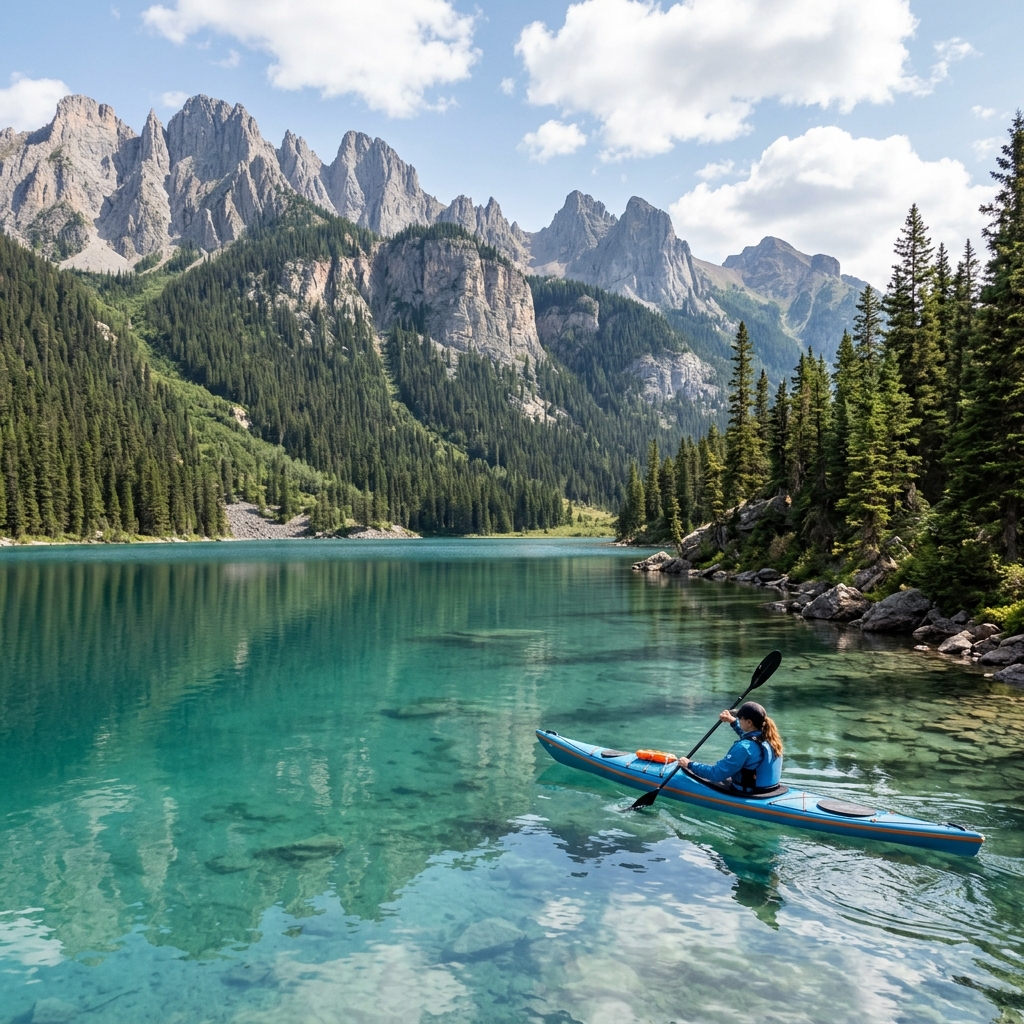
Every year, the same lists circulate: Iceland, Patagonia, New Zealand, the Swiss Alps. They are magnificent places. They are also places where you will queue behind forty other hikers at a viewpoint, pay resort-town prices for a mediocre sandwich, and fight for the last parking spot at the trailhead by 7:30 in the morning.
This is not that list.
What follows are twelve destinations where the adventure is real, the infrastructure exists but the crowds do not, and the ratio of effort to reward tilts heavily in your favor. Some of these places are emerging. Others have been quietly excellent for years while everyone flew over them on the way to somewhere more famous.
1. The Accursed Mountains, Albania
The Albanian Alps — locally called Bjeshket e Namuna, or the Accursed Mountains — are the Dolomites without the day-trippers. The Valbona to Theth hike is the signature route: a six-to-eight-hour traverse over a 1,795-meter pass with views into valleys that have no road access. The trail is well-marked but not paved, groomed, or sanitized. You will cross snowfields in June, ford streams, and arrive in Theth to find a village of stone towers and guesthouses where dinner is whatever the family grew.
Albania received roughly 10 million visitors in 2024, a fraction of neighboring Greece’s 33 million, and most of those visitors stayed on the Riviera coast. The mountains remain genuinely uncrowded. A guesthouse in Valbona costs €25 to €40 per night including meals. The ferry across Lake Koman that starts the journey is itself one of Europe’s most dramatic boat rides — a three-hour passage through fjord-like canyon walls.
Getting there: Fly to Tirana, then take a furgon (shared minibus) to Shkodra and onward to Koman or Valbona. The logistics are part of the adventure.
2. The Lofoten Islands, Norway (Off-Season)
Lofoten has appeared on enough lists to no longer be a secret. But here is what the lists do not mention: from September through April, the tourist infrastructure remains open while the summer crowds vanish entirely. You get the same dramatic granite peaks rising straight from the Arctic Ocean, the same red fishing cabins (rorbuer), and the same cod-drying racks — but you also get the Northern Lights, empty hiking trails, and the particular quality of Arctic twilight that photographers call “the blue hour” except here it lasts for weeks.
Winter hiking in Lofoten requires proper gear and shorter daylight, but trails like Ryten (the viewpoint above Kvalvika Beach) and Reinebringen are accessible year-round with microspikes. Sea kayaking operates through October. And the surf — yes, Lofoten has a surf scene — runs best from September to March, when Atlantic swells hit Unstad Beach beneath snow-covered mountains.
Rorbuer accommodation drops 40 to 60 percent outside summer. A cabin that costs 2,500 NOK per night in July drops to 1,200 NOK in November.
3. Georgia’s Tusheti Region
Georgia has gained attention for its wine and its capital, Tbilisi. The Tusheti region, in the northeast corner of the country, has not. Access requires driving one of the most dramatic mountain roads in the Caucasus — a single-lane gravel track that climbs to the 2,926-meter Abano Pass, open only from late June to early October. On the other side sits a medieval landscape of stone defensive towers, shepherd communities, and hiking trails that connect villages across high alpine meadows.
The multi-day trek from Omalo to Shatili follows ancient trading routes through passes above 3,000 meters. You will see more sheep than people. Guesthouses in Omalo charge 80 to 120 GEL (roughly $30 to $45 USD) including three meals. The food is Georgian — which means it is exceptional — heavy on cheese-filled bread (khachapuri), dumplings (khinkali), and stews cooked over wood fires.
Georgia requires no visa for most nationalities and remains one of the most affordable countries in Europe for travelers. Internal flights from Tbilisi to the Tusheti road start-point are unnecessary; the drive from Tbilisi takes about seven hours and is itself an experience worth having.
4. Oman’s Jebel Akhdar and Empty Quarter
Most Middle East adventure tourism funnels toward Dubai’s manufactured experiences or Jordan’s Wadi Rum. Oman offers something different: genuine wilderness with genuine hospitality and none of the theme-park atmosphere.
Jebel Akhdar (the Green Mountain) rises to 2,980 meters and holds terraced villages, rose gardens, and a rim trail called the Balcony Walk that traces the edge of a 1,000-meter-deep canyon. The hiking is moderate and the air is cool — a shock after the coastal heat of Muscat.
The Wahiba Sands and the western edge of the Empty Quarter (Rub’ al Khali) offer dune camping that bears no resemblance to the glamping operations in other Gulf states. Local Bedouin guides take small groups into the deep desert by 4x4, set up simple camps, and cook meals over open fires. The silence at night is total.
Oman is safe, well-organized, and refreshingly uncommercialized. The people are famously hospitable. A two-week self-drive itinerary covering the mountains, desert, and coast costs roughly half what an equivalent trip in the UAE would run.
5. Taiwan’s Taroko Gorge and Mountain Trails
Taiwan has world-class hiking that almost nobody outside Asia knows about. Taroko Gorge, on the east coast, is a 19-kilometer marble canyon with trails cut into cliff faces hundreds of meters above the Liwu River. The Zhuilu Old Trail — a permit-required route along a path blasted into sheer marble walls — is one of the most dramatic day hikes anywhere on earth.
Beyond Taroko, Taiwan’s central mountain range holds peaks above 3,000 meters and multi-day trails through old-growth forests. The Yushan (Jade Mountain) trail reaches 3,952 meters — the highest point in Northeast Asia — and requires only moderate fitness. Permits are allocated by lottery and limit daily visitors, keeping the trail pristine.
Taiwan’s trail infrastructure is excellent. Mountain huts are maintained, trails are marked, and the public transport system can get you from Taipei to most trailheads without a car. The food at every elevation is remarkable. Street markets in Hualien (the gateway city to Taroko) serve some of the best dumplings and noodle soups in the country.
Practical note: Taiwan’s mountain trails require free permits obtained online 4 to 35 days in advance. Apply early for popular routes like Yushan.
6. The Faroe Islands, Denmark
Eighteen islands in the North Atlantic, roughly equidistant between Scotland and Iceland, with a population of 54,000 and landscapes that look computer-generated. Sea stacks, cliff faces dropping 600 meters to the ocean, grass-roofed villages, and puffin colonies — the Faroe Islands deliver visual drama that rivals Iceland at a fraction of the visitor count.
The hiking is superb. The trail to Kallur Lighthouse on Kalsoy crosses a narrow ridge with ocean on both sides. The lake above the ocean at Sorvagsvatn (Leitisvatn) creates a visual illusion that makes it appear to float above sea level. Both hikes are under three hours and accessible to anyone with reasonable fitness.
The Faroese have implemented a volunteer tourism program — Closed for Maintenance, Open for Voluntourism — that invites visitors to help with trail maintenance and environmental conservation in exchange for free accommodation and meals. It is one of the more thoughtful approaches to tourism management anywhere in the world.
Getting there is straightforward: Atlantic Airways flies direct from Copenhagen, Edinburgh, and Reykjavik. Accommodation is limited, so book early for summer visits.
7. Kyrgyzstan’s Tien Shan Mountains
Central Asia’s best-kept secret for trekking. The Tien Shan range offers high-altitude lake treks (Ala-Kul at 3,532 meters is the classic), horse-supported multi-day routes through jailoo (summer pastures), and genuine nomadic culture that is not performed for tourists but simply the way people live.
Community-Based Tourism (CBT) organizations in Karakol and Bishkek connect travelers with local families who offer yurt stays, horseback trekking, and guided routes. A week-long guided trek with horse support, meals, and yurt accommodation costs $300 to $500 USD — a price point that makes comparable experiences in Patagonia or Nepal look extravagant.
Kyrgyzstan offers visa-free entry for most nationalities. Internal transport is cheap if rough. The country is actively investing in trail infrastructure through organizations like the Kyrgyz Community Based Tourism Association.
8. Slovenia’s Soča Valley
Everyone goes to Lake Bled. Almost nobody continues west to the Soča Valley, where the river runs an impossible shade of emerald green through limestone gorges, and the Julian Alps provide a backdrop for kayaking, canyoning, paragliding, and via ferrata routes.
The town of Bovec is the activity hub. Multi-sport packages combining whitewater kayaking, zip-lining, and canyoning run €100 to €200 per day — roughly half the price of equivalent experiences in the Swiss or Austrian Alps. The trails on the Slovenian side of Triglav National Park are less trafficked than the Chamonix valley by an order of magnitude.
Slovenia is small enough that you can combine the Soča Valley with Ljubljana’s food scene and the Karst wine region in a single week without feeling rushed.
9. Svalbard, Norway
The northernmost settlement in the world with regular flights. Longyearbyen sits at 78 degrees north, surrounded by glaciers, polar bears, and Arctic wilderness that operates on geological time.
Summer visitors (June through August) get 24-hour daylight, glacier kayaking, and boat trips to the ice edge where the pack ice begins. Winter visitors get polar darkness, the Northern Lights directly overhead, and snowmobile expeditions into valleys that have no human inhabitants. Dog sledding here is not a tourist novelty — it is transport.
Svalbard requires guided excursions outside Longyearbyen due to polar bear risk. This is not a restriction but a feature: guides carry rifles, know the terrain, and provide context that transforms a landscape from “pretty but empty” to “alive with meaning.” Multi-day camping trips on the ice cap are available for those who want genuine Arctic immersion.
10. Madagascar’s Tsingy de Bemaraha
A UNESCO World Heritage Site that receives fewer than 15,000 visitors per year. The Grand Tsingy is a 600-square-kilometer maze of razor-sharp limestone pinnacles, some reaching 100 meters high, connected by suspension bridges and via ferrata cables. You climb, crawl, and squeeze through passages between the stone needles while lemurs watch from the clifftops.
Getting to Tsingy requires commitment: a 14-to-18-hour drive from Antananarivo on roads that test the definition of “road.” The rainy season (November to April) makes the approach impassable. But the difficulty of access is exactly what keeps the site uncrowded and uncompromised.
Madagascar’s biodiversity is unmatched — 90 percent of its wildlife exists nowhere else on earth. Combining Tsingy with the Avenue of the Baobabs and Andasibe-Mantadia National Park (for close-range lemur encounters) creates a three-week itinerary that bears no resemblance to any other trip.
11. The Azores, Portugal
Nine volcanic islands in the mid-Atlantic that feel like a cross between Hawaii and Ireland. Crater lakes, hot springs, whale watching, and hiking trails through hydrangea-lined paths above the ocean. São Miguel is the most accessible island and has enough variety for a full week: Sete Cidades (twin crater lakes, one green, one blue), Furnas (geothermal cooking and hot springs), and coastal trails along sea cliffs.
The Azores have no mass tourism infrastructure. Hotels are small, restaurants are family-run, and the diving and whale watching operations run small boats. The islands sit directly on the Mid-Atlantic Ridge, which creates upwellings that attract sperm whales, blue whales, and dolphins in reliable numbers from April through October.
Flights from Lisbon take 2.5 hours. SATA and Ryanair both serve the route, with fares often under €80 return if booked in advance.
12. Namibia’s Fish River Canyon and Skeleton Coast
Namibia is known among safari travelers but overlooked by the adventure crowd, which is a mistake. The Fish River Canyon — the second largest canyon in the world — offers an 85-kilometer, five-day hike that is one of Africa’s great wilderness walks. No guides are required, no infrastructure exists along the route, and the permit system limits daily starts to ensure solitude.
The Skeleton Coast in the northwest is a desert-meets-ocean landscape of shipwrecks, seal colonies, and sand dunes that run directly into the Atlantic surf. Self-drive camping along the coast is possible with a 4x4 and advance permit from the Ministry of Environment.
Namibia is one of Africa’s safest and most organized countries for independent travel. Roads are excellent (mostly gravel but well-maintained), fuel stations are regular, and campsites are well-equipped.
How to Choose Your Next Underrated Adventure
The common thread across these twelve destinations is not obscurity for its own sake. Each one offers an experience that its more famous equivalent cannot: lower cost, fewer people, and the feeling of genuine discovery rather than processed tourism.
Start with your priority. If it is alpine hiking, look at Albania, Georgia, or Kyrgyzstan. If it is coastal and marine, consider the Azores, Faroe Islands, or Oman. If it is desert and canyon wilderness, Namibia and Oman deliver. For cultural immersion alongside the adventure, Georgia, Kyrgyzstan, and Taiwan stand out.
Then check your calendar against the destination’s optimal window. Most of these places have short peak seasons and long shoulder seasons where conditions are still excellent but visitor numbers drop further.
The best adventure travel in 2026 is not about going somewhere nobody has heard of. It is about going somewhere that has not yet been optimized, packaged, and reproduced for mass consumption. These twelve places qualify. For now.
Planning Resources
If you prefer slow, overland approaches to your adventure destinations, our guides to European train travel and scenic rail journeys worldwide cover the ground-level logistics. For packing advice tailored to multi-activity trips, see our train travel packing list — most of the gear principles apply regardless of your transport mode.