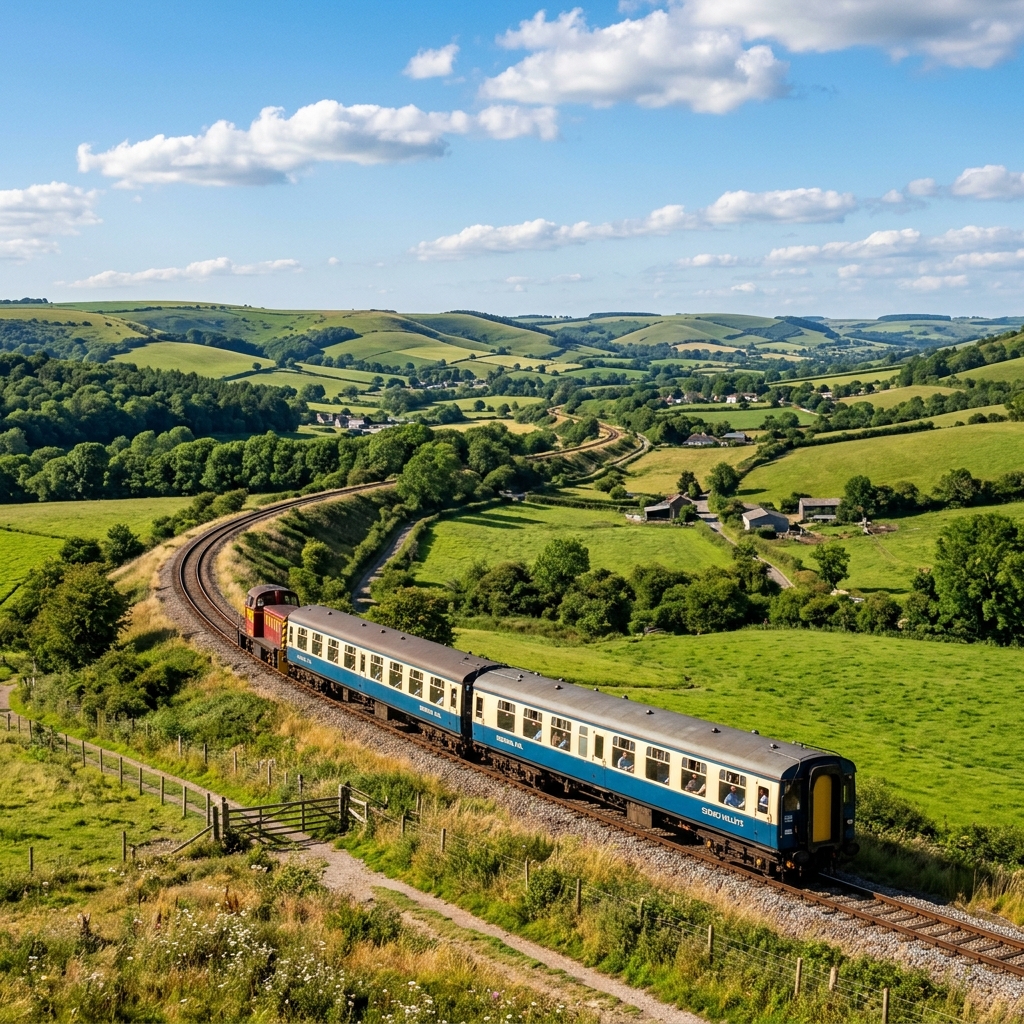
The luxury train industry has created an unfortunate impression: that scenic rail travel is inherently expensive. The Venice Simplon-Orient-Express charges 3,000 euros for a night. The Rocky Mountaineer starts at 1,500 CAD for a two-day journey. The Maharajas’ Express in India costs 800 USD per night. These are fine experiences, we’ve written about the Orient Express, but they’re not the only way to see the world from a train.
The mountains outside a luxury train window are the same mountains visible from the regular train that costs fifty times less. The tea plantations of Sri Lanka look exactly as beautiful from a second-class carriage that costs two dollars as they do from anything else. The scenery is free. What you’re paying for on luxury trains is the food, the service, and the company, not the view.
This guide covers ten of the world’s most scenic rail journeys that cost under 100 USD, most of them under 50, several under 10. These are regular scheduled services, not tourist products. You’ll share them with commuters, families, and people going about their lives. The scenery is a bonus they get every day.
TL;DR: The world’s best scenic rail journeys don’t require luxury tickets. Sri Lanka’s hill country train (from 1.50 USD), Norway’s Bergen Line (from 22 euros), Japan’s coastal lines (from 15 USD), and India’s Konkan Railway (from 3 USD) all offer world-class views at standard fares. The scenery is the same, only the price is different.
1. Colombo to Ella, Sri Lanka (from 1.50 USD, 7 hours)

The train from Colombo to Ella is routinely listed among the most beautiful rail journeys in the world, and it costs less than a cup of coffee in most Western countries. A second-class ticket on Sri Lanka Railways is approximately 1.50 USD for the full 7-hour journey. First class (reserved seats with slightly wider windows) costs about 5 USD.
The route climbs from the lowland capital through the central highlands to the tea country around Nuwara Eliya and Ella. The scenery shifts from tropical coastal plains to misty mountain forests to the geometrically precise tea plantations that cover the hillsides in vivid green. The Nine Arch Bridge near Ella, a colonial-era viaduct spanning a jungle gorge, has become an Instagram landmark, but it’s more impressive from the train than from any photograph.
The train is slow, the windows are open (no air conditioning in second class), and the doors stay open too, passengers lean out for photographs and breeze. It’s not comfortable by European standards. It is, by any standard, one of the great rail experiences on earth.
Tips: Book first-class or observation car in advance at Colombo Fort station. Second class is unreserved, board early for a window seat. The Kandy to Ella section (4-5 hours) is the most scenic if you want to skip the lowland portion.
2. The Bergen Line, Norway (from 22 euros, 7 hours)
Norway’s flagship scenic route from Oslo to Bergen crosses the Hardangervidda mountain plateau at 1,222 metres, the highest point on any mainline railway in northern Europe. The journey takes seven hours and passes through fields that shift from forested hills to bare, snow-covered tundra to the dramatic fjord descents of western Norway.
A Minipris ticket booked in advance costs from 249 NOK (about 22 euros). The same journey on the Flåm Railway tourist train, a branch off the Bergen Line, costs three times more for scenery that is arguably no better than the main line itself.
We’ve covered this route in detail in our Scandinavia scenic trains guide. The point here is the price: 22 euros for seven hours of Alpine-class scenery is one of the best deals in European rail travel.
3. The Konkan Railway, India (from 3 USD, 12 hours)
The Konkan Railway runs 741 km along India’s western coast between Mumbai and Mangalore, through a field of coconut palms, rice paddies, beaches, and the Western Ghats mountains. The engineering is remarkable: 2,000 bridges and 91 tunnels through some of the most challenging terrain in Indian railway history.
A second-class sleeper ticket costs approximately 3 USD. An air-conditioned three-tier berth costs about 8-10 USD. For either price, you get twelve hours of coastal scenery that includes river crossings on bridges hundreds of metres long, tunnel approaches through mountain passes, and stretches where the Arabian Sea is visible from the window.
Indian trains are their own world, crowded, noisy, social, and endlessly interesting. The chai wallah passes through the carriage with sweet tea. Vendors sell snacks at every station. The Konkan Railway is not a quiet, contemplative European experience. It’s a sensory immersion.
Tips: Book at irctc.co. at least 30 days ahead for AC berths. The Jan Shatabdi Express (daytime) offers the best views; the overnight Netravati Express is more practical for the full Mumbai-Mangalore run.
4. Tokyo to Shin-Osaka via Shinkansen, Japan (from 95 USD, 2h 15min)
The Shinkansen is not usually discussed as a scenic journey, it’s discussed as a feat of engineering and punctuality. But the Tōkaidō Shinkansen between Tokyo and Osaka passes Mount Fuji at 285 km/h, and on a clear day, Fuji appears in the window for about two minutes of transcendent, speed-blurred beauty.
The journey costs about 13,870 yen (roughly 95 USD) for an unreserved seat on the Nozomi. If you’re visiting Japan for a week or more, a Japan Rail Pass (from about 230 USD for 7 days) covers unlimited Shinkansen travel (except Nozomi/Mizuho) and is dramatically better value. Our Japan Rail Pass guide and Tokyo to Kyoto guide cover the details.
But the Shinkansen’s greatest scenic routes are the branch lines. The Akita Shinkansen through the mountains of northern Honshu. The Hokuriku Shinkansen to Kanazawa, which crosses the Japanese Alps. The regular JR lines along the coast of the Japan Sea. Japan’s rail scenery extends far beyond Fuji, our Japan by train guide covers the network.
5. Cusco to Puno, Peru (from 30 USD by local train, 10 hours)
The train between Cusco and Puno crosses the Altiplano, the high Andean plateau, at altitudes exceeding 4,300 metres. The field is vast, arid, and surreal: llamas and alpacas graze on plains that stretch to snow-capped peaks on every horizon.
PeruRail operates a luxury “Titicaca” service at 275 USD. But the PeruRail Expedition service (when running) and local options cover the same route for 30-50 USD. The scenery, Andean peaks, high-altitude lakes, altiplano grasslands, is identical regardless of what you paid.
The altitude is significant. Cusco sits at 3,400 metres; the route summit is above 4,300 metres. Coca tea helps. Take it seriously, altitude sickness is real and unpleasant.
6. The Reunification Express, Vietnam (from 25 USD, 34 hours)
Vietnam’s main north-south railway runs 1,726 km from Hanoi to Ho Chi Minh City through the entire length of the country. The full journey takes about 34 hours, most travellers break it into segments, stopping at Huế, Đà Nẵng, and Nha Trang along the way.
A soft sleeper berth (4-berth compartment) costs approximately 25-40 USD for a section like Huế to Đà Nẵng (3 hours) or Đà Nẵng to Nha Trang (10 hours). The Hải Vân Pass section, where the train climbs through a mountain pass above the coast between Huế and Đà Nẵng, is the scenic highlight. The pass offers views down to the coast that are among the best in Southeast Asian rail travel.
Our Vietnam train guide covers the full route, booking options, and where to break the journey.
7. Kandy to Jaffna, Sri Lanka (from 3 USD, 7-8 hours)
A second Sri Lankan entry, because the country’s rail scenery is that good and that cheap. The Colombo-Ella route gets the attention, but the northern line from Kandy to Jaffna, restored after the civil war and fully operational since 2014, passes through a dramatically different landscape: the dry zone of the north, with its palmyra palms, ancient irrigation tanks, and Hindu temples.
The journey is less immediately spectacular than the hill country route but more culturally interesting. You cross from the Sinhalese Buddhist heartland to the Tamil Hindu north, and the architecture, field, and food change as you go. A second-class ticket costs about 3 USD.
8. The Death Railway, Thailand (from 2 USD, 3 hours)
The railway between Bangkok (Thonburi station) and Nam Tok follows the route of the infamous Burma-Thailand “Death Railway” built during World War II by Allied prisoners of war and Asian forced labourers. The section along the River Kwai, including the bridge at Kanchanaburi, is both historically significant and scenically beautiful.
A third-class ticket for the full route costs about 100 THB (roughly 2.75 USD). The train crosses the Wampo Viaduct, a wooden trestle bridge built along the face of a cliff above the river, which is one of the most dramatic rail crossings in Southeast Asia.
This is slow travel at its most literal: the train averages about 50 km/h. The open windows, the jungle scenery, and the weight of history make it one of the most memorable rail journeys in Asia. Our Thailand by train guide covers the full Thai rail network.
9. Sarajevo to Mostar, Bosnia (from 5 euros, 2 hours)
The train from Sarajevo to Mostar follows the Neretva River through one of the most dramatic gorges in the Balkans. The track was rebuilt after the Bosnian War and runs through tunnels and along cliff faces above the emerald-green river.
A one-way ticket costs about 5 euros. Two hours. The scenery is Alpine in scale, the gorge narrows to canyons where the river is hundreds of metres below, and distinctly Balkan in character. Mostar itself, with its famous bridge and Ottoman old town, is the reward at the end.
This is the cheapest entry on the list that also qualifies as genuinely world-class scenery. Five euros for two hours of gorge and mountain. It’s hard to argue with the value. Connect with our Balkans by train guide for the broader Balkan rail network.
10. The California Zephyr, USA (from 60 USD, 51 hours)
The most expensive route on this list in absolute terms, but also one of the longest, 2,438 miles from Chicago to San Francisco across seven states. A coach seat on Amtrak starts at approximately 60-150 USD depending on the date and how far ahead you book.
For that price, you get the Nebraska plains, the Colorado Rockies (including Glenwood Canyon, twelve miles of red rock walls rising 1,300 feet above the Colorado River), the Utah salt flats, and the Sierra Nevada descent through Donner Pass. Fifty-one hours of American field that no domestic flight can approximate.
A roomette (private sleeper cabin) starts from about 200 USD per person per night, including all meals. For two nights and 2,438 miles, including food, that’s competitive with any accommodation in the cities you’d otherwise stay in.
Our California Zephyr guide covers the route in detail. See also our Amtrak Empire Builder and Coast Starlight guides for other affordable American scenic routes.
The Pattern: Scenery Is Free
The consistent lesson across these ten routes is that field doesn’t charge admission. The Swiss Alps are visible from a 35-euro regular train. The Sri Lankan tea country is visible from a 1.50-dollar second-class carriage. The Norwegian fjords are visible from a 22-euro Minipris ticket.
Luxury trains sell comfort, food, and exclusivity. They do not sell better views. The window of a regular train looks out at the same world as the window of a premium train. The difference is what’s inside the carriage, not what’s outside it.
If you want to see the world by train, and there is no better way to see it, the barrier is not money. It’s knowing which routes to take and when to book. Every route in this guide is accessible to anyone with a modest budget and a willingness to look out the window.
For European scenic routes specifically, see our most scenic European trains guide and best train journeys in the world. For the budget approach, see our Europe budget train travel guide.