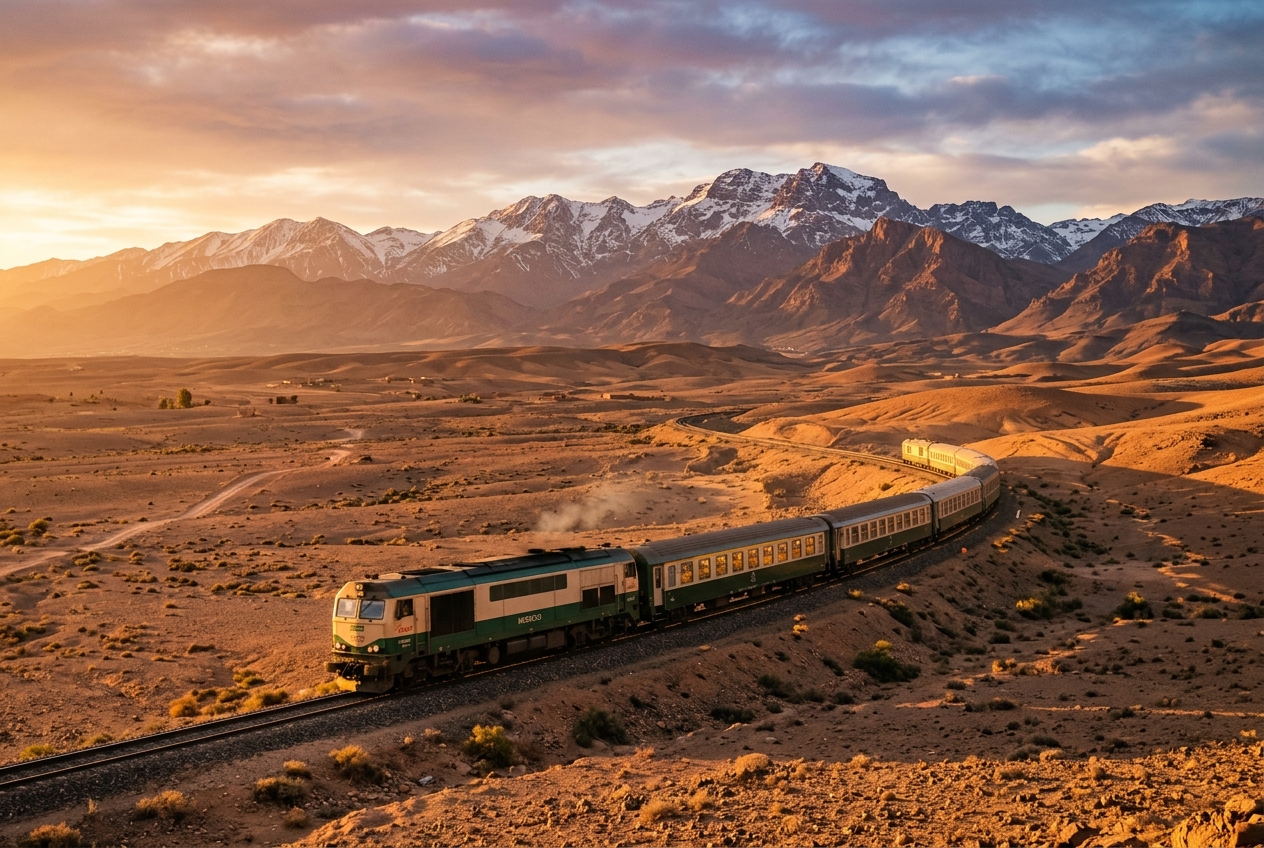
Morocco arrives differently depending on how you enter it. By air into Marrakech, you land already inside the spectacle — the airport is 20 minutes from the Djemaa el-Fna, the city doesn’t build up, it just begins. By train from Tangier, you enter the country by degrees, the Spanish coast receding across the Strait of Gibraltar, the Rif mountains appearing, and the train carrying you south through a landscape that shifts from Mediterranean to something older and more complex with every hour.
The rail route is the better introduction. And Morocco’s train network — ONCF, the Office National des Chemins de Fer — is considerably better than most visitors expect.
combined Spain and Morocco rail itinerary
TL;DR: Al Boraq high-speed connects Tangier to Casablanca in 2h 10min (from €16). Standard trains link Casablanca to Fès (4h 30min), Rabat (1h), and Marrakech (3h). Book at oncf.ma or station windows. Ferry from Tarifa (Spain) to Tangier Med takes 40min (€30–€45). First class is worth the modest premium on journeys over 2 hours. Supratours buses extend the rail network to Essaouira and the south.
The ONCF Rail Network
Morocco’s national railway network is centred on the Casa-Rabat-Tangier-Fès spine — a main line that connects the country’s five largest cities in a loose triangle, with Marrakech hanging south from Casablanca as a major spur. The network is not extensive — it does not reach Agadir, Ouarzazate, or the desert south — but what it covers, it covers well.
The key routes for travellers:
| Route | Time | Service Type |
|---|---|---|
| Tangier Ville → Casablanca | 2h 10min | Al Boraq (high-speed) |
| Casablanca → Rabat | 1h | Intercity |
| Casablanca → Fès | 4h 30min | Intercity |
| Casablanca → Marrakech | 3h | Intercity |
| Rabat → Fès | 3h 30min | Intercity |
All routes depart from Casablanca Voyageurs — the city’s main station — or Casablanca Casa-Port, the station closer to the medina and port area. Casa-Port is the more convenient station for visitors arriving by ferry or staying near the old town; Voyageurs has more departures and better connections.
Al Boraq: Africa’s First High-Speed Train
The Al Boraq (البراق — named after the mythical creature that carried the Prophet Mohammed on his night journey) entered service in November 2018 as Africa’s first high-speed railway. It runs between Tangier Ville and Casablanca Voyageurs on dedicated high-speed track reaching 320 km/h, reducing the journey from 4h 30min on the old line to 2 hours 10 minutes.
The train is an Alstom Euroduplex, the same platform used on French TGV services, and the ride is smooth and fast. Onboard: air conditioning, power outlets at every seat, a café car, and a generally modern atmosphere comparable to a second-tier European high-speed service.
Fares:
- Second class: MAD 160–200 (€15–€19) advance; MAD 220–260 at standard pricing
- First class: MAD 220–280 (€21–€27) advance; higher at standard pricing
The Al Boraq stops at Kénitra (north of Rabat) and Rabat-Agdal on the Tangier–Casablanca run. It does not currently extend south to Marrakech, though an extension is planned. For now, Casablanca remains the junction point for onward travel.
Booking Al Boraq
Book through the ONCF website (oncf.ma) — the site has an English version, accepts international Visa and Mastercard, and issues e-tickets for mobile presentation. Alternatively, tickets are available at station windows, and unlike many European services, seat availability is rarely as constrained — booking a day or two ahead is usually sufficient except at Eid holidays and major Moroccan public holidays.
The Tangier–Casablanca corridor is the busiest in Africa. ONCF carried over 47 million passengers in 2023 — impressive for a country of 37 million people, reflecting how seriously Morocco has invested in rail infrastructure relative to road. The Al Boraq investment (€2 billion for 186km of new high-speed track) was funded in part by French loans and reflects a strategic ambition that has no obvious parallel elsewhere on the continent. The result is a train service that a French or Spanish traveller would recognise as genuinely modern.
Getting to Morocco from Europe: Trains and Ferries
The Classic Route: Seville → Tarifa → Tangier
The most travelled overland route from Europe to Morocco runs through southern Spain to the Strait of Gibraltar:
-
Seville Santa Justa to Algeciras by train: approximately 2h 45min, direct services operated by Renfe. Fares from €10–€25.
-
From Algeciras, ferries run to Tangier Med port (the main ferry terminal, 40km east of Tangier city) operated by Baleàlia Lines, FRS, and others. Crossing time: 1h 30min. Fares: €30–€45 per person one-way.
-
From Tangier Med port, free shuttle buses run to Tangier Med railway station, from which Al Boraq services run south. Alternatively, CTM buses connect Tangier Med port to Tangier Ville station (40min, MAD 30 / €3).
The Fast Route: Tarifa → Tangier Ville
Tarifa, 40km west of Algeciras, offers a shorter ferry crossing to Tangier Ville (the city-centre port, with a train station adjacent) via FRS Ferries. The crossing takes 35–40 minutes and fares run €30–€42 one-way. This is the most convenient option for connecting directly to ONCF trains, as Tangier Ville station is within the port itself.
Tarifa is accessible by bus from Algeciras (40min, €3–€5) or by hiring a taxi. There is no direct train to Tarifa (the nearest station is Algeciras).
The Ceuta Route
Algeciras also has frequent ferries to Ceuta — a Spanish enclave on the Moroccan coast — crossing in 35 minutes. From Ceuta, you cross into Morocco at Fnideq and take a taxi or bus to Tetouan, Chefchaouen, or Tangier. This route is longer and more complicated than the direct Tarifa–Tangier crossing; it makes sense primarily for people who want to visit Chefchaouen before connecting to the train network.
The Romantic Option: Paris → Madrid → Algeciras
For travellers starting from northern Europe, the full overland route from Paris through Spain to Morocco is genuinely achievable by rail:
- Paris Austerlitz → Madrid Chamartín (Trenhotel night train or Renfe TGV via Barcelona) — see Paris to Barcelona train guide
- Madrid → Algeciras or Málaga (approximately 4–5h by AVE to Málaga, then coastal train to Algeciras)
- Ferry to Tangier
- Al Boraq north to south
The total journey from Paris to Marrakech by train and ferry, done at a comfortable pace with one overnight stop in Madrid, takes approximately 3 days. It is not efficient. It is, by most accounts, an extraordinary way to arrive in Africa.
The Main Cities by Train
Tangier: The Gateway
Tangier has been in transition for two decades: from the slightly seedy entrepôt that writers like Paul Bowles and William Burroughs famously inhabited to something more prosperous and more officially presentable. The medina remains authentically navigable (unlike Fès, it is small enough to orient within an hour), the cliff-top kasbah has excellent views across the Strait, and the cafes on the Grand Socco are genuinely animated in the evening.
Tangier Ville station sits at the edge of the port, about 2km from the medina. A petit taxi to the medina costs MAD 15–25 (€1.40–€2.40). The new high-speed Al Boraq platform is separate from the conventional platform at the same station.
Paul Bowles lived in Tangier for 52 years, in the same apartment on the Rue du Maroc. The Cinémathèque de Tanger and the American Legation Museum both have permanent exhibits on the Tangier literary scene of the 1950s–70s. Neither is very large. Both reward an afternoon.
Casablanca: The Real Morocco
Most visitors treat Casablanca as a transit point. This is understandable — the city lacks Marrakech’s visual drama and Fès’s mediaeval intensity — but it means most visitors miss what Morocco actually looks like for the 40% of Moroccans who live in cities.
Casablanca is a modern, functioning North African metropolis: boulevards, cafes, a central market, a fishing port, a corniche along the Atlantic. The Hassan II Mosque — completed in 1993, the third-largest mosque in the world, standing on a platform extending over the Atlantic — is one of the most architecturally significant buildings in Africa. Entry by guided tour only for non-Muslims; tours run at 9am, 10am, 11am, and 2pm daily except Fridays.
The Corniche (Boulevard de la Corniche) west of the city centre is where Casablancans actually go in the evening: seafood restaurants, cafes, the Atlantic. Rick’s Café (the film-set recreation) is a tourist trap that is nonetheless executed with considerable style.
Fès: One Week Minimum
Of all the cities reachable by train from Tangier or Casablanca, Fès makes the strongest case for slow travel. The medina — Fès el-Bali — is the largest intact medieval city in the world: 9,400 streets, 800 years of continuous habitation, 350,000 people living inside its walls. It is a UNESCO World Heritage Site that is not a heritage site in the conventional sense, because it is still completely alive.
The famous Chouara tannery (visible from rooftop viewpoints above the dyeing vats) is an actual working tannery, not a spectacle — though it has become a spectacle by proximity. The University of al-Qarawiyyin, founded in 859 CE and considered the oldest continuously operating university in the world, still functions as an institution of Islamic scholarship. The medersas — traditional Islamic boarding schools — are architectural marvels of zellige tile, carved plaster, and cedarwood.
Give Fès a week. The first two days you are lost. The third day you begin to understand the geography. By the fourth day, the city begins to show you things that tourists on three-day itineraries never see.
Fès station (Gare de Fès) sits north of the new town, a 10-minute taxi ride (MAD 15–25) or 30-minute walk from the Bab Boujloud gate of the medina.
Fès operates on several simultaneous time scales at once. The calls to prayer from a dozen minarets are staggered — each mosque runs on slightly different clocks — so the city is never fully silent from dawn to night. The medina smells of tanneries, bread ovens, and cedar shavings from the woodworking souks. None of this is a performance. It is simply how a medieval city continues.
Marrakech: The Reward
Marrakech sits at the end of a 3-hour train journey from Casablanca, and the approach across the Haouz plain — flat, reddish, the Atlas Mountains rising suddenly to the south — is its own announcement.
The Djemaa el-Fna square in the evening — food stalls, musicians, acrobats, storytellers, the minarets of the Koutoubia rising above — is one of the greatest urban experiences in the world, and it is entirely authentic in the sense that matters: Moroccans outnumber tourists in it, on most nights, for most of the year.
Marrakech Gare is in the Gueliz district (the French-built new town), approximately 2km from Djemaa el-Fna. Petit taxis cost MAD 20–30 to the medina; the 30-minute walk through Gueliz is instructive about how the other half of Marrakech lives.
Class System: 1st vs. 2nd on Standard Trains
On ONCF’s standard intercity trains (not Al Boraq), both classes are organised in compartments — enclosed sections of six (first class) or eight (second class) seats in a traditional European couchette arrangement.
Second class is functional and comfortable for journeys up to two hours. On a full train — and trains from Casablanca to Marrakech are often full on Friday afternoons and Sunday evenings — eight people in a compartment becomes warm and sociable in a way that’s either delightful or trying depending on temperament.
First class has six-seat compartments: slightly more space, marginally quieter, reliably air-conditioned on modern rolling stock. The price premium on a Casablanca–Fès journey is MAD 50–80 (€5–€8) — a negligible sum for a significant improvement in comfort on a 4h 30min journey.
Practical note: On longer journeys, the café/bistro car on ONCF trains serves mint tea (always excellent), coffee, sandwiches, and Moroccan pastries. The tea is served in the traditional glass with a spring of fresh mint; it costs MAD 5–10 (€0.50–€1). Drink it.
Supratours: Extending Beyond the Rail Network
Supratours is ONCF’s official bus subsidiary, extending the rail network to cities and towns the trains don’t reach. Key routes:
- Marrakech → Essaouira: 2h 30min, MAD 80–100 (€8–€10). The Atlantic coastal city of Essaouira is one of the most pleasant towns in Morocco — whitewashed walls, a functioning fishing port, excellent fresh seafood, a significant wind that keeps temperatures comfortable even in summer.
- Marrakech → Agadir: 3h, MAD 120–150 (€11–€14).
- Fès → Meknes → Beni Mellal: connections to interior cities.
- Desert connections: Supratours buses from Marrakech or Fès towards Ouarzazate and Zagora exist but are long journeys (5–6h+). CTM (the other national bus company) runs competing services on most routes; quality is comparable.
Supratours tickets are sold at counters inside ONCF stations, often adjacent to the train ticket windows. Through-journey tickets (train + Supratours bus) are available at Casablanca and Marrakech for Essaouira connections.
A Suggested Itinerary: Seville to Marrakech by Rail
This itinerary uses trains, one ferry, and the Al Boraq to traverse from southern Spain to Morocco in approximately 10 days at a slow travel pace:
Day 1–2: Seville — Arrive by train from Madrid (2h 30min AVE) or from elsewhere in Spain. Seville is the right place to begin: the cathedral, the Alcázar, and an evening in the Triana district establish the Andalusian context that Morocco partly emerged from.
Day 3: Algeciras and the crossing — Train from Seville to Algeciras (2h 45min, ~€15). Ferry to Tangier Med (1h 30min). Arrive in Tangier by late afternoon. First evening in Morocco.
Day 4–5: Tangier — Kasbah, medina, the Cinémathèque. Short day trip to Chefchaouen (the blue city, 2h by CTM bus) if the schedule allows.
Day 6: Al Boraq to Casablanca — 2h 10min south. Hassan II Mosque in the afternoon.
Day 7–10: Fès — Train from Casablanca to Fès (4h 30min). Four days in the medina.
Day 11–14: Marrakech — Train from Fès to Casablanca (4h 30min) then south to Marrakech (3h). Djemaa el-Fna, the souks, Supratours day trip to Essaouira.
Return: fly from Marrakech Menara Airport (direct to most major European cities), or reverse the rail route back to Spain.
Spain by train — full guide Paris to Barcelona by train
Practical Information
ONCF Booking: oncf.ma
The ONCF website has an English version that is functional for booking Al Boraq and intercity services. International cards are accepted. E-tickets are issued as PDFs or mobile tickets. The interface is less polished than European booking platforms but reliable. For complex journeys, station ticket windows are sometimes easier — staff at major stations (Casablanca, Fès, Marrakech) typically speak French; English is available at tourist-facing counters in the main stations.
Station tip: Arrive 15–20 minutes before departure for Al Boraq services; the platform gates close 5 minutes before departure. For standard trains, 10 minutes is sufficient.
Currency and Prices
The Moroccan Dirham (MAD) is not freely convertible outside Morocco — change euros or dollars at the airport or at bank branches inside major stations (Casablanca, Marrakech, Fès all have ATMs and change offices). The current rate runs approximately MAD 10–11 per euro.
Rail travel in Morocco is extremely affordable by European standards: the entire Tangier–Casablanca–Fès–Marrakech circuit by train costs well under €50. Budget accommodation in a decent medina riad in Fès runs €25–€60 per night. Food in medina restaurants costs €5–€12 per meal. Morocco is, for European visitors, a very affordable country.
Safety and Practical Realities
Morocco is a safe country for travellers by most measures, including solo female travellers, though the usual urban precautions apply (keep bags close in crowded souks, be alert for the standard tourist hustles near major sites). The train network is notably safe — ONCF stations have security and the trains themselves are a comfortable, mainstream option used by Moroccan families, students, and business travellers.
Some practical notes:
- Dress modestly outside beach resorts — covered shoulders and knees is the respectful default in medinas and conservative areas.
- Wifi is available in most stations and on Al Boraq trains (variable quality).
- Morocco uses GMT+1 year-round (no daylight saving); Spanish travellers need to adjust their connection timings accordingly.
There is a particular quality to arriving in Fès el-Bali on foot, through one of the old bab (gates), in the early morning when the light is low and the bread ovens are active and the city is running its own rhythms entirely independent of your presence. No Riad Airbnb listing prepares you for it. No travel photograph captures it. The only way to know it is to be there, slowly, for long enough that the city stops performing and starts simply being.
Related Reading
- Athens by Train: Arriving, Exploring, and Day Trips by Rail — Athens by train is easier than you think: suburban rail from the airport in 40min, direct services from…
- The Best Scenic Train Routes in the USA: A Guide to America’s Great Rail Journeys — Amtrak’s long-distance trains are slow by European standards, frequently delayed, and entirely worth taking.
- Oslo by Train: Arriving, Exploring, and Norway’s Rail Network — Oslo by train from Stockholm takes 5 hours; from Copenhagen, 7h 30min via Göteborg.