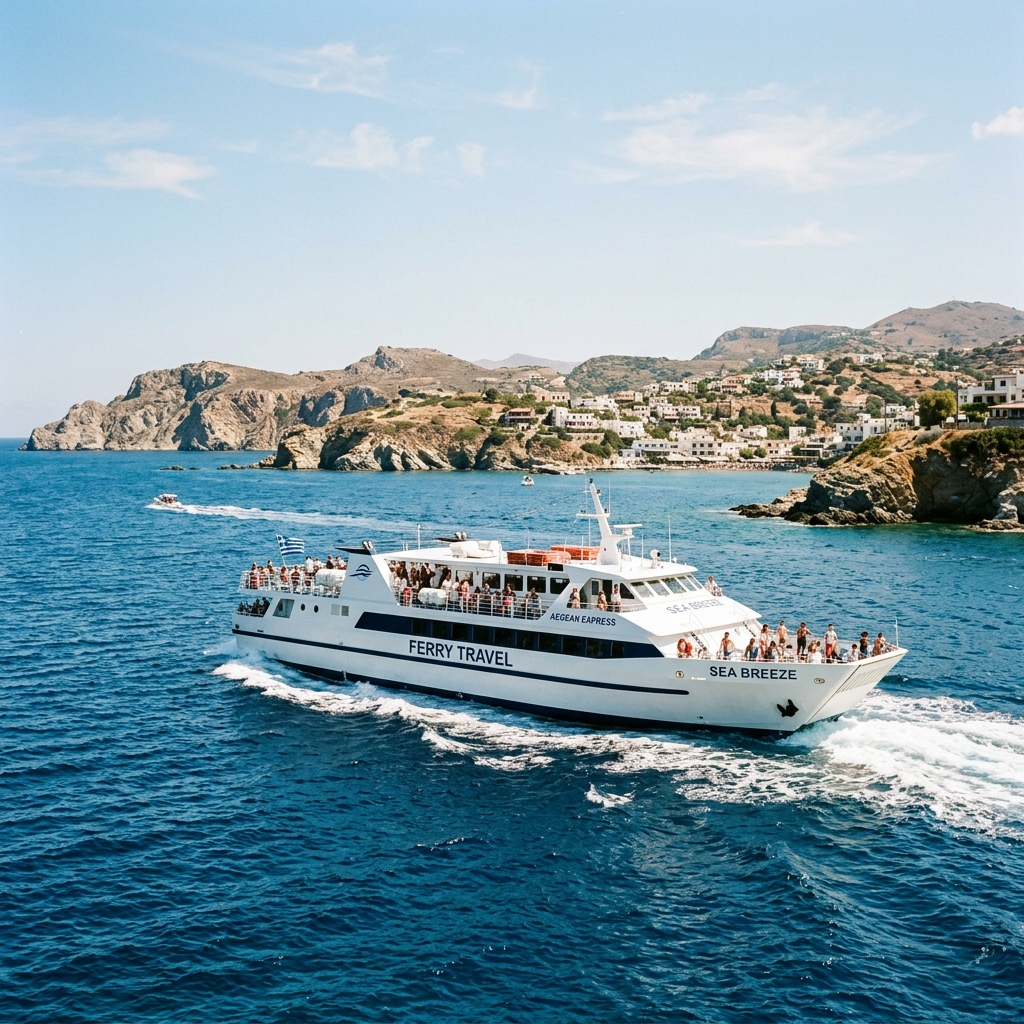
Compare the cabin plus the hotel night you are not buying, not the Ryanair seat. This desk treats European ferries as door-to-door logistics — foot-passenger fares, overnight cabins, and when to skip the ship — not a romance product.
There is a persistent assumption among travellers that ferries are the expensive, slow option, something you take when there’s no alternative, not something you choose. On specific corridors that assumption fails once you add bags, airport transfers, and a hotel night.
On the twelve routes below, published foot-passenger fares sit in the same band as — or below — a budget airline ticket once luggage and transfers are included. They depart from city-centre ports, not airports 40 km away. They have no airline bag fees and no two-hour security buffer. The long ones run overnight. The useful comparison is flight + hotel, not the bare airfare.
Night-train berths that solve the same overnight problem live on Night Trains in Europe. Family connections live on Train Travel with Kids in Europe. If you stay on rails, fare tactics are How to Save Money on European Train Tickets and daylight windows are The 12 Most Scenic Train Routes in Europe. Live hubs: the journal and tools. This desk does not sell tickets; see how we make money.
Desk listing check: foot-passenger and cabin prices on Trasmediterranea, Jadrolinija, GNV, Grimaldi, Tallink, Viking Line, Brittany Ferries, and DFDS change by sailing. Confirm the current fare and cabin type on the operator page — comparison sites are a map, not a checkout. Euro figures below are research ranges from operator pages in early 2026, not a live quote.
Desk note: this desk does not run a private ferry-fare lab and did not place mystery carts on twelve operator sites as a field test. Prices below are research ranges and illustrations from published operator and comparison pages — not a live sailing quote. Confirm the current foot-passenger fare before you pay.
TL;DR: Twelve European ferry routes that can beat flying once you count luggage, transfers, and a hotel night. Research snapshots: Barcelona–Mallorca from about €35, Split–Ancona from about €40, Helsinki–Tallinn from about €15. Skip the ferry when a city-airport budget hop with no bags already wins door-to-door. Skip a deck seat on 18-hour crossings — buy the cabin or take the plane.
Before you book — the checklist airline ads skip
Work this list before you open a flight search on the same city pair.
- Name the port, not the airport. Palma’s port is a walk from the old town; Rome Fiumicino is not Civitavecchia. The transfer is part of the fare.
- Count bags and the hotel night. A cabin on an overnight sailing replaces a hotel. A deck seat does not.
- Book the operator first. Direct Ferries and FerryScanner are useful maps. The cheapest checkout is usually the company site.
- Check Eurail or Interrail ferry discounts only after you know the sailing exists. Pass discounts are not universal.
- Decide skip versus buy. Skip the ship on a two-hour hop served by a cheap city airport when you have no bags. Skip a deck seat on Barcelona–Civitavecchia or Genoa–Barcelona. Skip bringing a car fare if you are already on trains.
How the Cost Comparison Actually Works

Budget airline fares look cheap because they strip out everything except the seat. A research illustration of €25 on Ryanair becomes a research range of €50–€80 once you add a cabin bag, a checked bag, and seat selection. Then add the airport transfer: a research range of €15–€30 each way for most European airports. Then add the time: two hours before departure, one hour after arrival for immigration and baggage. The €25 flight has cost a research range of €80–€140 and five hours.
A ferry from the same city centre costs its ticket price, allows you to bring as much luggage as you can carry, and departs from a terminal you can walk or tram to. If it runs overnight, you save a research range of €50–€150 on accommodation. On many of the routes below, the comparison is not close.
This doesn’t mean ferries are always cheaper. Short flights within countries with cheap airports (Portugal, Spain, Poland) can still beat ferries on pure ticket price. But for the routes below, the ferry wins, on cost, on convenience, or on both.
For more on European ferry travel, see our Croatia ferry guide, Greek ferries practical guide, and Italy ferry routes.
Mediterranean Routes
1. Barcelona to Mallorca, Trasmediterranea / Baleària (from 35 euros, 7-8 hours)
The overnight ferry from Barcelona to Palma de Mallorca departs in the evening and arrives early morning. A deck seat costs about 35 euros; a cabin from 55 euros. The equivalent Ryanair flight costs 15-50 euros for the seat alone, plus 30-50 euros for luggage and 30 euros for airport transfers at each end.
The ferry arrives at Palma’s port, which is a 15-minute walk from the old town. The airport is 11 km away. You disstart rested if you’ve booked a cabin. The math, even before you subtract the saved hotel night, favours the ferry.
2. Split to Ancona, Jadrolinija / SNAV (from 40 euros, 10-11 hours overnight)
The overnight ferry between Croatia and Italy crosses the Adriatic. A deck seat from about 40 euros; a 4-berth cabin from 55 euros per person. The route runs several times per week in summer, less frequently in winter.
There is no equivalent budget flight from Split to Ancona. The nearest airport pairing is Split to Rome (Ryanair, from 25 euros, but Ancona is 300 km from Rome). The ferry is the direct route between the two coastlines, and it saves a hotel night. From Ancona, trains connect to Rome, Florence, and Bologna in 2-3 hours.
3. Genoa to Barcelona, GNV / Grandi Navi Veloci (from 55 euros, 18-20 hours)
A long overnight sailing that replaces what would be an expensive flight or a 10-hour drive. GNV offers foot passenger fares from about 55 euros; cabins from 80 euros. The ship departs in the late afternoon and arrives the following morning.
Eighteen hours sounds long, but you’re asleep for most of it. The onboard facilities include restaurants, bars, and a deck where you can watch the Mediterranean pass. The saved hotel night and the absence of airport transfers make this competitive with flying on total cost.
4. Civitavecchia (Rome) to Barcelona, Grimaldi Lines (from 55 euros, 20 hours)
Similar to the Genoa route but departing from Rome’s port. Civitavecchia is 80 minutes from Roma Termini by regional train (about 5 euros). The ferry departs in the evening and arrives in Barcelona the following evening, 20 hours at sea.
Cabin fares from about 65-90 euros include the sleeping accommodation. A Ryanair flight from Rome Fiumicino to Barcelona plus airport transfers plus a hotel night costs 100-160 euros. The ferry is cheaper and more interesting.
5. Naples to Palermo, Tirrenia / GNV (from 35 euros, 10 hours overnight)
The overnight ferry between Naples and Sicily is one of the most practical connections in the Mediterranean. Foot passenger fares start at 35 euros for a deck seat; cabins from about 50 euros. The ship departs in the evening and arrives early morning.
The equivalent Ryanair flight costs 20-60 euros plus transfers, Naples airport is 7 km from the city, Palermo airport is 35 km. The ferry docks in the centre of both cities. For travellers connecting from Naples by train or heading onward to Palermo by train, the ferry integrates neatly into a slow travel itinerary.
Northern European Routes
6. Helsinki to Tallinn, Tallink / Viking Line / Eckerö (from 15 euros, 2 hours)
The shortest and cheapest route on this list. The ferry between Finland and Estonia takes two hours across the Gulf of Finland. Foot passenger fares start at about 15 euros, less than most airport transfers in either city.
There are 10-15 departures daily in summer. The terminals in both cities are within walking distance or a short tram ride from the centre. Budget flights exist on this route but cost roughly the same and take longer door to door. The ferry is simply more practical.
7. Stockholm to Helsinki, Viking Line / Tallink Silja (from 35 euros, 16 hours overnight)
The overnight cruise ferries between Stockholm and Helsinki are an institution. The ships are enormous, Viking Line’s vessels carry 2,500 passengers, and the 16-hour crossing passes through the Stockholm archipelago (thousands of islands, several hours of scenery) before crossing the Baltic to Helsinki.
Cabin fares from about 35-60 euros per person in a 4-berth cabin, including the sleeping accommodation. The onboard facilities include restaurants, saunas, and a tax-free shop that subsidises the ticket price. This is not a ferry in the conventional sense, it’s a floating hotel that happens to move.
8. Frederikshavn (Denmark) to Gothenburg (Sweden), Stena Line (from 20 euros, 3 hours 15 minutes)
A practical North Sea crossing between Denmark and Sweden. Foot passenger fares from about 20 euros. The ship is modern and comfortable, with views across the Kattegat strait.
This route connects Denmark’s Jutland peninsula with Sweden’s west coast, avoiding the longer overland route via Copenhagen and the Øresund Bridge. Useful for travellers heading from Norway or northern Denmark to Gothenburg and onward to Stockholm.
Atlantic and Channel Routes
9. Santander to Portsmouth, Brittany Ferries (from 80 euros, 24-32 hours)
The direct ferry between northern Spain and England crosses the Bay of Biscay in 24-32 hours depending on the vessel. It’s not cheap in absolute terms, cabin fares from about 80-120 euros, but it replaces a flight plus transport from London to the south coast, or a multi-day overland journey through France.
The Bay of Biscay crossing can be rough in winter. In summer, it’s often calm enough to spend time on deck watching for dolphins and whales, the bay is one of Europe’s best cetacean-spotting areas. The ship has restaurants, a cinema, and cabins that are essentially small hotel rooms.
10. Dublin to Holyhead, Irish Ferries / Stena Line (from 25 euros, 3 hours 15 minutes)
The main ferry connection between Ireland and Wales. Foot passenger fares from about 25-35 euros. The fast ferry takes 1 hour 50 minutes; the standard ferry about 3 hours 15 minutes.
Dublin Port is 3 km from the city centre (bus connects). Holyhead station is adjacent to the port and has direct trains to London Euston (4 hours). This ferry-plus-train combination is often cheaper than flying Dublin to London once transfers are included, and it’s significantly more interesting.
11. Amsterdam (IJmuiden) to Newcastle, DFDS (from 35 euros, 16 hours overnight)
The overnight ferry between the Netherlands and England crosses the North Sea. DFDS operates modern ships with cabins, restaurants, and entertainment. Foot passenger fares from about 35-50 euros including a cabin.
IJmuiden is 30 minutes from Amsterdam by bus. Newcastle port connects to the city centre by bus in 20 minutes. The crossing saves a hotel night and puts you in northeast England, convenient for onward travel to Edinburgh, the Lake District, or the Yorkshire Dales by train.
12. Calais to Dover, P&O / DFDS / Irish Ferries (from 15 euros, 1 hour 30 minutes)
The Channel crossing. Foot passenger fares from about 15-25 euros. Ninety minutes from France to England. The white cliffs of Dover approaching from the sea is one of the genuinely iconic arrivals in European travel.
This route is most useful as part of a longer overland journey, Paris to London via Calais and Dover, for example, can be cheaper than the Eurostar if you combine French trains with the ferry and UK trains. It takes longer, but you see the cliffs, and you cross the Channel on the surface rather than under it.
How to Book European Ferries
Book direct with the ferry company for the best prices. Most operators, Trasmediterranea, GNV, Jadrolinija, Tallink, Viking Line, Brittany Ferries, DFDS, have straightforward booking websites with English-language versions.
Comparison sites like Direct Ferries and FerryScanner show routes and prices across multiple operators. Useful for finding routes you didn’t know existed.
Book 2-4 weeks ahead for summer sailings. Cabins on popular overnight routes (Barcelona-Mallorca, Split-Ancona, Stockholm-Helsinki) sell out. Deck seats are usually available closer to departure, but sleeping in a cabin is substantially better than sleeping in a chair.
Foot passenger fares are always cheaper than vehicle fares. If you’re travelling by train and ferry, which is the natural combination for slow travel in Europe, you’ll always pay the lowest fare category.
Check Eurail/Interrail ferry discounts. Several operators offer 30-50% off with a valid pass. This can make overnight ferries exceptionally good value as part of a rail-and-ferry itinerary. Our rail pass guide covers pass benefits in detail.
When Ferries Beat Flying, and When They Don’t
Skip the ferry when the distance is very long and there is no overnight cabin, when a budget airline serves a convenient city airport (Lisbon, Madrid, many Polish cities), or when you are travelling light with no checked bag. Skip Direct Ferries as the checkout if the operator site is cheaper. Skip stacking a tight train connection onto a late arrival — ports are not airports, but they still eat time.
Ferries win on routes where:
- The ferry terminal is in or near the city centre (most Mediterranean ports, Helsinki, Tallinn, Dublin)
- The route runs overnight (saving a hotel night)
- You’re carrying luggage that would cost extra on a flight
- The airport is far from the city (Rome Fiumicino, Palermo, Gothenburg)
Flights win on routes where:
- The distance is very long and there’s no overnight option
- Budget airlines serve convenient airports (Lisbon, Madrid, many Polish cities)
- You’re travelling light with no checked bag
For slow travellers already moving overland, the ferry is often the better door-to-door choice on the twelve corridors above. It is part of the journey rather than an interruption of it. You arrive having seen something rather than having endured something.
See also: night trains in Europe, train travel with kids, save money on European trains, most scenic train routes, Greek island ferries, Norwegian fjord ferries, and Italy ferry routes.